BUNDLE OF THIN GLASS POLARIZER
ENGLISH
MAKER: most likely Beck
c. 1860s-1880s
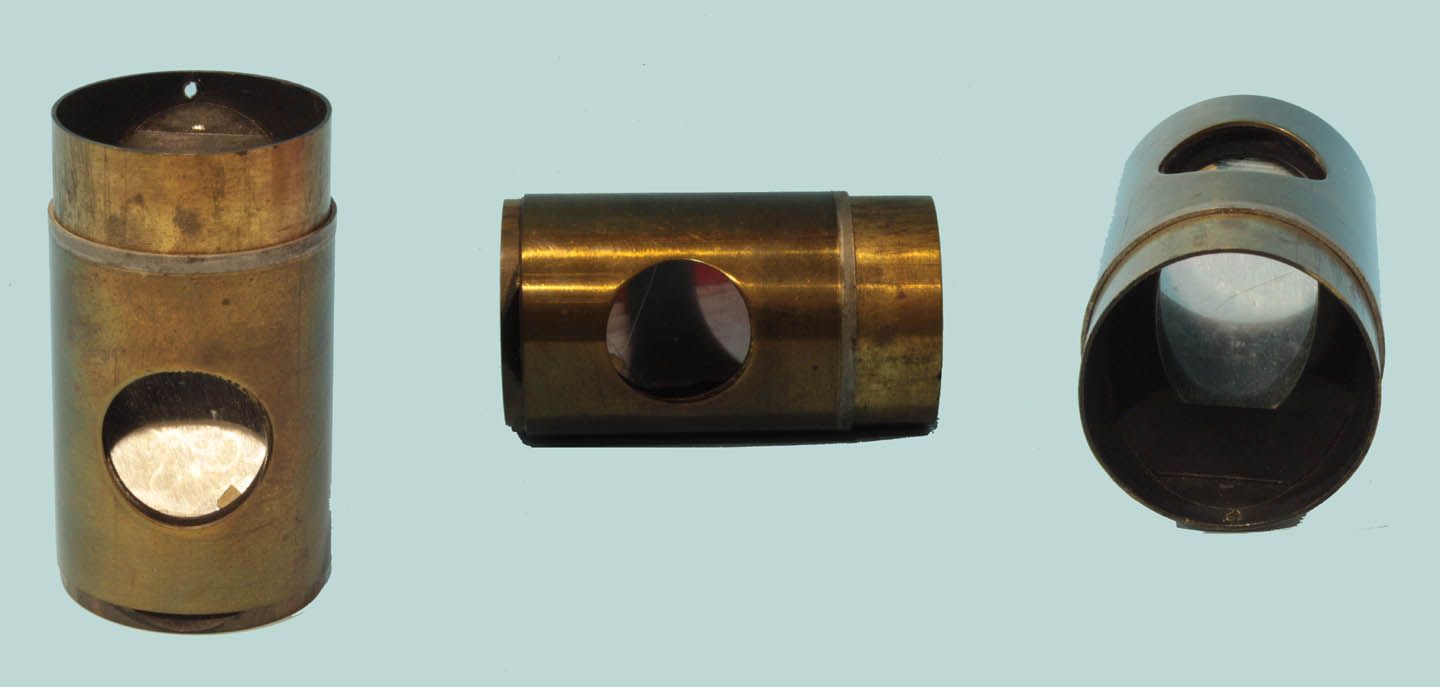
DESCRIPTION:
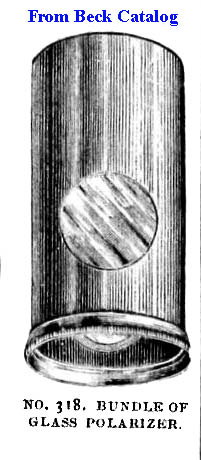
This substage polarizer, which uses a stack of thin glass plates oriented at an angle to the light source, as a polarizer was offered in Beck catalogs from no later than the 1860s through at least 1888. It was also described in Richard Beck's A Treatise on the Construction, Proper Use and Capabilities of Smith, Beck, and Beck's Achromatic Microscope of 1865. This type of polarizer was especially useful when used for lower power polarized light work with larger objects, and was much cheaper than large Nicol prisms, (which when large, commanded a premium price).
HISTORY*:
The discovery of polarization of light has been attributed to Erasmus Bartholinus in 1669 who discovered the phenomenon of double refraction in calcite crystals, although he did not understand the nature of the phenomena. Extinction by a second crystal was described by Christian Huygens in 1690.
In the second decade of the 19th century, Sir David Brewster made the discovery of polarized light could be produced by glass at an angle dependent in its refractive index. In 1818, Fresnel and Arago carried out a two-pinhole experiment using polarized light. Fresnel and others subsequently solidified the wave theory of light which explained polarization as well as diffraction.
Henry Fox-Talbot adopted polarization to the microscope in 1834. In 1846, Legg** published a double image prism experiment which demonstrates the phenomena of extinction very well. This experiment was considered so important, that the apparatus for replicating it was often included in first class microscope outfits such as the Ross outfit of 1847 on this site and also the Smith & Beck outfit of 1862. The double image prism page illustrates the use of some of these accessories from the Ross outfit.