COMPOUND MONOCULAR GERMAN MICROSCOPE WITH ENGLISH TRIPOD FOOT
MAKER: ?
c. 1910
Please Click On Any Picture for a Larger Version
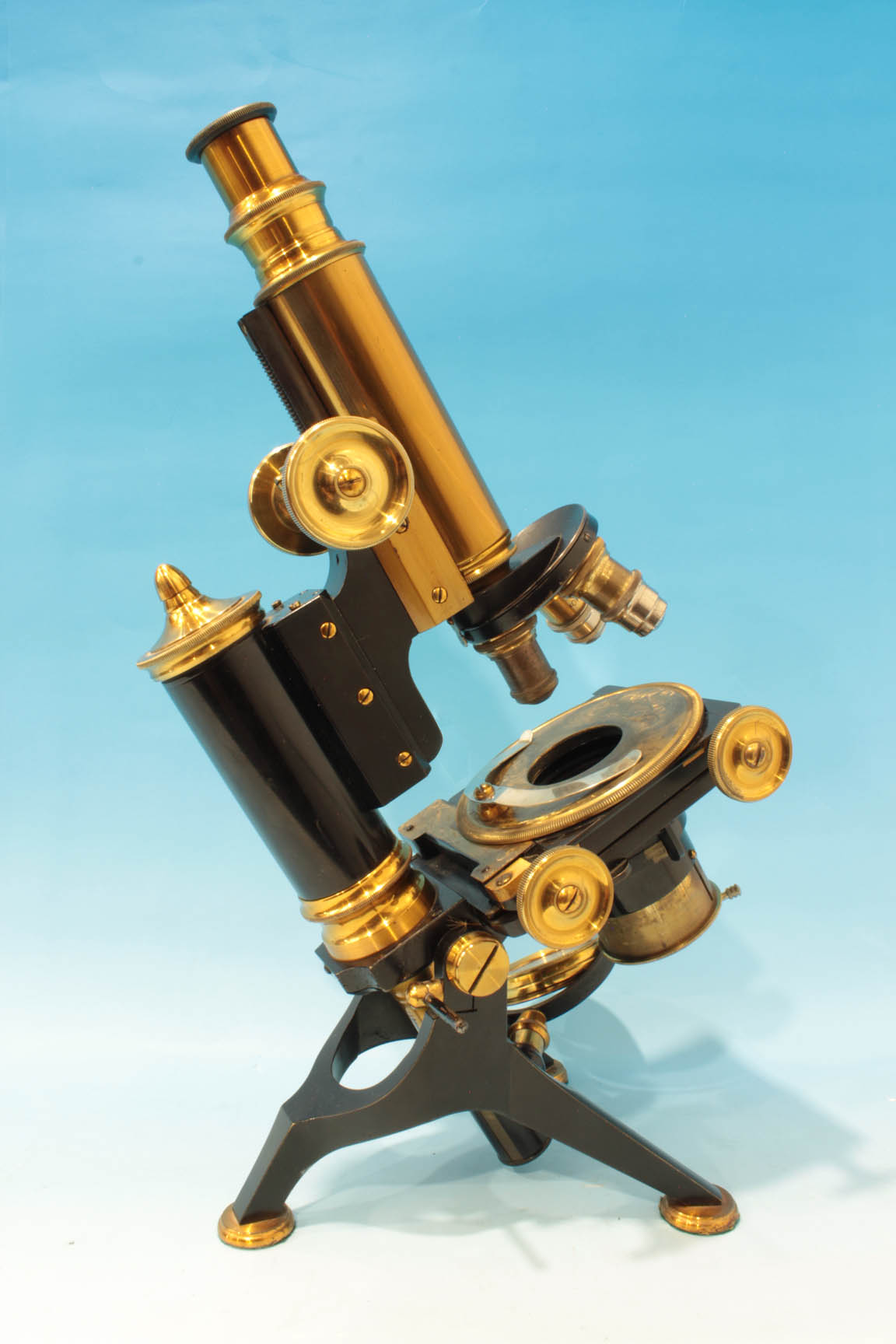
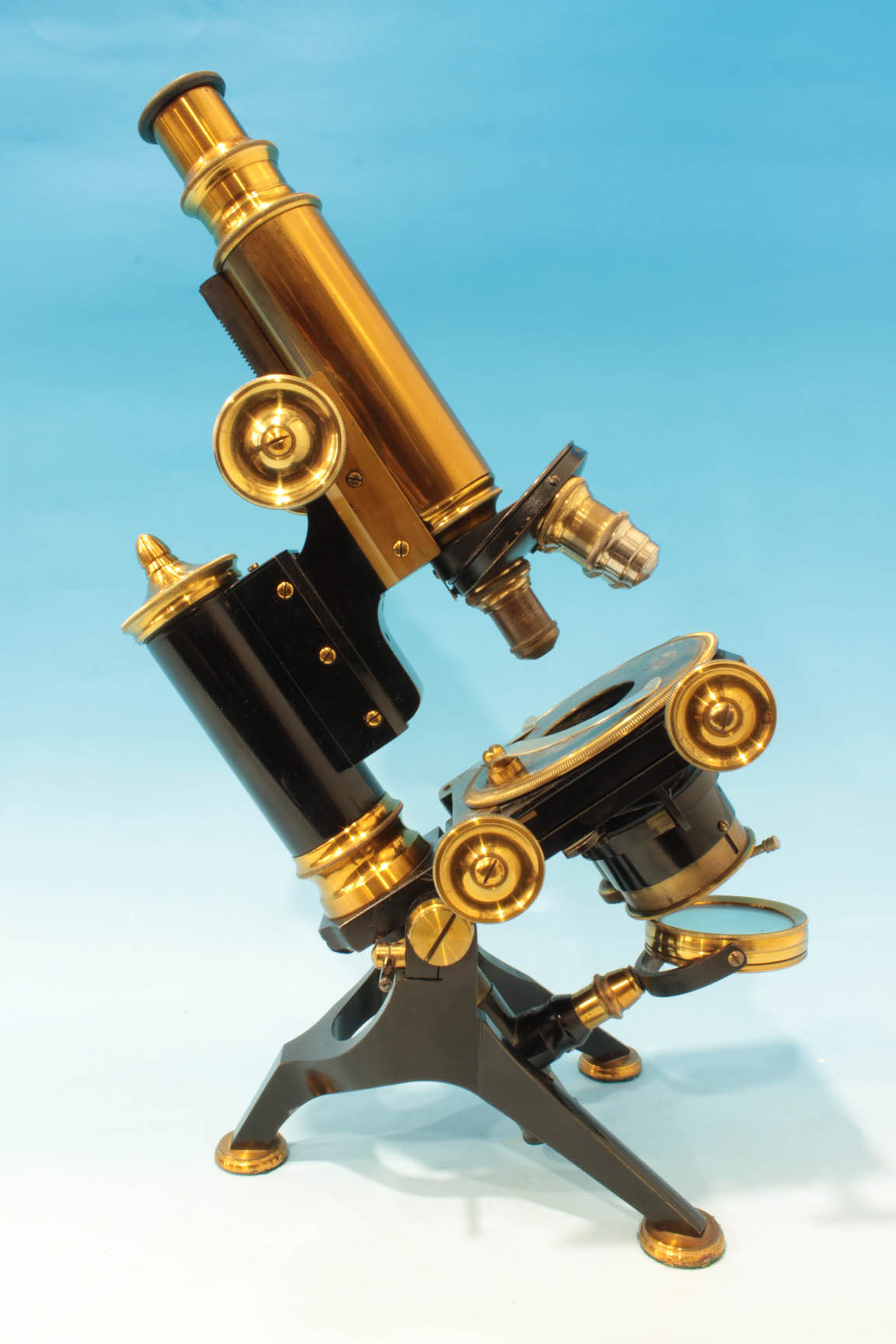
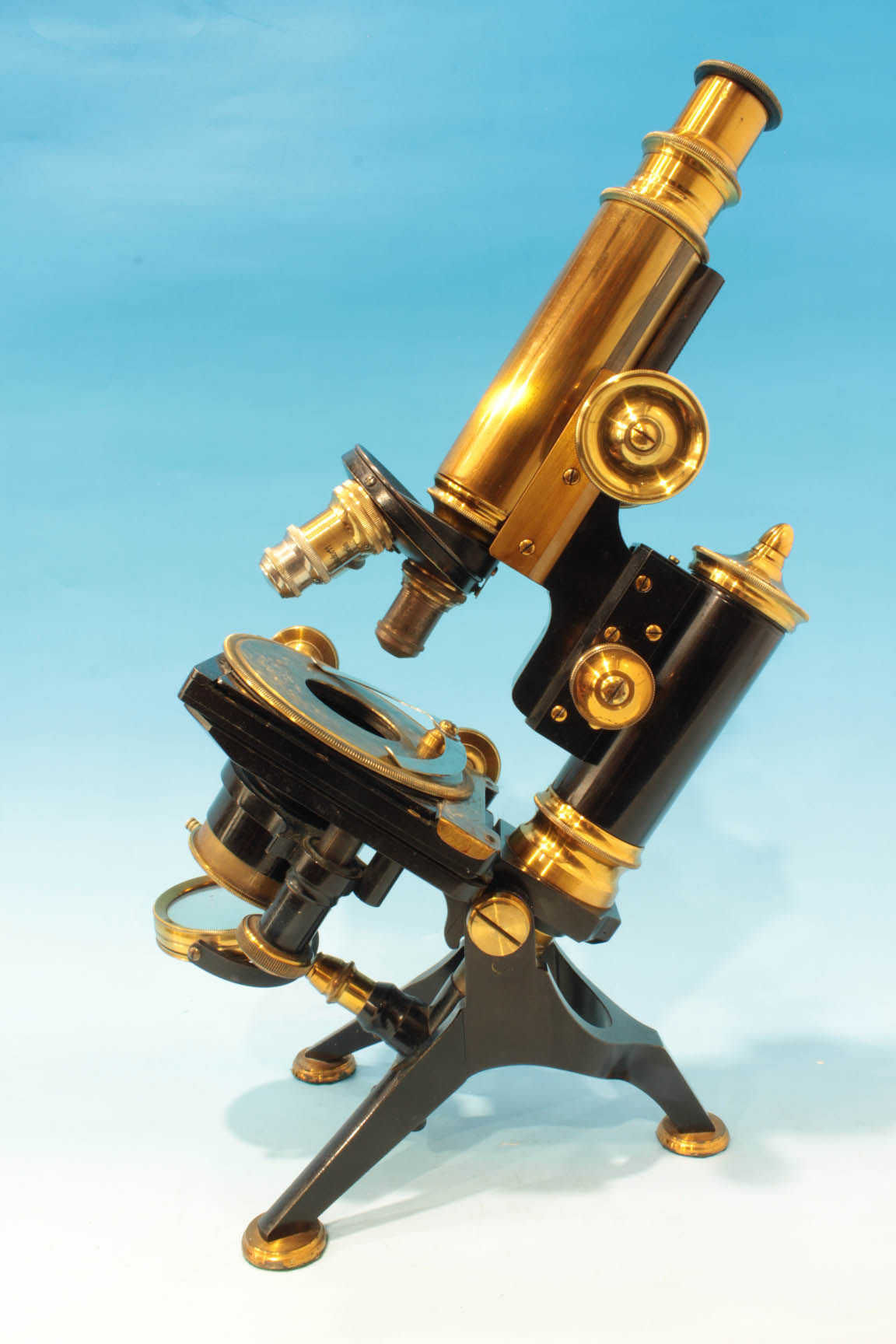
DESCRIPTION:This is an unsigned monocular microscope with an English tripod foot and otherwise German-type features. It comes with its original case. The microscope has diagonal rack and pinion coarse adjustment. There is a nickel-plated drawtube. It has a side fine adjustment knob only on the left side.
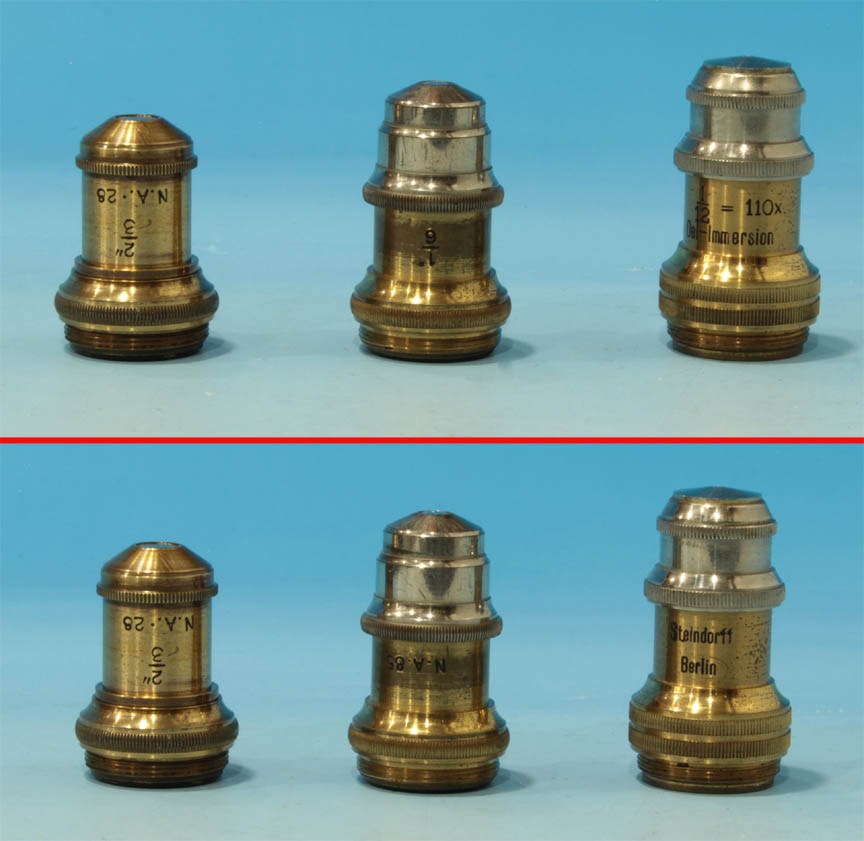
There is a triple nose piece carrying 3 objectives, a 2/3 inch with 0.25 n.a., a 1/6 with 0.85 n.a., and a 1/12th oel immersion. The oil immersion objective and its can are signed by Steindorff, Berlin, although they all appear to be made by the same company. There are two eyepieces, one labelled 2
and the other 4
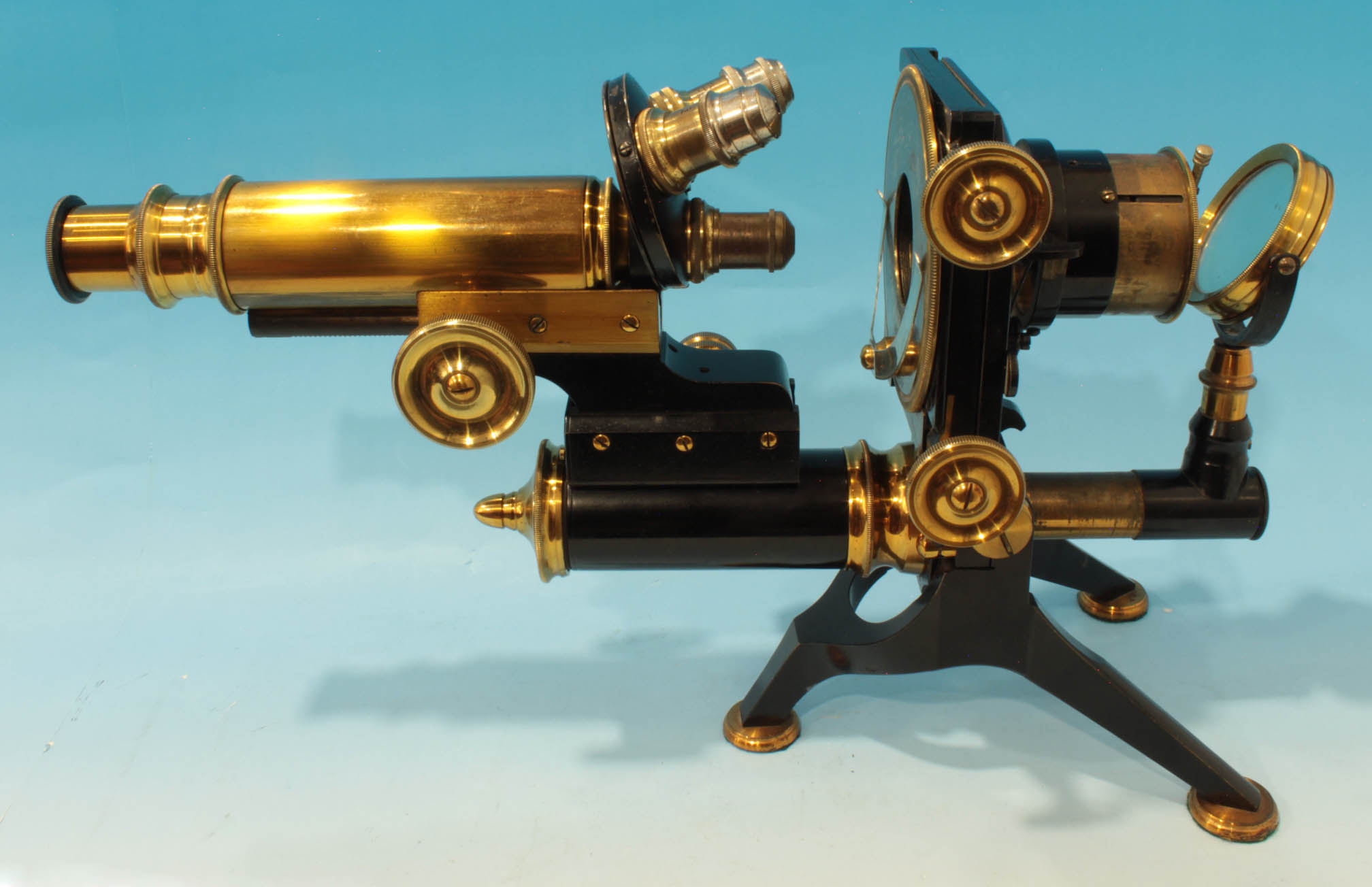
. The microscope can be inclined to any position between vertical and horizontal with stops at both the extremes. There is a black lever on the right side of the microscope which rotates in the coronal plane clockwise to tighten the inclination joint.
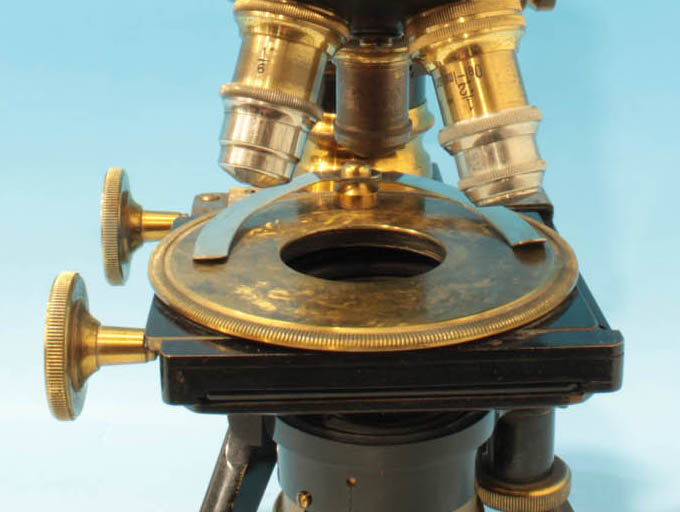
The mechanical stage has separate controls for the X and Y axes and a knurled-edge round top plate that has a smooth action and may be rotated by hand. The knob at the front of the stage moves it in the X or right-left axis, and the Y axis movement is controlled by the rear knob. Its stage clips are curved to fit the round top plate, and are both anchored by a single screw at the same location.
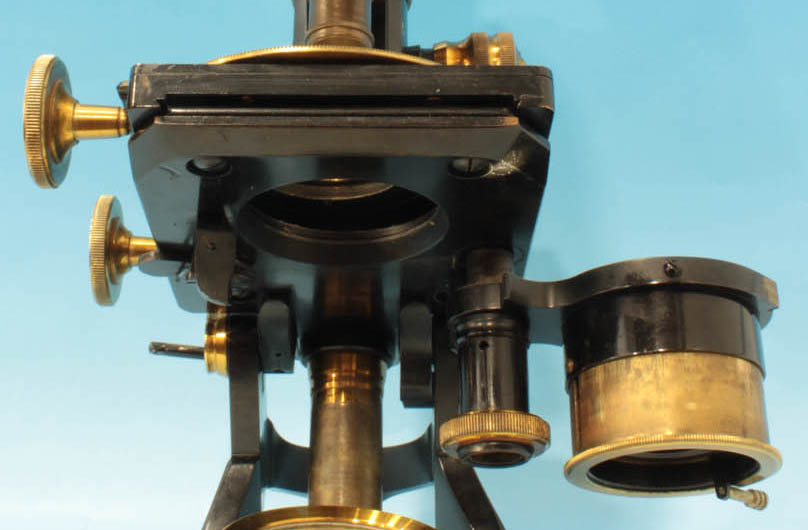
The substage has a quick-screw focus from the left side of the bottom of the stage. The substage housing has a nickel-silver knob controlling an iris diaphragm on its bottom. The condenser housing can be pulled down from its ring, guided by a screw and slot. This facilitates swinging the housing out of the optical axis when the condenser is in place, which otherwise prevents this motion due to it protruding through the relatively thick stage. The condenser is an Abbe-type, and fits into the top of the substage housing. This condenser has a removeable top to allow its use with low power objectives. A sprung latch holds the condenser housing in place, which is released by pressing the lever on the bottom of the right side of the stage towards the back of the microscope. The gimbaled mirror is plane and concave; it can also swivel left or right as well as be moved up or down on the tailpiece.
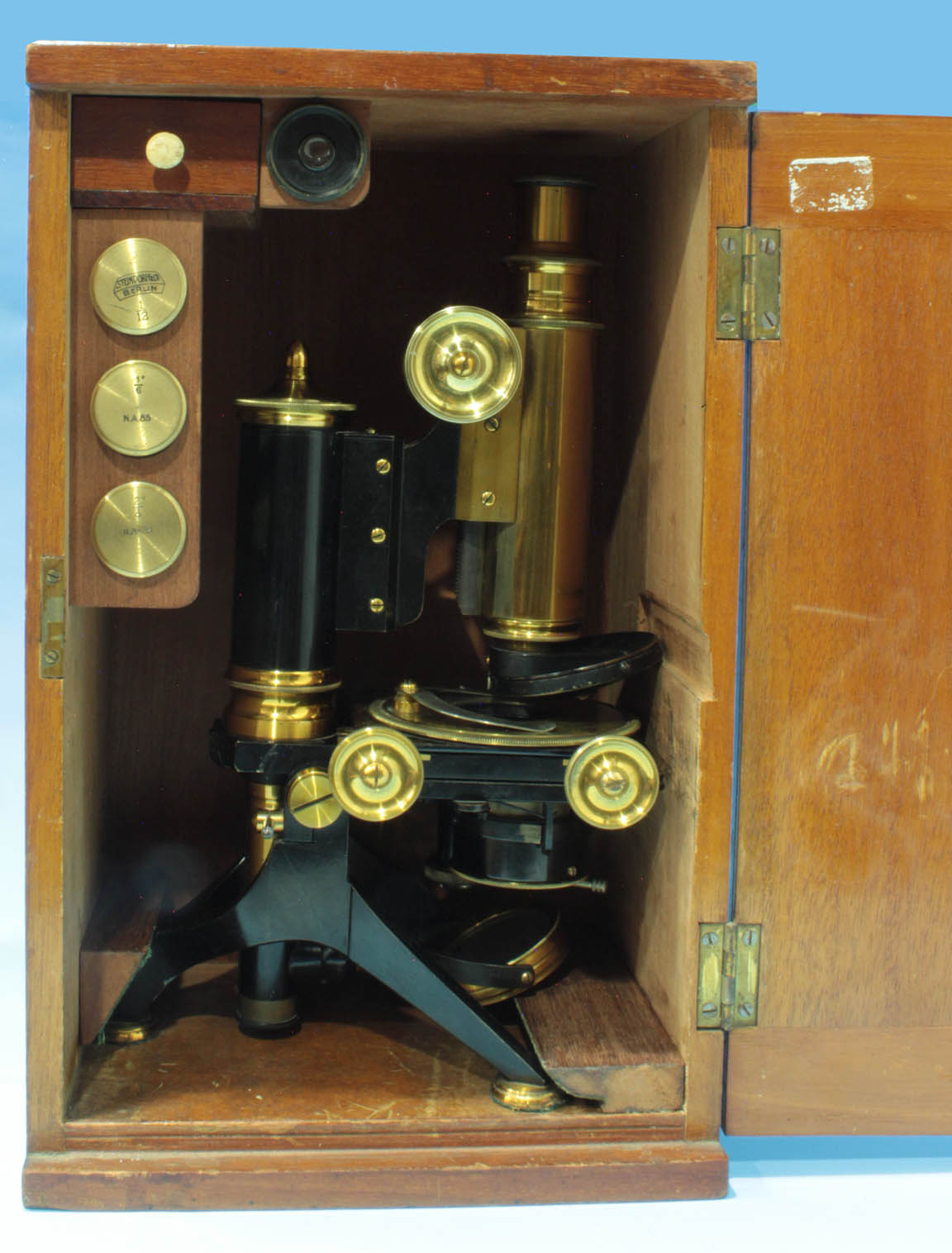
The fitted original case houses the micrscope; it has a small drawer for slides and also has fittings to house the three objective cans and one of the eyepieces, the other eyepiece being stored on the microscope. It has a lock but no key.
HISTORY:
As of October, 2023,according to the History of Manufacture in Berlin web site, Emil Steindorff founded his business in Berlin in 1879; the site also states that Steindorff & Co had been making microscopes for over 100 years
. Yet no catalog of their older microscopes seems to exist. The firm went bankrupt in 1986.
As of November 2023, I have not found any other example or publications describing this microscope. I also I cannot find a Steindorff catalog describing microscopes, although they were known to make them when this microscope was made in the early 20th century. Although it is known that some Leitz microscopes were sold with an English tripod foot as early as 1893 and as late as 1912, this microscope is quite different than any of the known examples by Leitz.
The rack of this microscope is mounted on a rod attached to the optical tube. This rod is flattened on one side, a typical German form. Unusual features of this microscope include the curved stage clips both attached to the same single point, the location of the mechanical stage controls relatively far apart with one at the front and one at the back of the stage, the sideways-locking inclination lever, and the fact that the lister limb is attached to a fixed round pillar. The finding of the fine focus knob on only one side is another uncommon feature. One could hypothesize that the attachment to a pillar in this fashion represented a transition from a Continental limb to a Lister limb. I would certainly appreciate any additional information the reader could provide about Steindorff microscopes.
CONDITION:
This microscope is in very fine working condition with very minimal signs of use. The controls all work very well and the optics are excellent. All the joints and controls are nice and firm without any loose parts or joints. The plane mirror has some lines of silver loss, the concave side is well preserved.
The original hardwood case is sound but with scratches, especially on the back, wear of the finish on the brass handle, and the door seems to have been previously broken and improperly reassembled. There is a lock but no key.