
W(with arm rests like the
Y)
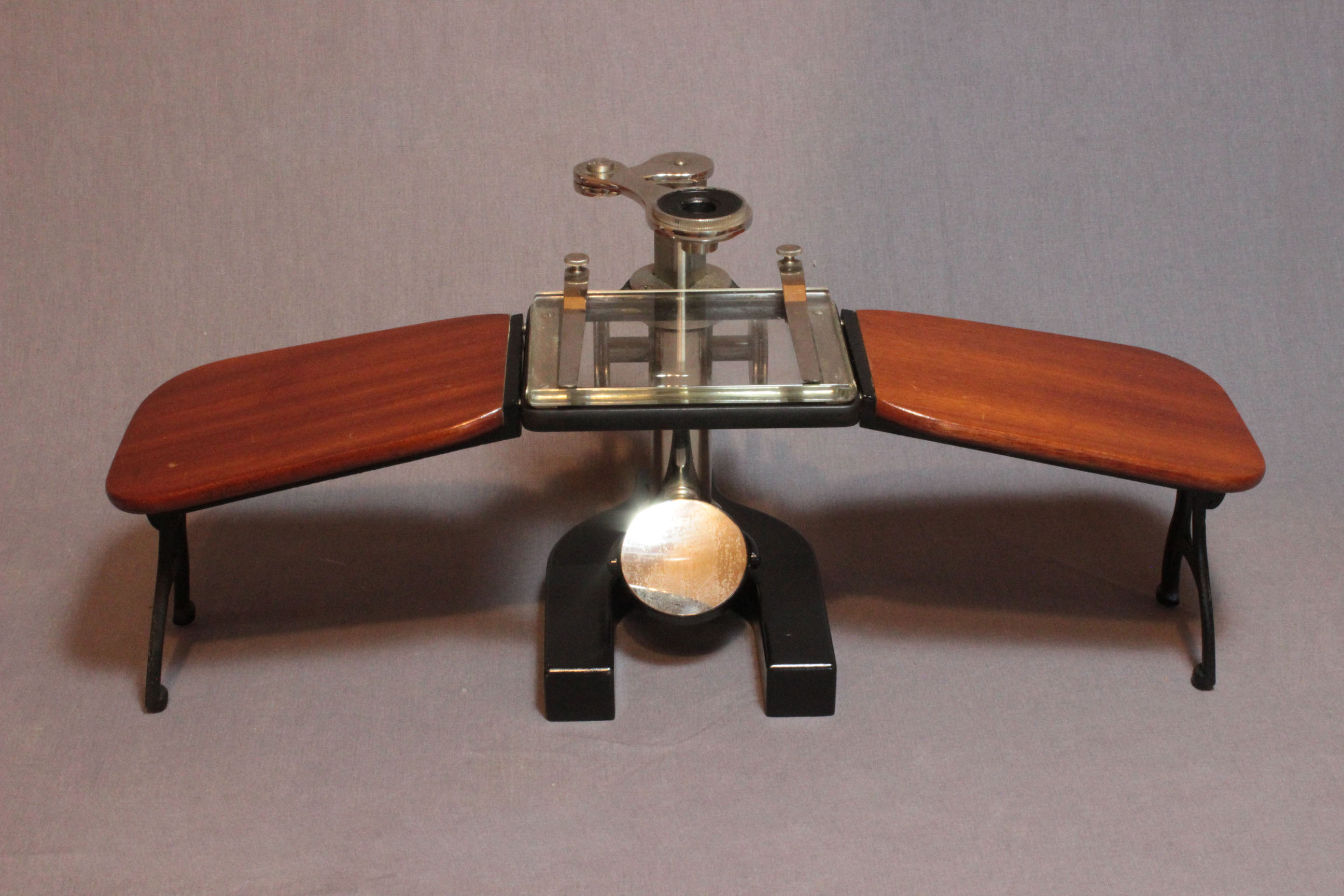
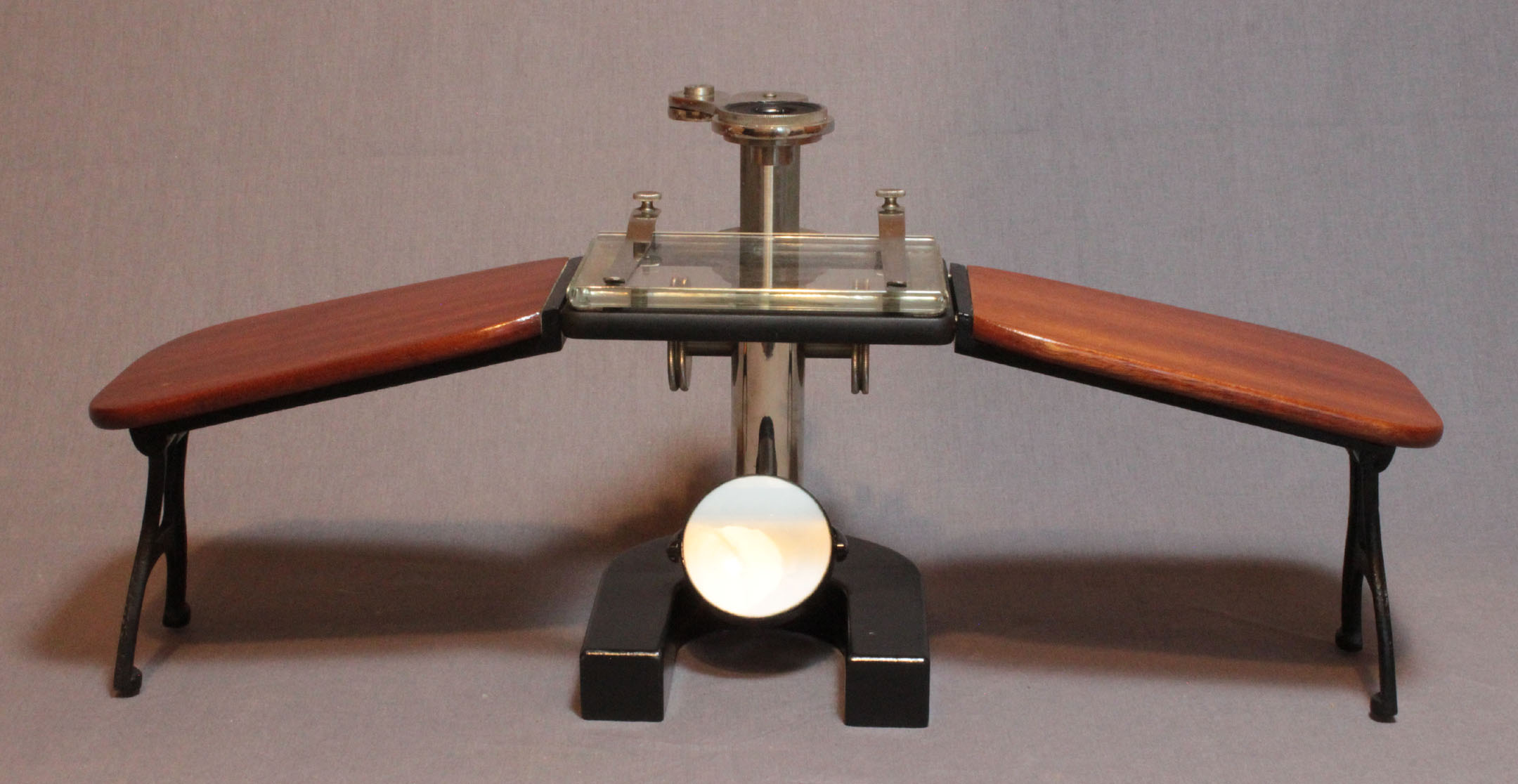
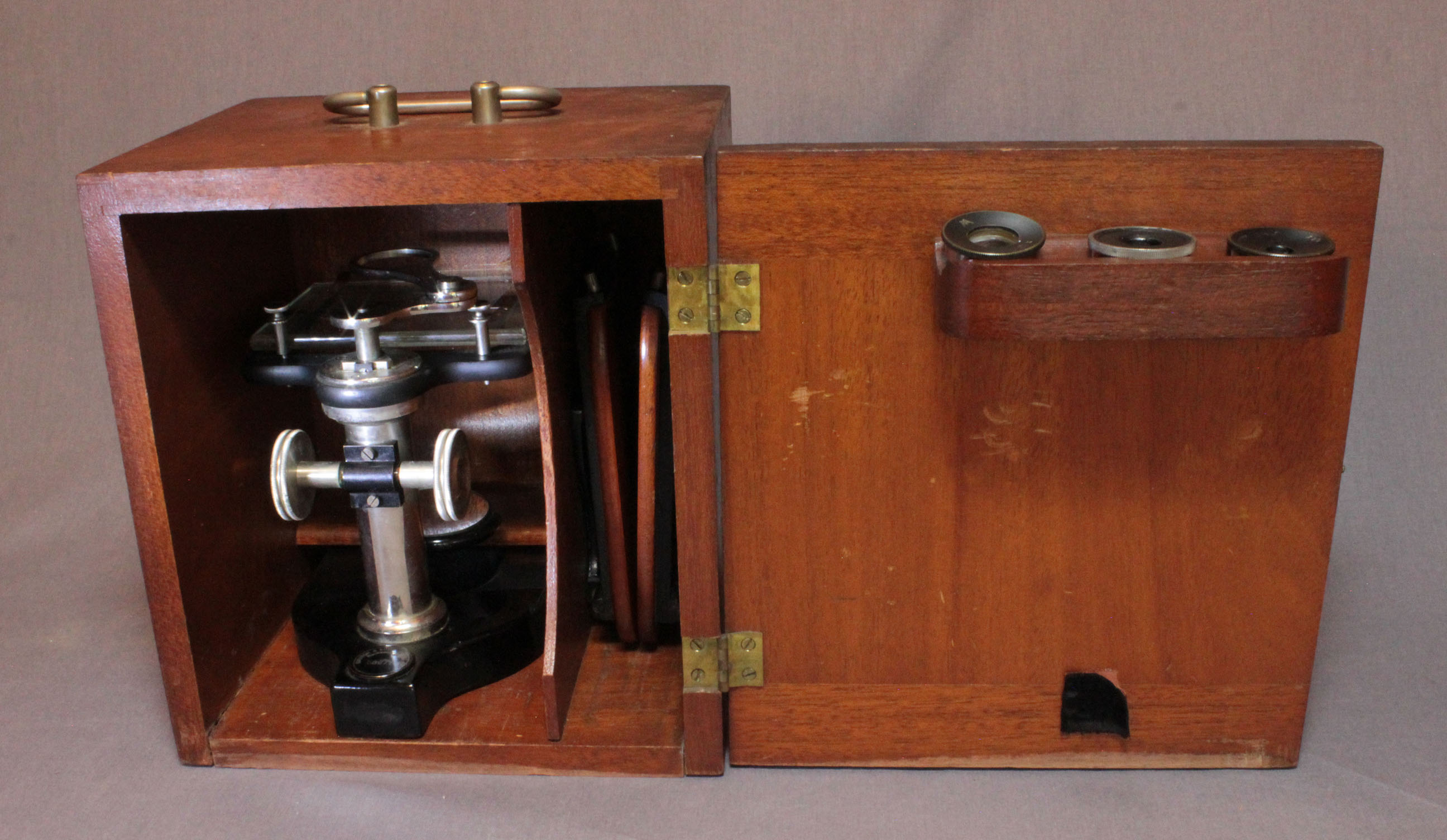
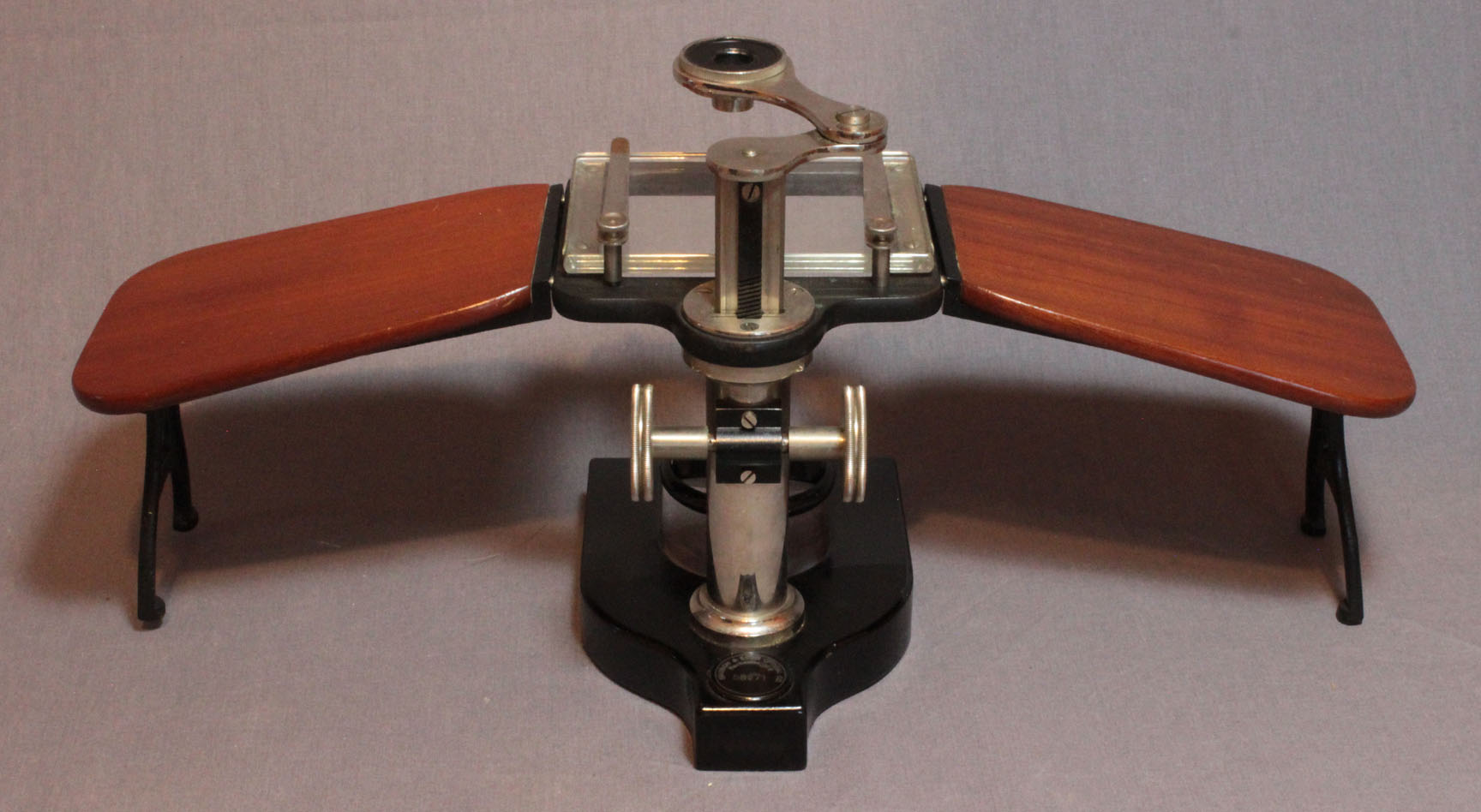
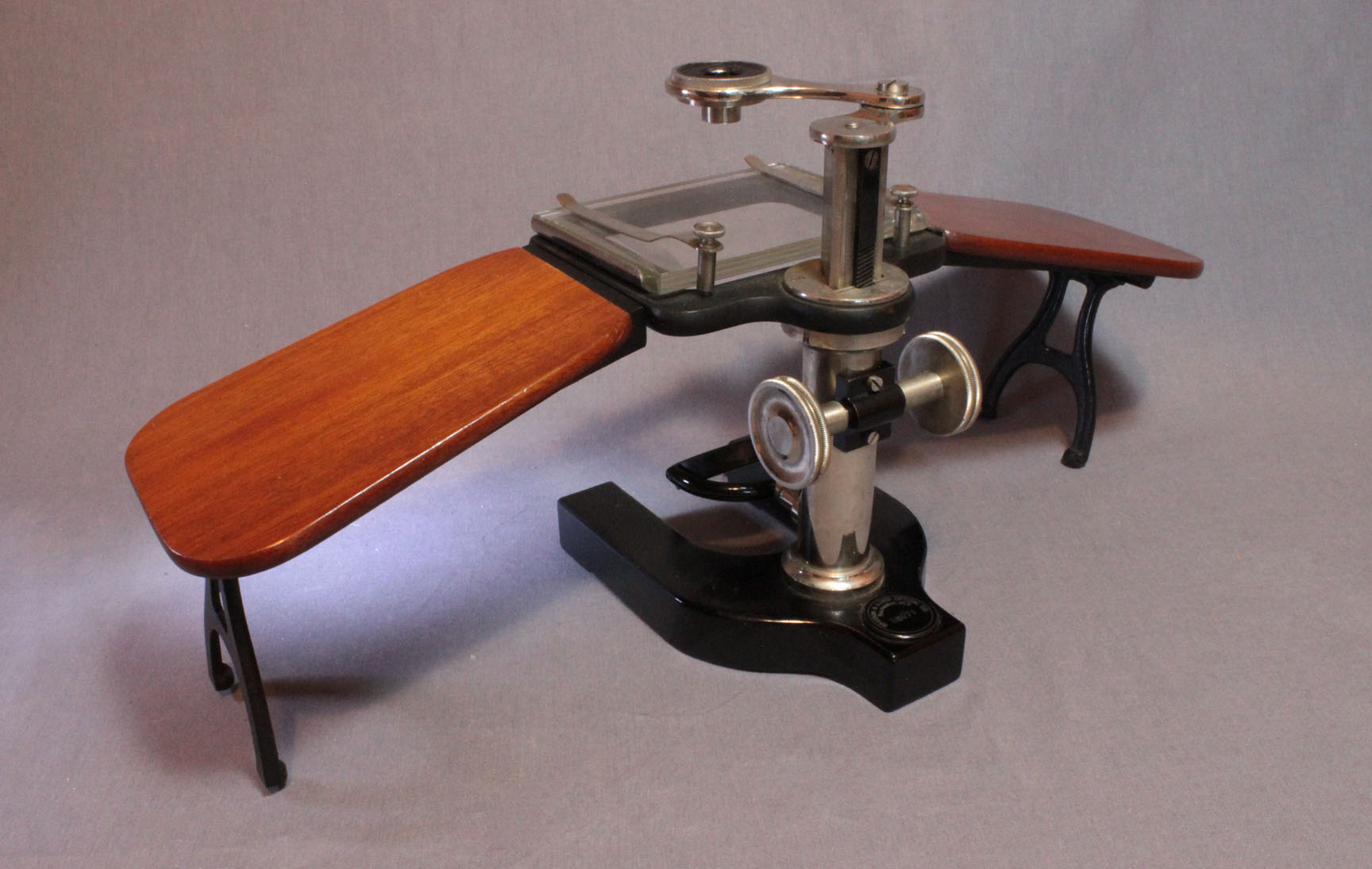
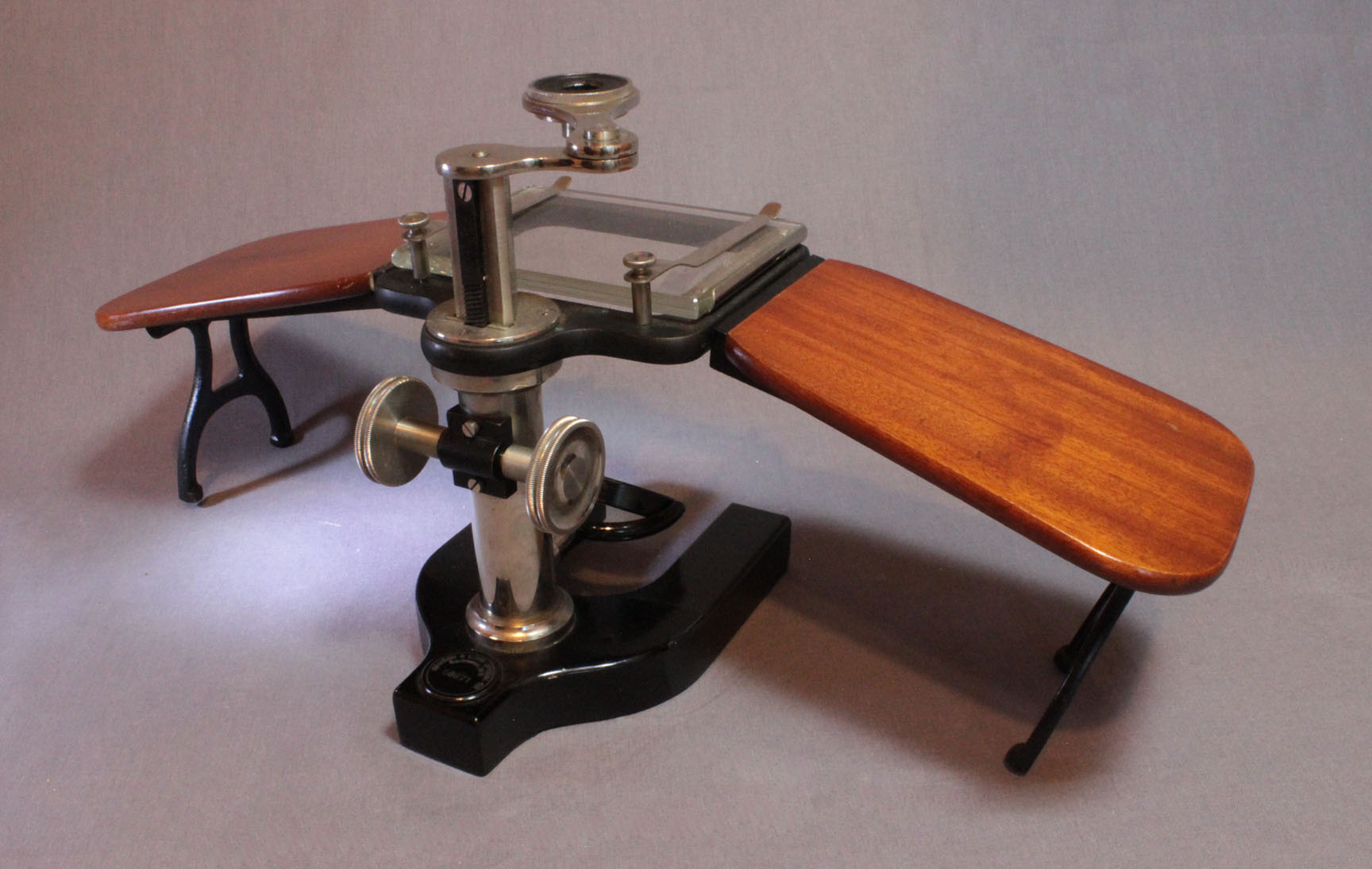
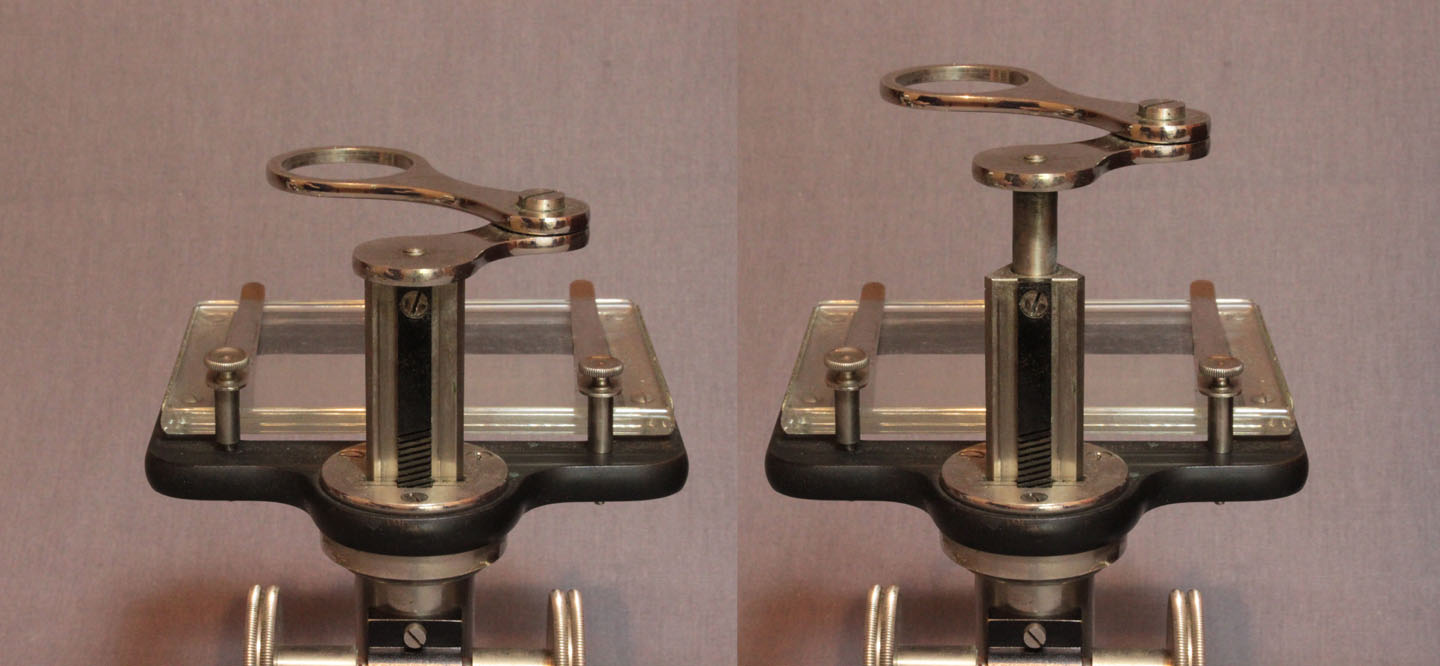
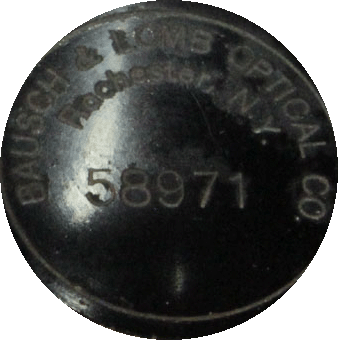 This microscope, which has features of both the 'Y' stand, and the 'W' stand (see history below), has a large continental Y-shaped foot measuring 2 3/4 X 5 3/8 inches (96 X 135 mm) in maximal dimensions. There is a round tag on the top of the back of the foot signed:
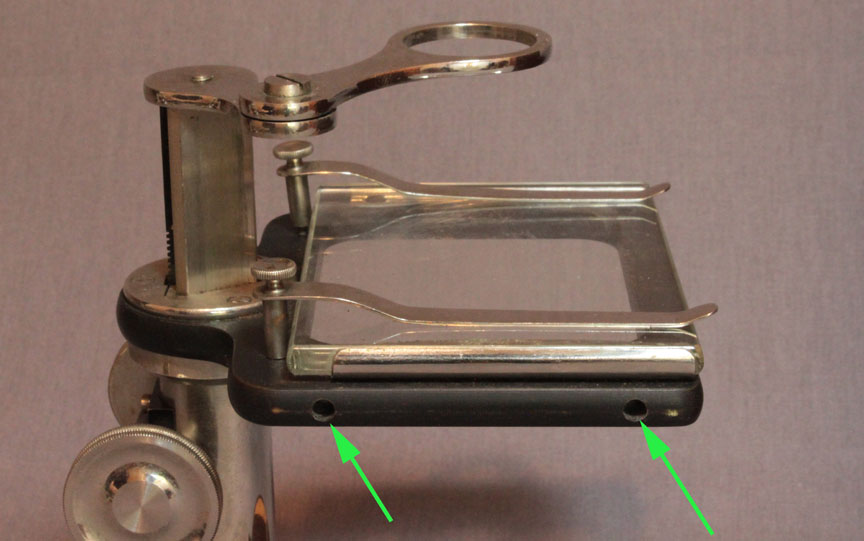
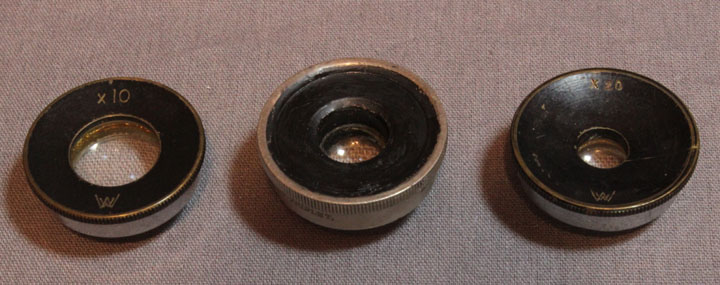
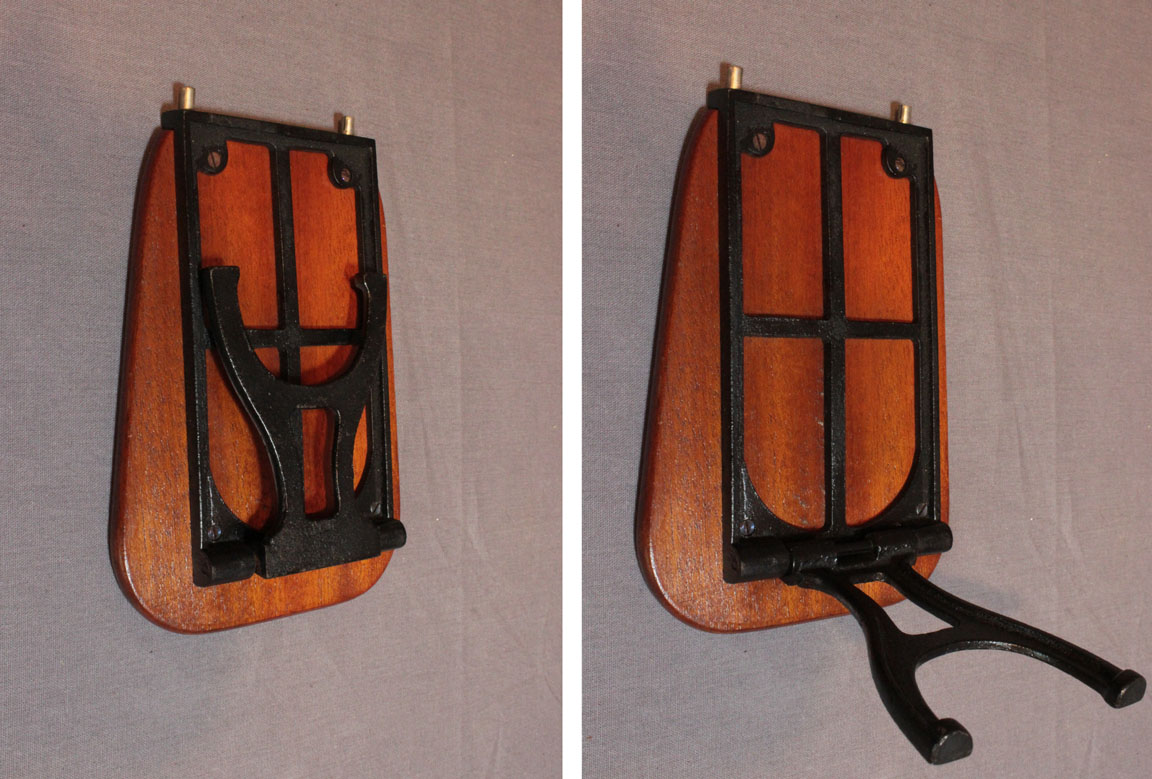
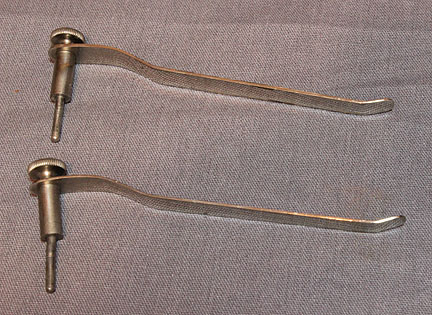
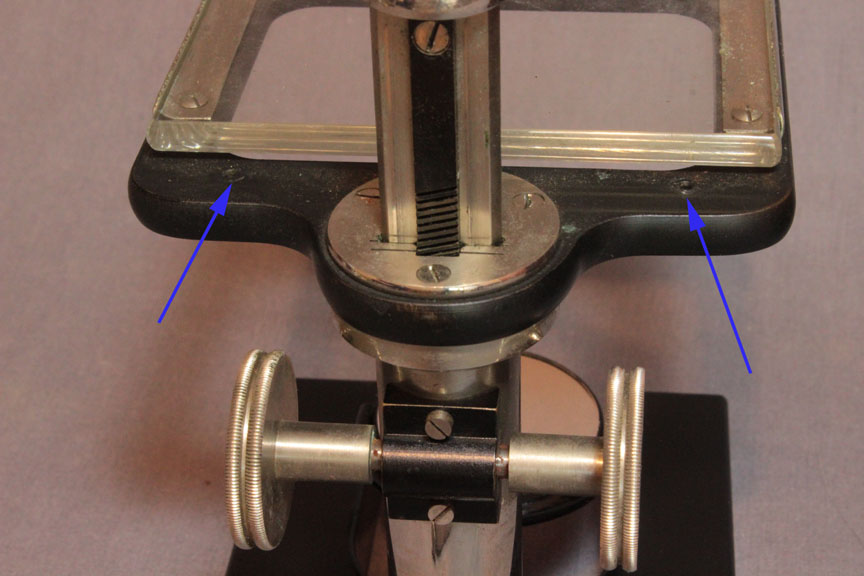
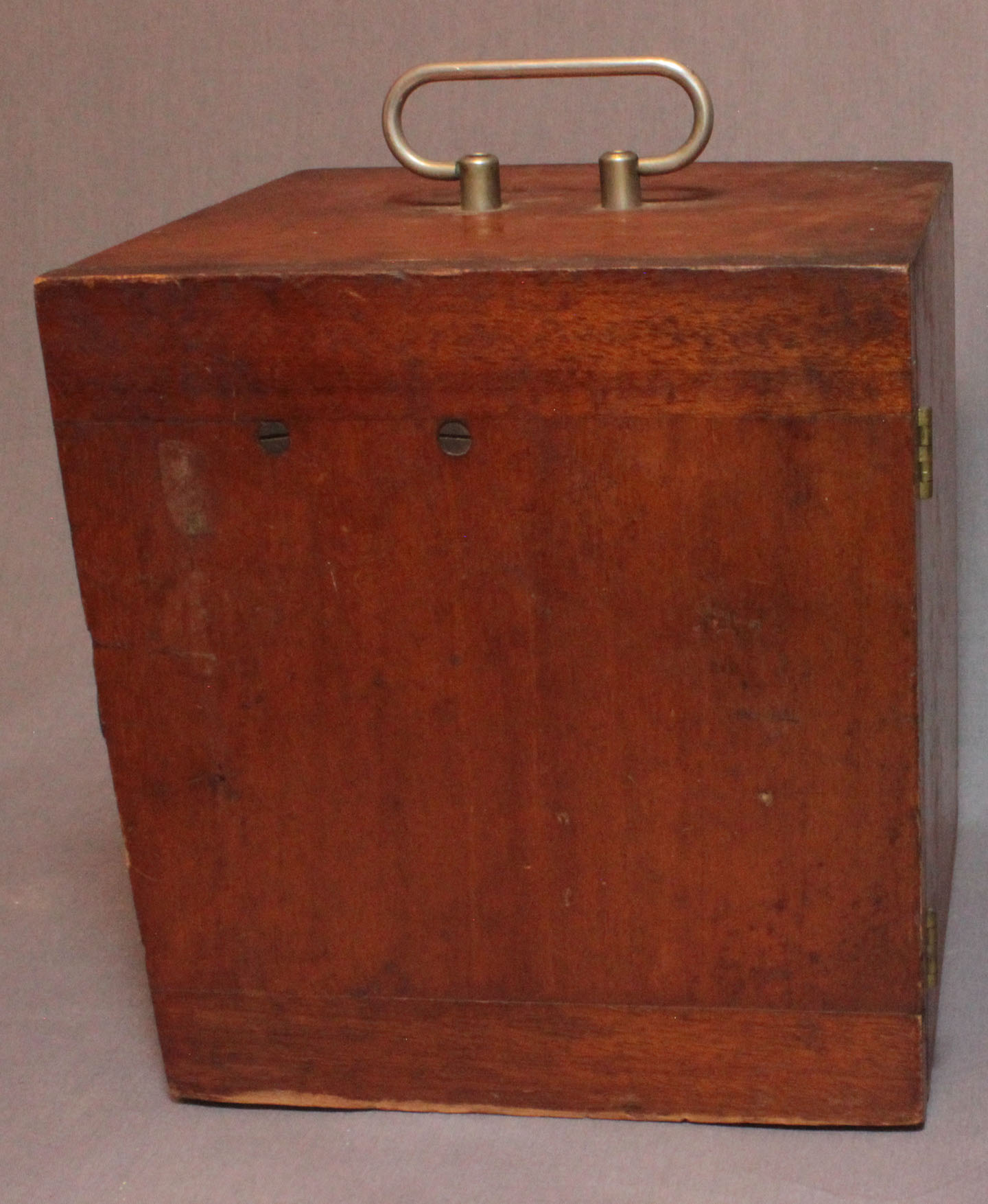
 BAUSCH & LOMB OPTICAL CO, Rochester, N.Y., 58971The instrument has a 1 3/4 inch (44 mm) gimbaled double sided reflector, the plano side of white glass, the other a concave mirror. A large pair of knurled hand wheels control the diagonal focusing of the bar, atop which is attached the articulated arm to hold the lens. The articulated arm is on a round post that may be extended further upwards to further increase the distance from the lens to the subject if required. The stage is covered in plate glass measuring about 3 7/8 X 1 7/8 inches(99 x 74 mm). A pair of mahogany arm rests have metal frames on their undersides, with pins to fit into holes in the sides of the stage (green arrows above). The black-painted frames have folding legs. A slot under the glass on the stage could accomodate a metal insert, painted black on one side and white on the other. Two long, removeable stage clips fit into holes at the rear of the stage (blue arrows above). The original wooden case accompanies the instrument. It has provision to store three lenses on the inside of the door. One original lens accompanies the instrument and is signed around the edge:
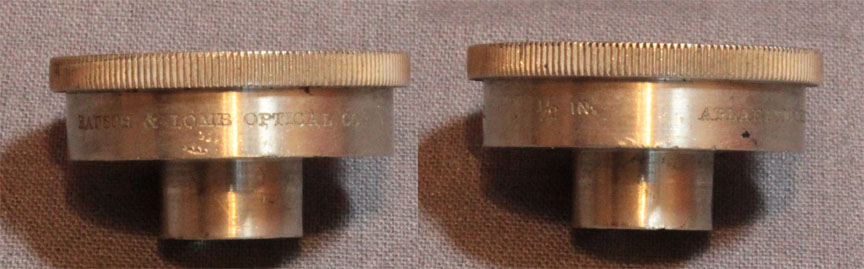
Bausch & Optical Co. 1/2 inch Aplanatic Triplet. This is a Hastings Triplet. Two other Watson triplets which fit the lens holder are also included, one a 10X and the other a 20X.
U,
Wand
YBAUSCH & LOMB DISSECTING MICROSCOPES:
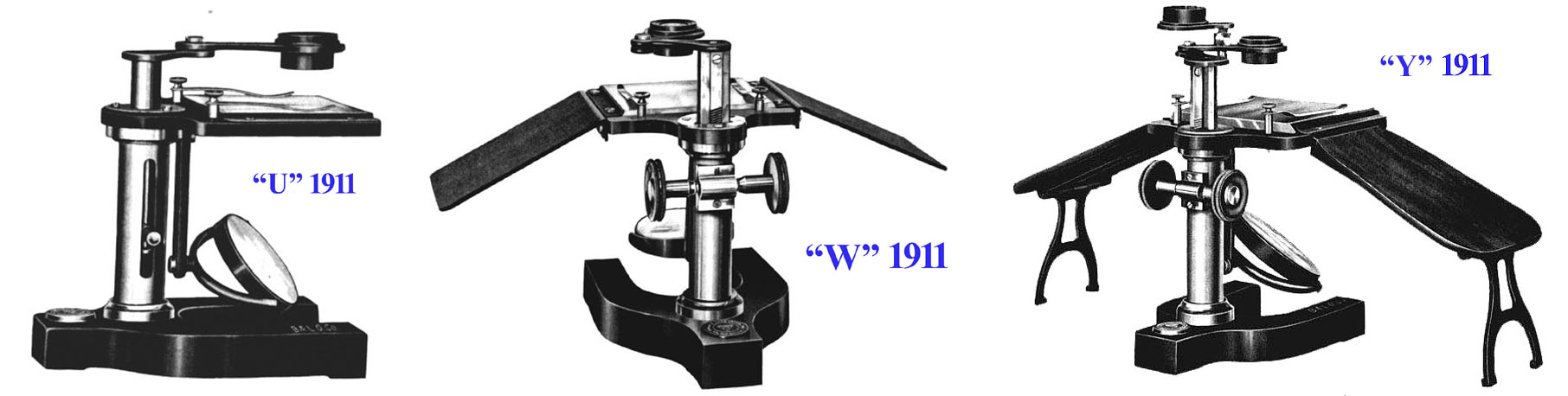
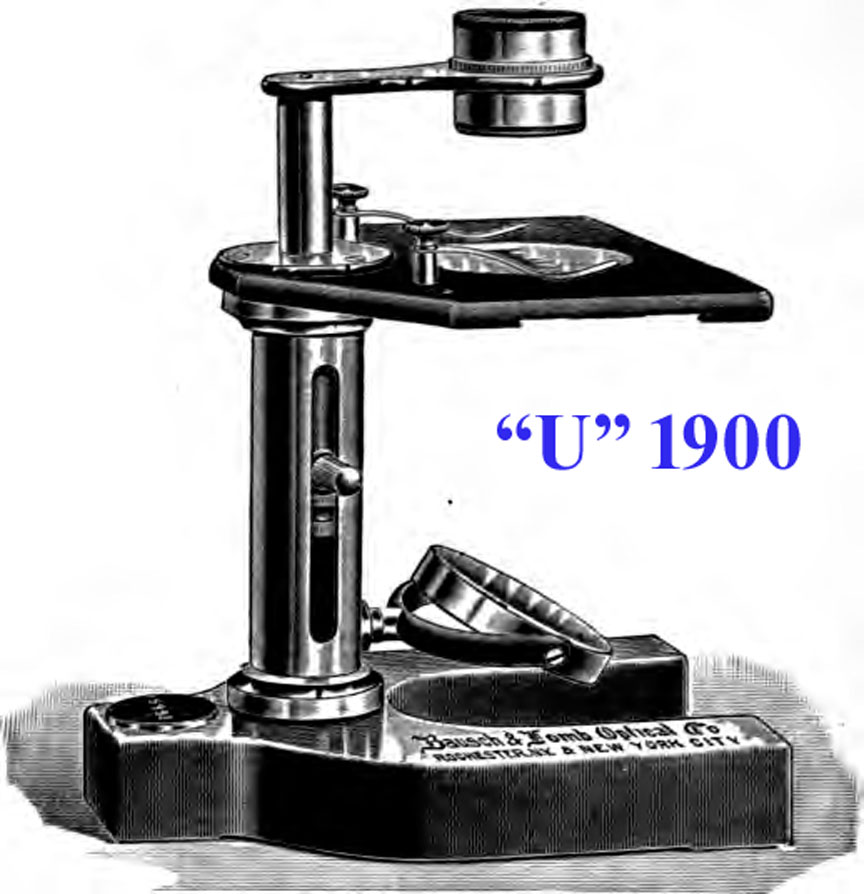
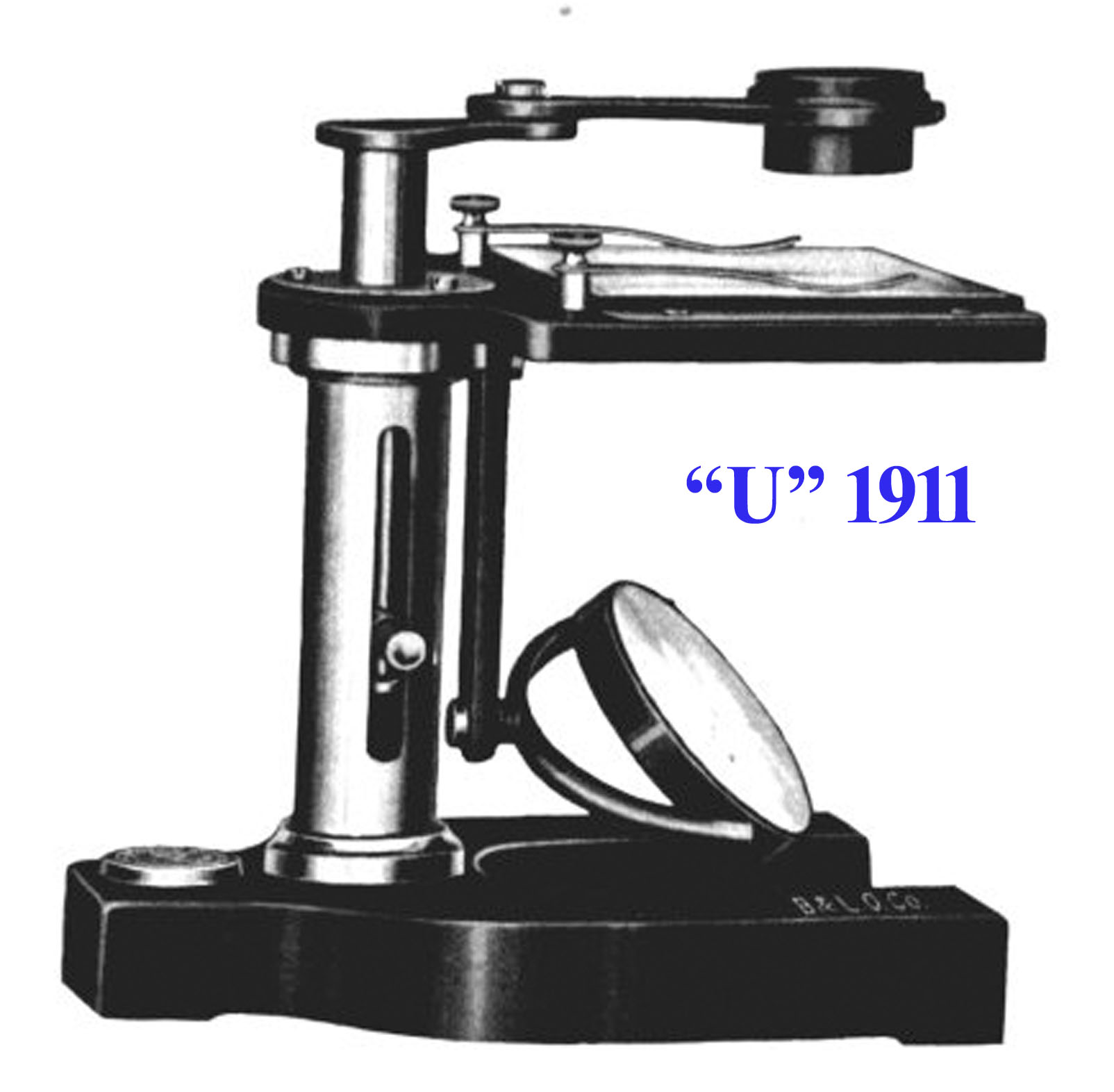 Although B & L made many different dissecting microscopes over the years, this section will concentrate on the U, Y, and W Models. The U had a push-pull focus and initially a single straight arm, though by 1911 it had a single articulation. Initially the stage was metal with a round glass insert; later the glass was a large rectangle. It was not initially offered with arm rests, but these were available by 1922.
 The
The Wstand was listed in the 1893 catalog, a description of which is shown to the left. This stand, had rack ad pinion focusing, a two-sided reflector, the flat side of white glass, and the convex side a mirror, just like the later
Wmodels, and could be supplied with a jointed arm, also like the later
W. It also had optional arm rests. The major differences from the later
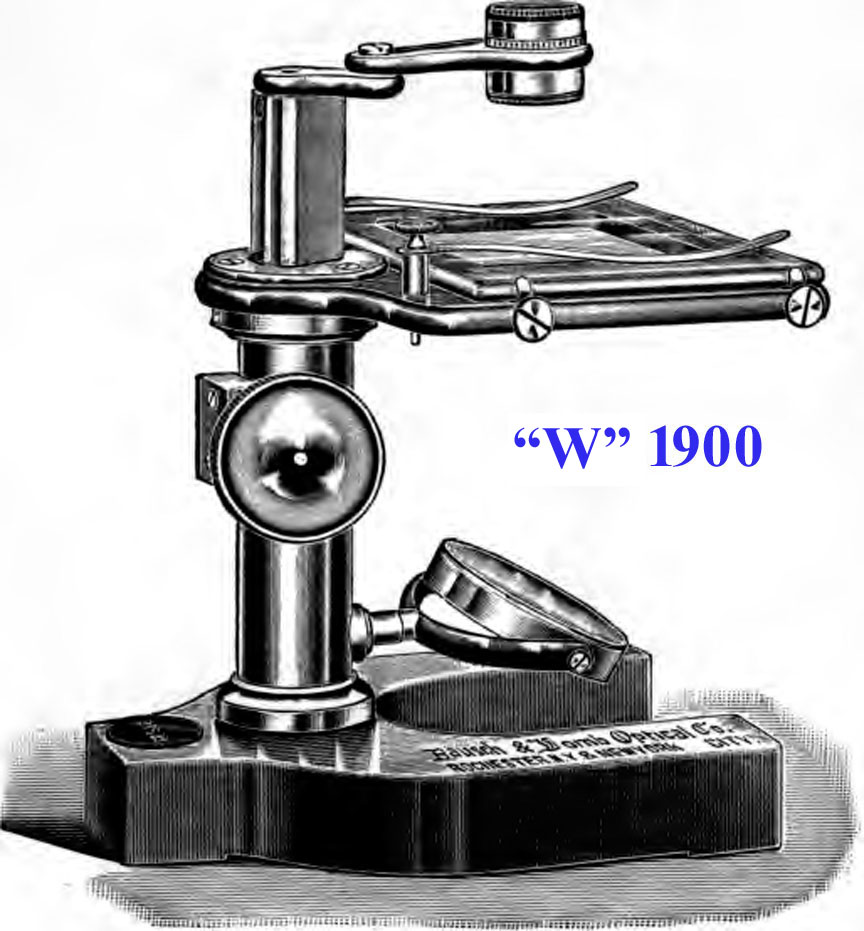
Wmodels were that this early version had round instead of horseshoe foot, the finish in lacquered brass instead of nickel-plating, and the stage of metal with a glass disk at its center, instead of the large rectangular glass plate on the later models. By 1900, all the models had nickel plated pillar, knobs and arm standard, though at least one example sold by Arthur H Thomas had a lacquered brass pillar and knobs. Although the U model continued to have a metal stage with circular glass insert, the W model now had a large rectangular glass stage.
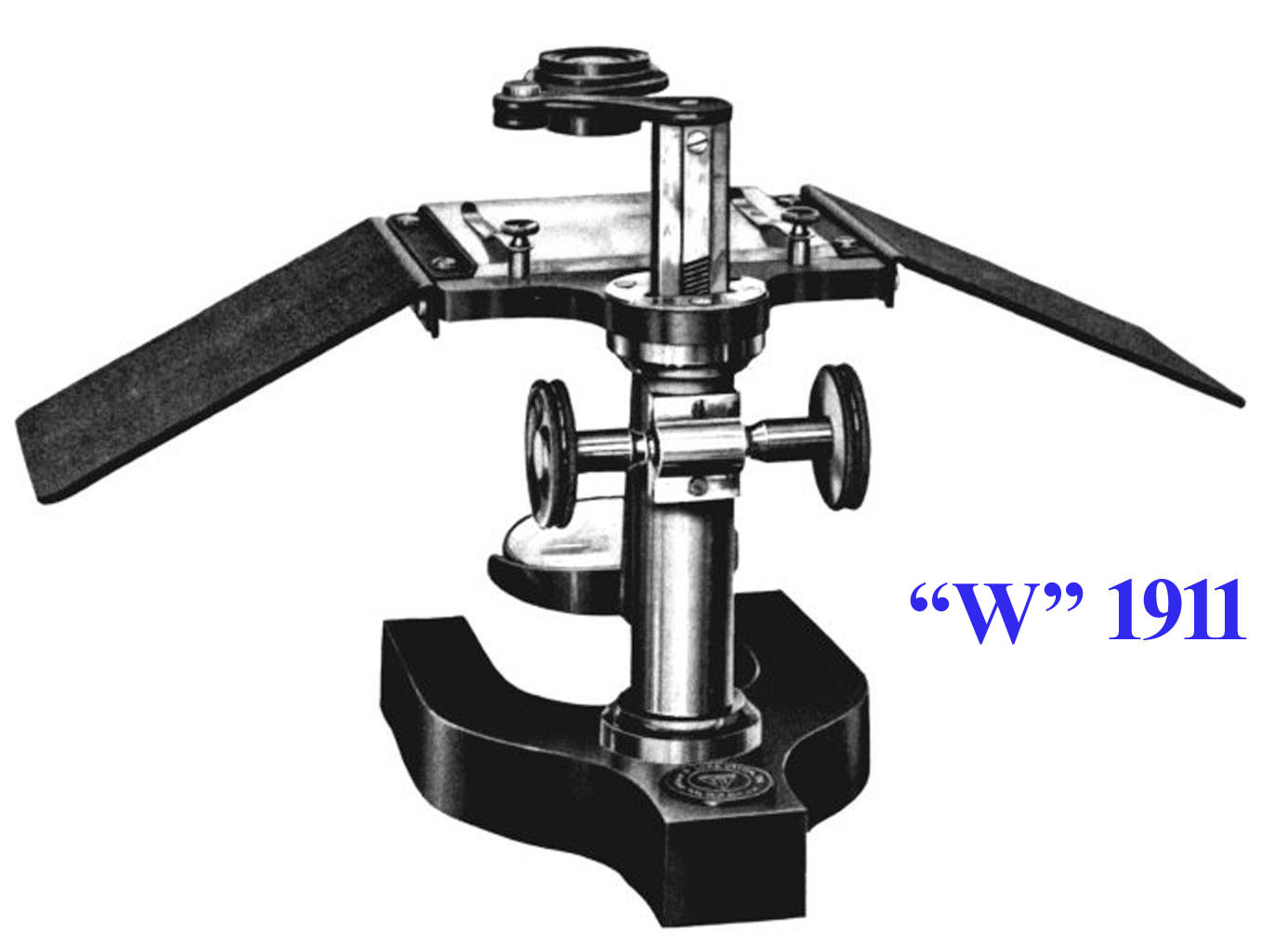 Sheet-metal arm rests could be attached to the right and left sides of the stage of the Model W.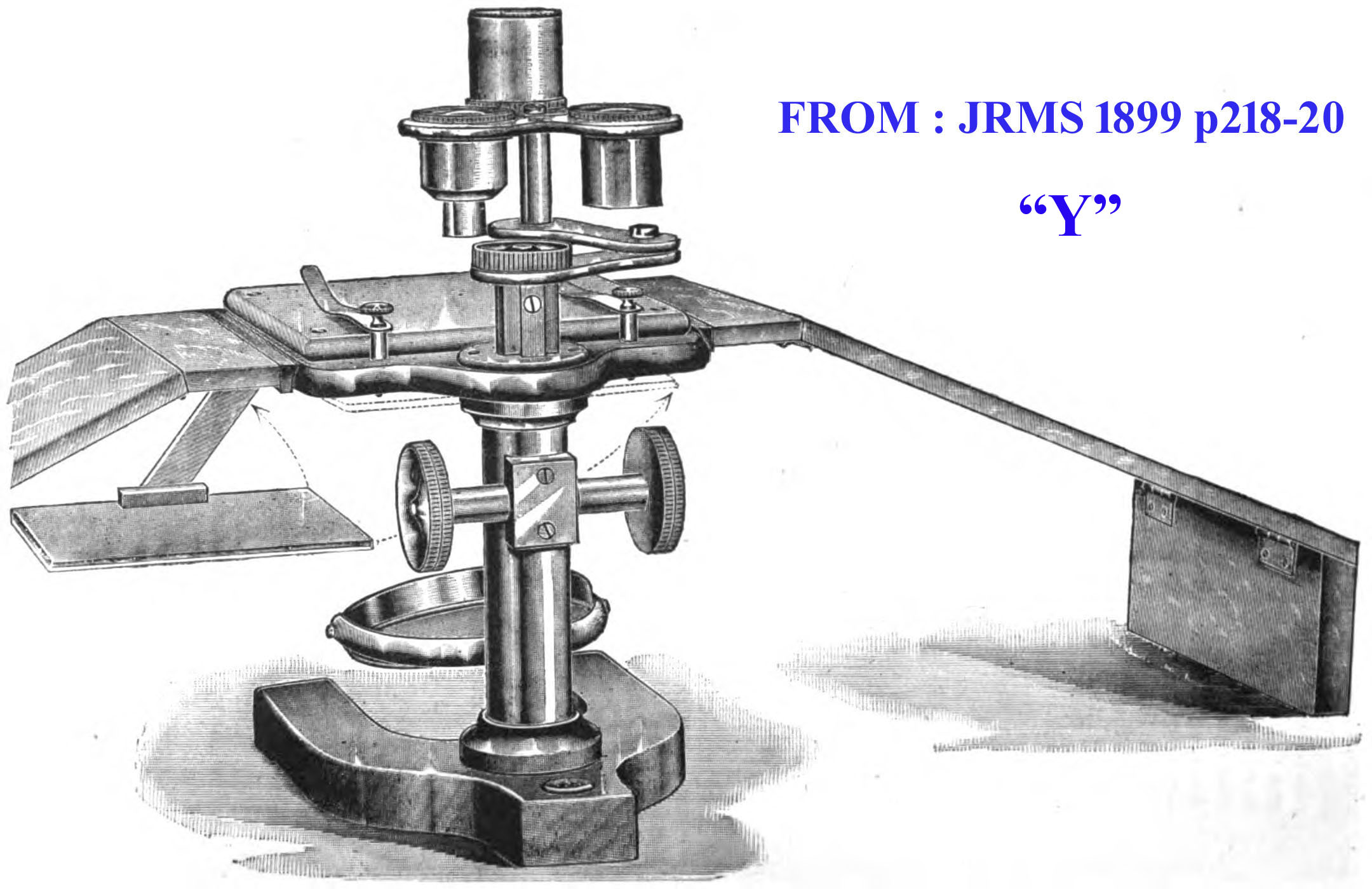
Ymodel, also known as Dr Meyers 'Improved' Dissecting Microscope was first described and illustrated in the JRMS of 1899, pp 218-220. This initial version of the Y stand had all-wood arm rests which had hinges to fold near their ends. It also had a black & white plate attached to the bottom of the hand rest on the left side which could be swung under the stage if required. Here it could serve as a black or white background for opaque objects, or the white side could be tilted at an angle to act as a
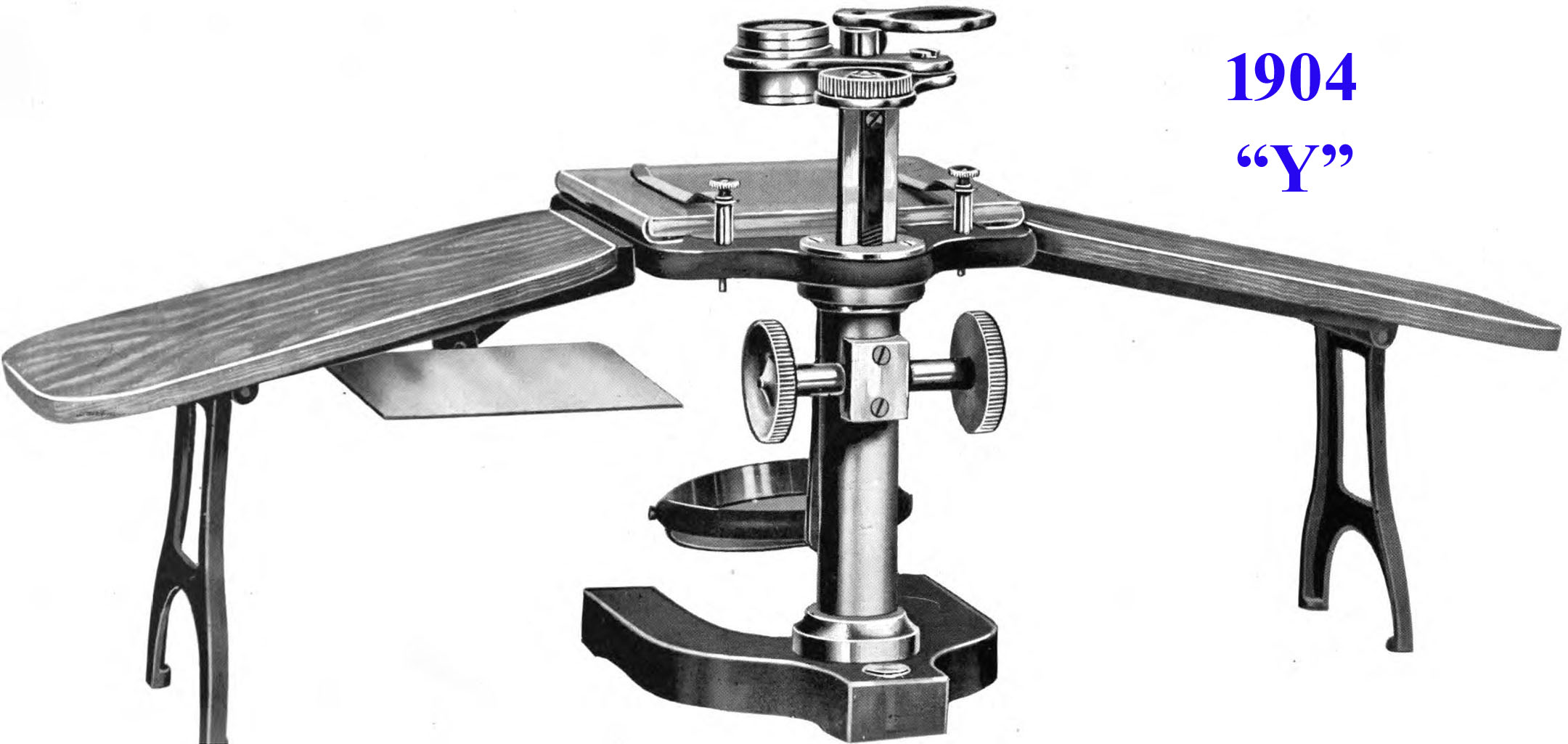
white cloudtype of illuminator. A feature that persisted on the Y stand over the years was a much larger diameter mirror than the U and W models. Another feature unique to this model, and again was carried forward, was the lens holder which could accomodate more than one lens; it could also accomodate a lens with a camera lucida above it.
 The Model
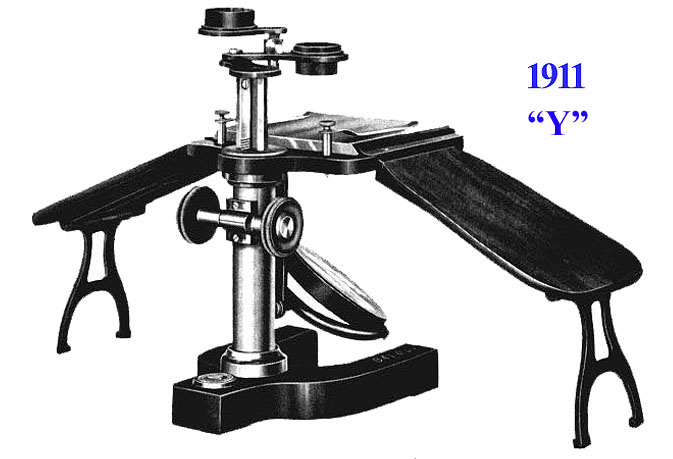
 YDissecting Microscope was listed in the 1900 through 1911 B & L catalogs. A microscope with a serial number corresponding to 1913 is a Y stand, and interestingly has a lacquered brass finish rather than a nickel finish. I would surmise these were sold into the middle of the second decade of the 20th century. That microscope carries the dealer label of the Arthur H. Thomas laboratory supply company*. Unfortunately, B & L catalogs from between 1912 and 1921 are not available to me. This model is not listed in the 1893 nor 1922 catalogs, although the lesser dissecting microscopes 'U' and W' were still listed in the latter. It states in the catalogs that the 'Y' was made to the specifications of Dr Paul Meyer.
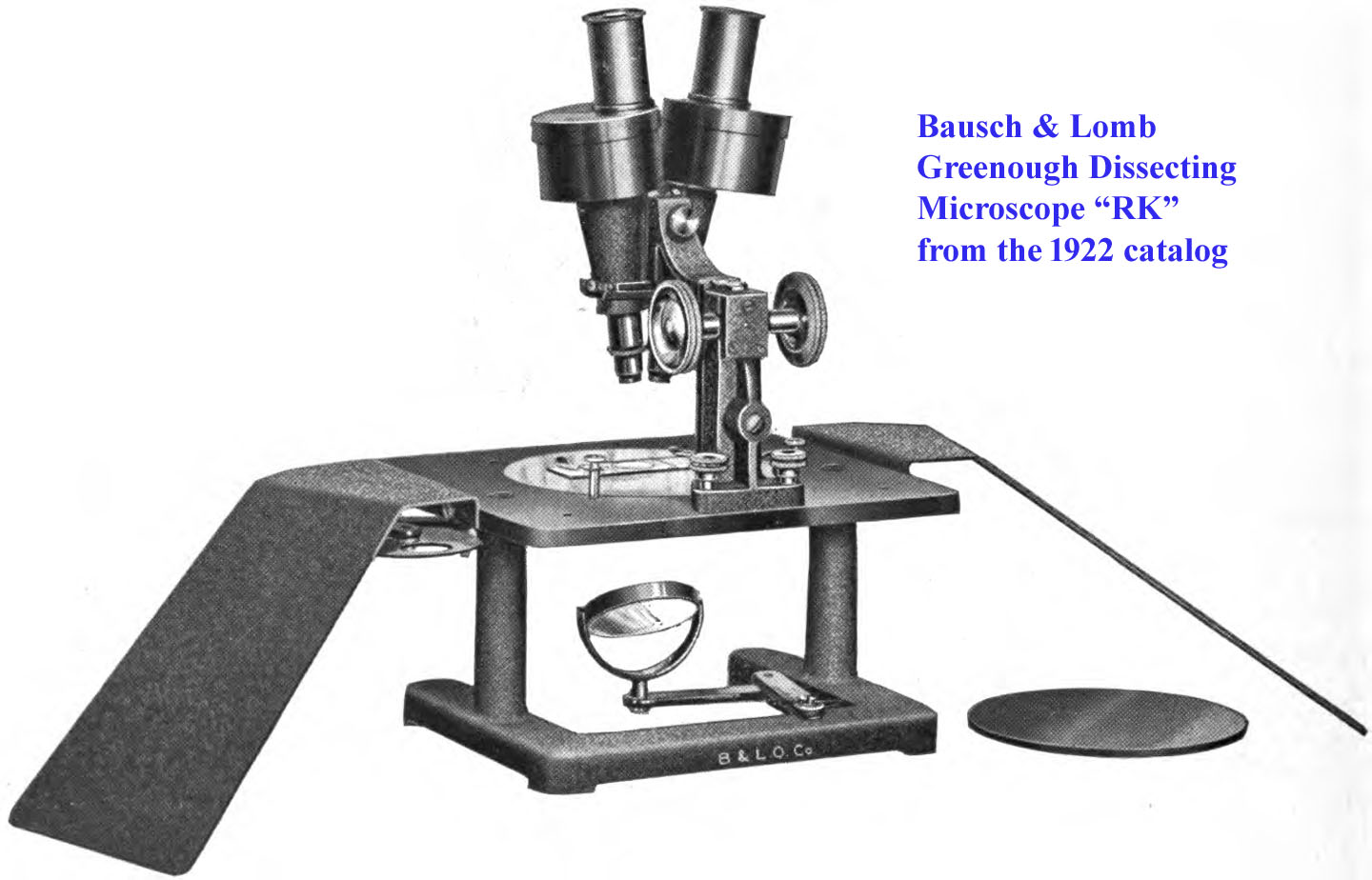 Horatio Greenough, an American who lived in Paris at the turn of the 20th century, invented a binocular stereo microscope that eventually became the standard for dissection microscopes. Invented in 1892, it was the Carl Zeiss company that first made these commercially about 1896. This did not not initially replace the monocular dissecting microscopes however. But by the 1920's stereo microscopes of the Greenough design did gradually replace the monocular types, which then became less popular, and when still made, were usually made to a much lower quality than the original designs like the stand shown on this page. A wide selection of Greenough designs were offered in the 1922 B & L catalog, along with Stands U and W.
 Ymodel and the
Wmodel. But overall is more like the W. Like the W, it has an articulated arm with provision for only one lens. It also has the same reflector as the W, with a concave mirror on one side and a flat white glass or porcelain reflector on the other. On the other hand, it has the long mahogany-topped arm rests with metal frame and legs typical of the Y model. Once the W was supplied with arm rests, they were usually short and made entirely of sheet metal. Since the Y stand was apparently transitioned out of existance sometime after 1911, this dissecting microscope may be a transitional form. An equally reasonable explanation would be a special order from the customer for a W stand with the longer arm rests.