
PORTABLE COMPOUND MICROSCOPE
C. 1925
SIGNED: 'SPENCER BUFFALO U.S.A.'
SIGNED ON BOX: 'SPENCER BUFFALO U.S.A. 225'
SERIAL NUMBER: 225 (?)
MODEL: REAL PORTABLE MICROSCOPE
OR NO. 75
| DESCRIPTION | HISTORY |
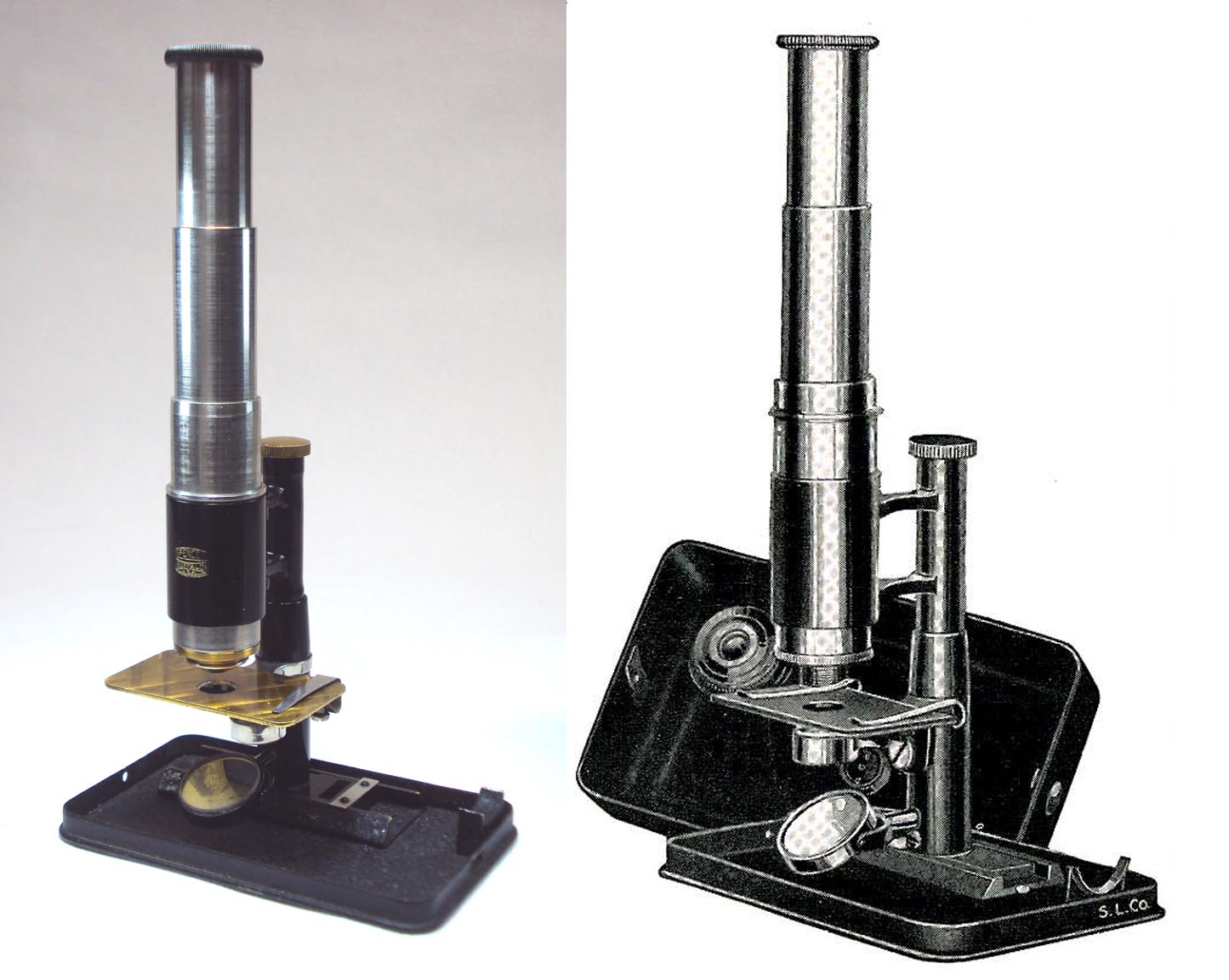
DESCRIPTION:
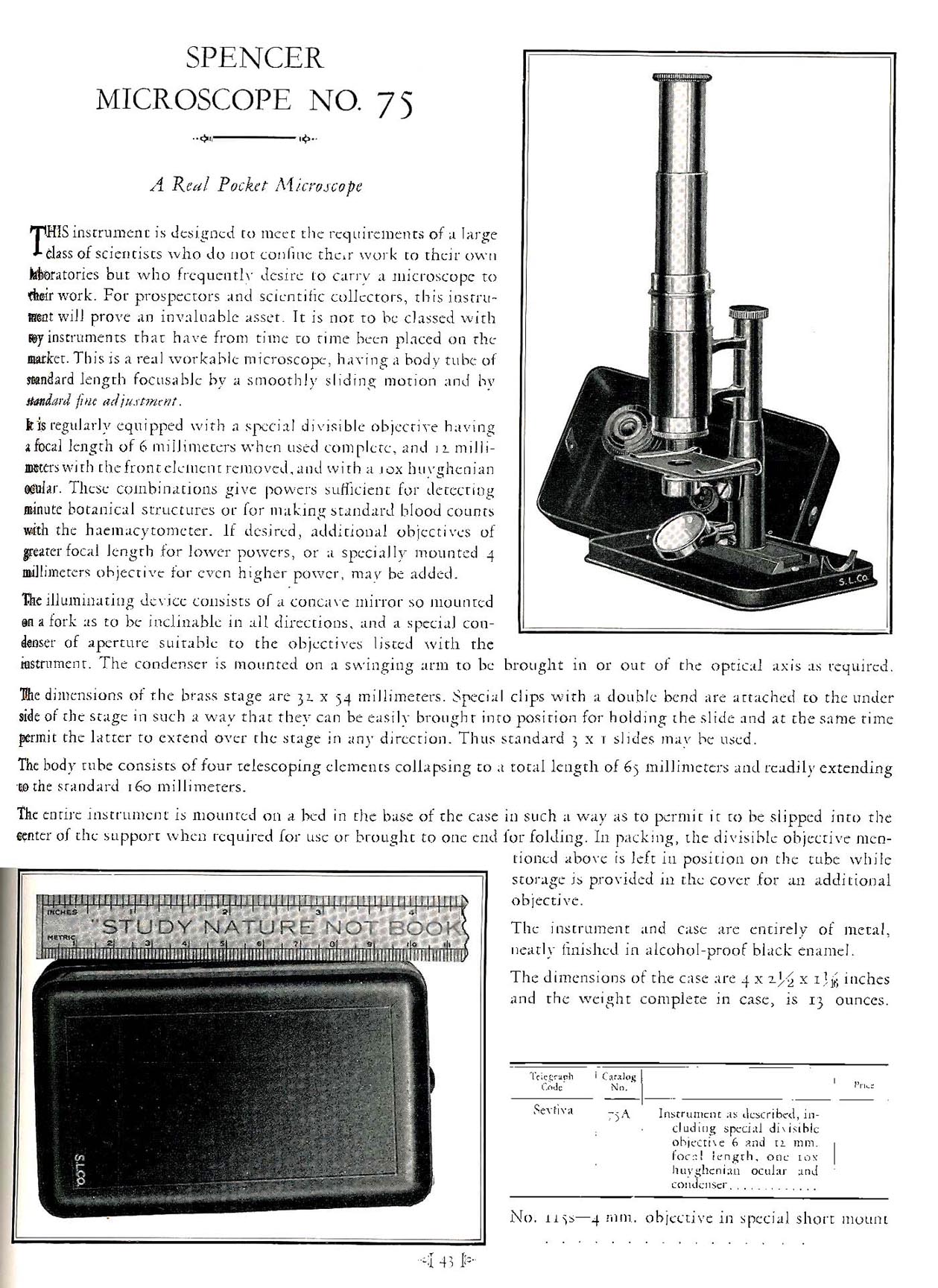
 This is a relatively heavy, but quite small, and clearly miniature portable folding microscope.
When packed, the case measuring 4 x 2.5 x 1 inches, is only slightly longer than Gould's Pocket microscope of the
nineteenth century. Coarse focus is push-pull on the main optical tube; fine focus is by a small knob at the top of the pillar, and acting
on it to achieve its purpose. The single gimballed mirror is on a rod which is permanently affixed to the lower pillar.
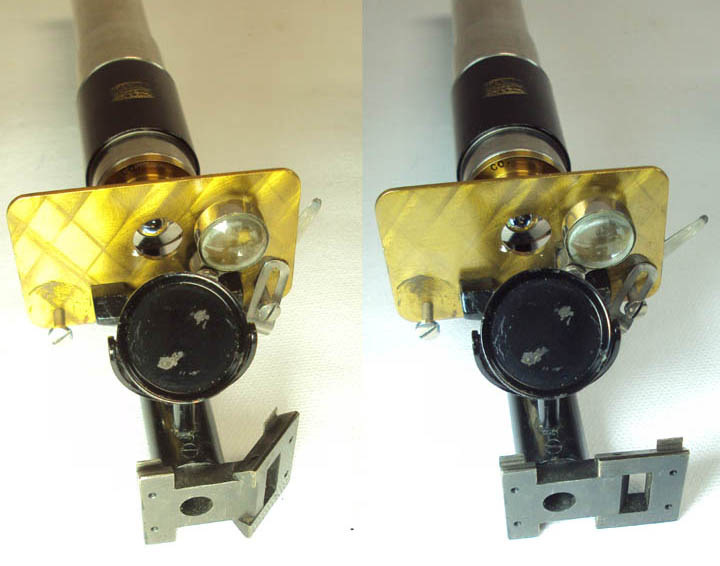
There were originally two stage clips which attached via pins screwed into the underside; although both pins remain, only one stage clip
survived with the instrument. The case serves as the foot, and the microscope erects upon it, via a sliding and hinged dovetail fitting; while
half of this fitting stores in the rail when the microscope is packed, the hinge allows the other half, with the microscope attached, to fold down.
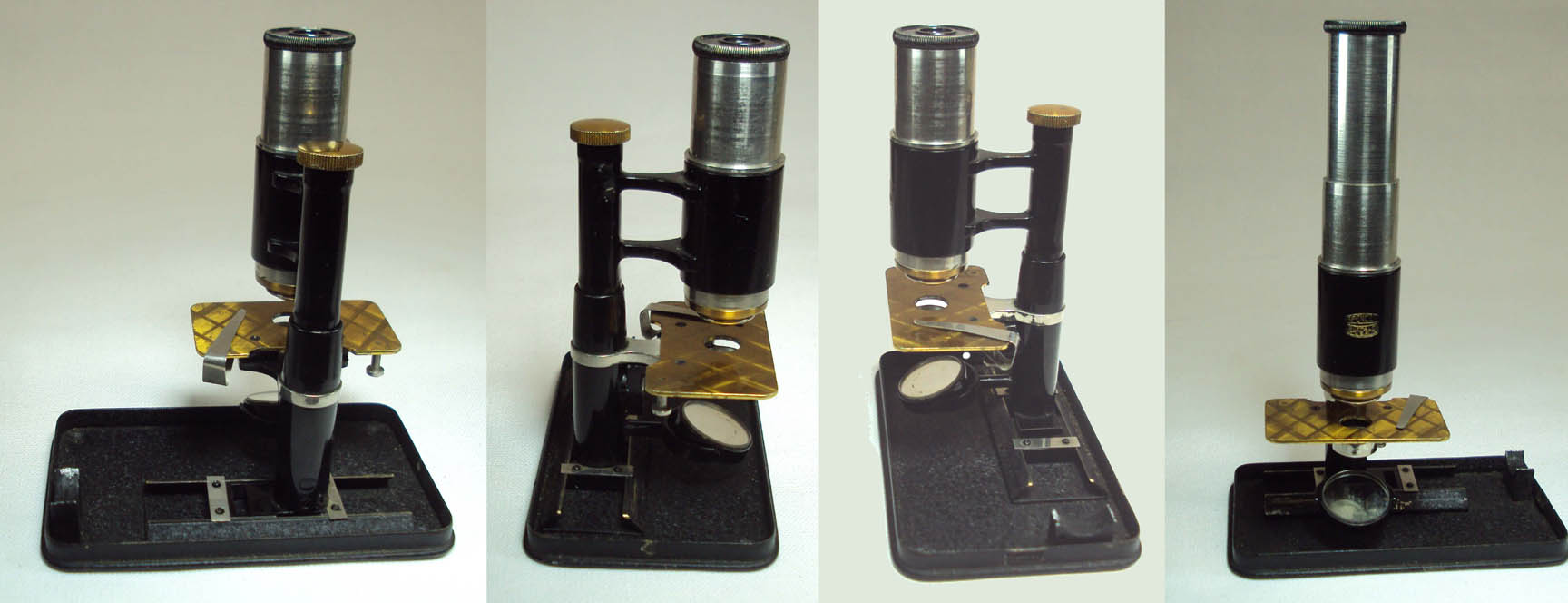
After the cover has been removed, the microscope may be seen folded as for storage in the first picture in the sequence to the right. The sequence
of erecting the microscope is depicted in the images that follow in numerical order(click to enlarge):
This is a relatively heavy, but quite small, and clearly miniature portable folding microscope.
When packed, the case measuring 4 x 2.5 x 1 inches, is only slightly longer than Gould's Pocket microscope of the
nineteenth century. Coarse focus is push-pull on the main optical tube; fine focus is by a small knob at the top of the pillar, and acting
on it to achieve its purpose. The single gimballed mirror is on a rod which is permanently affixed to the lower pillar.
There were originally two stage clips which attached via pins screwed into the underside; although both pins remain, only one stage clip
survived with the instrument. The case serves as the foot, and the microscope erects upon it, via a sliding and hinged dovetail fitting; while
half of this fitting stores in the rail when the microscope is packed, the hinge allows the other half, with the microscope attached, to fold down.
After the cover has been removed, the microscope may be seen folded as for storage in the first picture in the sequence to the right. The sequence
of erecting the microscope is depicted in the images that follow in numerical order(click to enlarge):
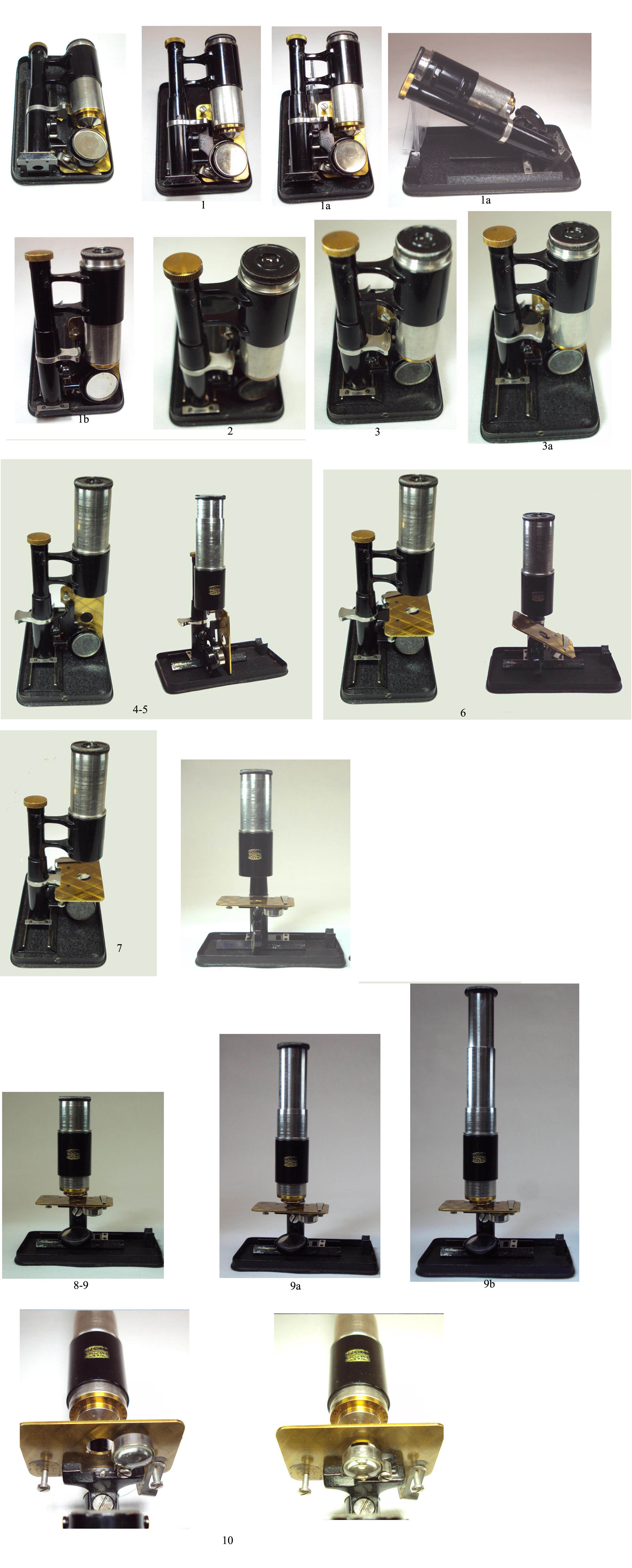
- The instrument is tilted up part way
- Once tilted part way up, it is pushed a short distance down its dovetailed track so that,
when the microscope is now fully vertical, the second part of the folding dovetail fitting can engage the track
- Next the entire assembly
is slid down to the middle of the track, engaging the second portion of the dovetail fitting of the foot, allowing full support to the microscope
- The optical tube is now pulled up fully inside the arm to allow the stage to rotate into place
- The chrome piece that will hold
the stage in place is rotated out of the way
- The stage can then be rotated up
- The chrome piece is then rotated into position, firmly
securing the stage in place
- The Mirror may now be rotated into position
- The optical tube can now be pushed down into to a working
distance from the stage, and its tube can be extended
- The substage condenser can now be swung into the optical axis if desired
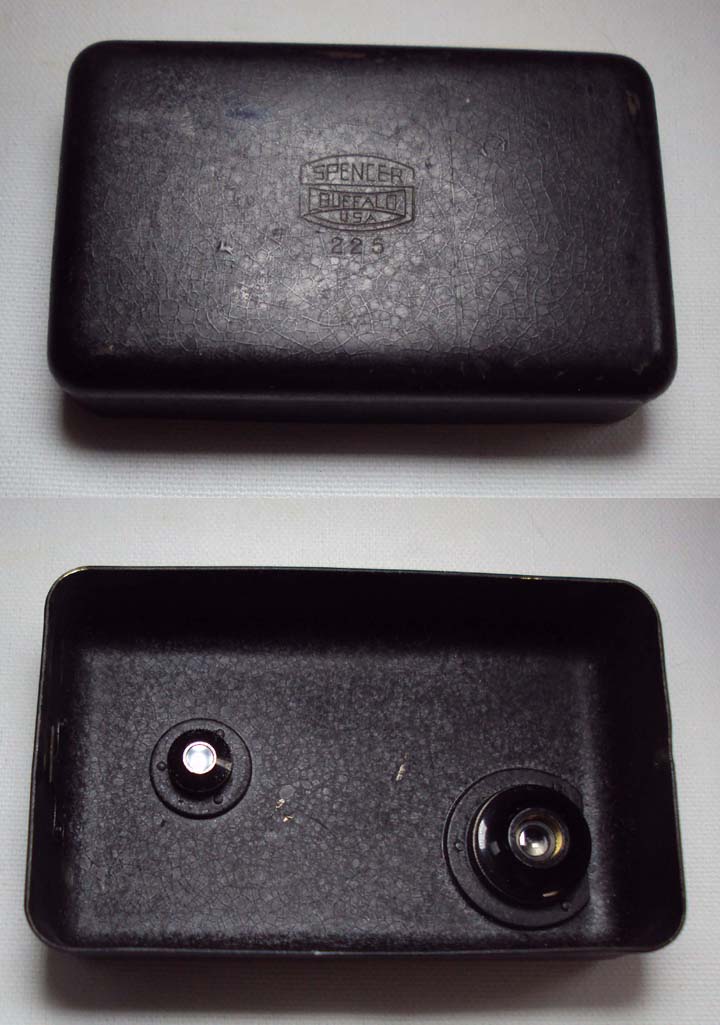
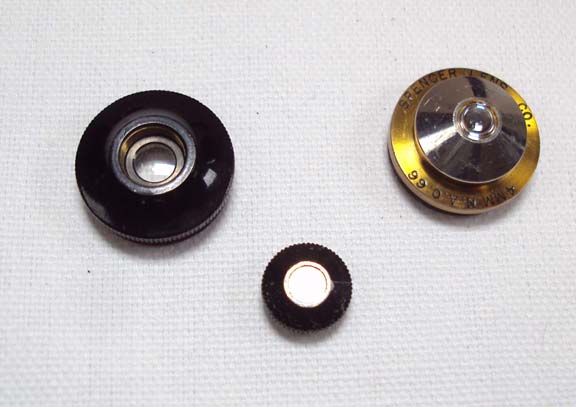 The microscope comes with a standard black divisible objective providing two magnifications with focal length of 6 mm or 12 mm.
There are threaded receptacles in the lid to store an objective and also the high power division of the divisible objective separately if desired.
A 4 mm objective is also present and was also offered as an option. It is signed:
The microscope comes with a standard black divisible objective providing two magnifications with focal length of 6 mm or 12 mm.
There are threaded receptacles in the lid to store an objective and also the high power division of the divisible objective separately if desired.
A 4 mm objective is also present and was also offered as an option. It is signed: SPENCER LENS CO. 4mm N.A. 0.66.
In use,
the instrument provides good images, however the bottom element of the Huygenian ocular has some chips around its edge visible in the field of view.
Although the advertisement states that an objective can be stored on the tube as well as in the lid, care must be taken to avoid contact of the outer
element of the objective with the mirror yolk when stored; a cloth spacer or piece of lens paper should be used to keep them separated.
 HISTORY: This is an example of a small portable microscope that became very popular in the 1920's and 1930's in England,
Germany, and America. They took many forms and varied in size. Some, like the Beck Baby London
were quite small but even in their case did not quite fit in a pocket. This 'Real Portable' pocket microscope provided
many features of a full service microscope, and yet in its case, close in size to the
Gould Improved Pocket Microscope of the 19th century, it could readily fit in ones pocket.
Unlike some lesser competitors, it provided modern achromatic optics, stage, condenser, ability to change objectives,
and a good fine focus mechanism. Even the Lietz Minor, was a bit too large to comfortably fit in the pocket, even when
completely folded in its case. This microscope is not listed in the Spencer 1917 catalog, but is listed from 1924 to 1929.
It was not listed in the 1930 catalog. This suggests it was made for only a few years, from sometime after 1917, until 1929.
I am grateful to James Solliday for the catalog listing information.
HISTORY: This is an example of a small portable microscope that became very popular in the 1920's and 1930's in England,
Germany, and America. They took many forms and varied in size. Some, like the Beck Baby London
were quite small but even in their case did not quite fit in a pocket. This 'Real Portable' pocket microscope provided
many features of a full service microscope, and yet in its case, close in size to the
Gould Improved Pocket Microscope of the 19th century, it could readily fit in ones pocket.
Unlike some lesser competitors, it provided modern achromatic optics, stage, condenser, ability to change objectives,
and a good fine focus mechanism. Even the Lietz Minor, was a bit too large to comfortably fit in the pocket, even when
completely folded in its case. This microscope is not listed in the Spencer 1917 catalog, but is listed from 1924 to 1929.
It was not listed in the 1930 catalog. This suggests it was made for only a few years, from sometime after 1917, until 1929.
I am grateful to James Solliday for the catalog listing information.
- The instrument is tilted up part way
- Once tilted part way up, it is pushed a short distance down its dovetailed track so that, when the microscope is now fully vertical, the second part of the folding dovetail fitting can engage the track
- Next the entire assembly is slid down to the middle of the track, engaging the second portion of the dovetail fitting of the foot, allowing full support to the microscope
- The optical tube is now pulled up fully inside the arm to allow the stage to rotate into place
- The chrome piece that will hold the stage in place is rotated out of the way
- The stage can then be rotated up
- The chrome piece is then rotated into position, firmly securing the stage in place
- The Mirror may now be rotated into position
- The optical tube can now be pushed down into to a working distance from the stage, and its tube can be extended
- The substage condenser can now be swung into the optical axis if desired
The microscope comes with a standard black divisible objective providing two magnifications with focal length of 6 mm or 12 mm.
There are threaded receptacles in the lid to store an objective and also the high power division of the divisible objective separately if desired.
A 4 mm objective is also present and was also offered as an option. It is signed: SPENCER LENS CO. 4mm N.A. 0.66.In use, the instrument provides good images, however the bottom element of the Huygenian ocular has some chips around its edge visible in the field of view. Although the advertisement states that an objective can be stored on the tube as well as in the lid, care must be taken to avoid contact of the outer element of the objective with the mirror yolk when stored; a cloth spacer or piece of lens paper should be used to keep them separated.
HISTORY: This is an example of a small portable microscope that became very popular in the 1920's and 1930's in England,
Germany, and America. They took many forms and varied in size. Some, like the Beck Baby London
were quite small but even in their case did not quite fit in a pocket. This 'Real Portable' pocket microscope provided
many features of a full service microscope, and yet in its case, close in size to the
Gould Improved Pocket Microscope of the 19th century, it could readily fit in ones pocket.
Unlike some lesser competitors, it provided modern achromatic optics, stage, condenser, ability to change objectives,
and a good fine focus mechanism. Even the Lietz Minor, was a bit too large to comfortably fit in the pocket, even when
completely folded in its case. This microscope is not listed in the Spencer 1917 catalog, but is listed from 1924 to 1929.
It was not listed in the 1930 catalog. This suggests it was made for only a few years, from sometime after 1917, until 1929.
I am grateful to James Solliday for the catalog listing information.