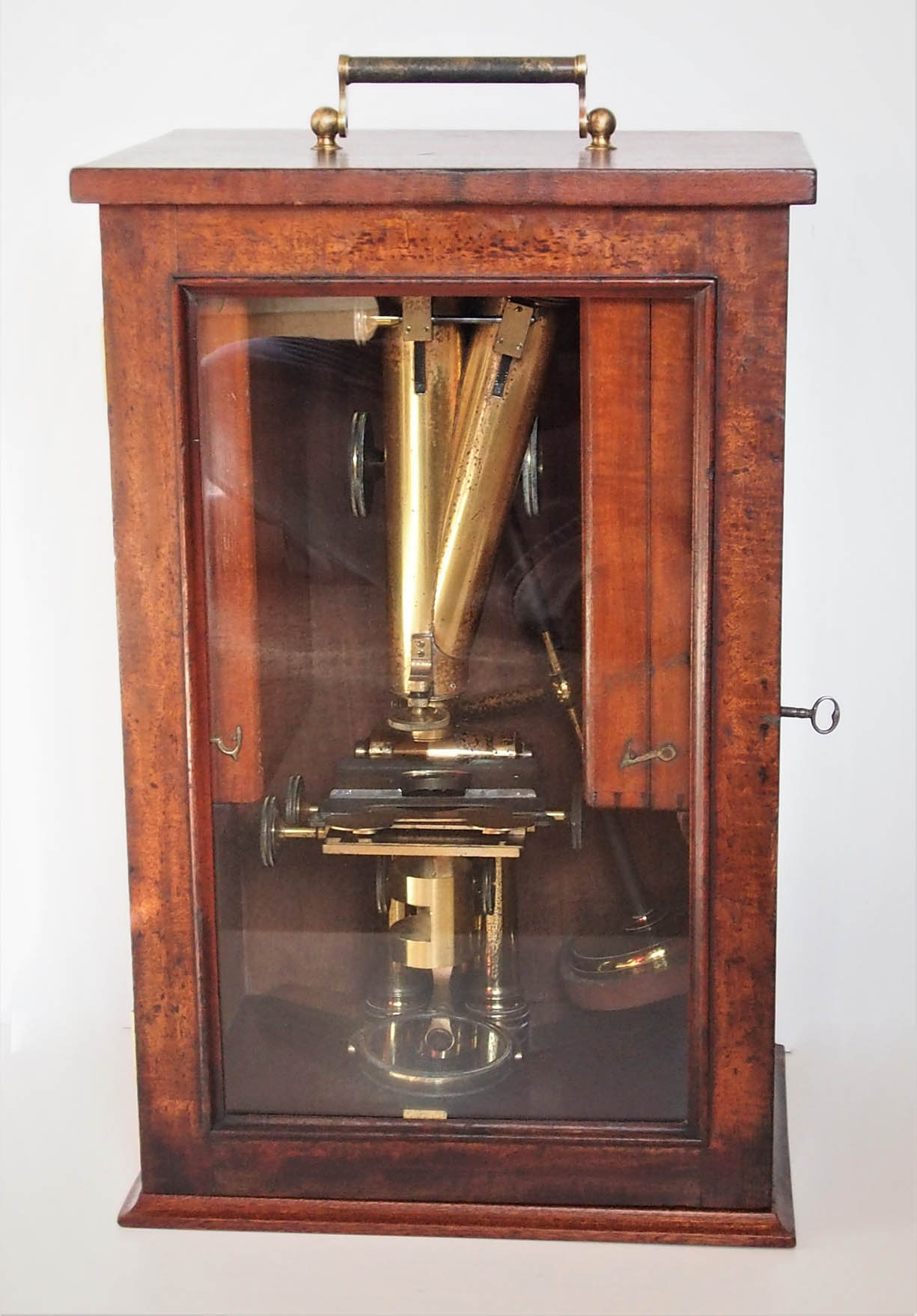
MAKER:SMITH & BECK
1862
ORIGINAL OWNER: Felix Marsh Rimmington, of Bradford, Yorkshire, Pharmacist and Pioneer Crime Scene Investigator
Author: Jurriaan de Groot
Editors: Barry Sobel and Joe Zeligs
Please Click On Any Picture for a Larger Version
DESCRIPTION:
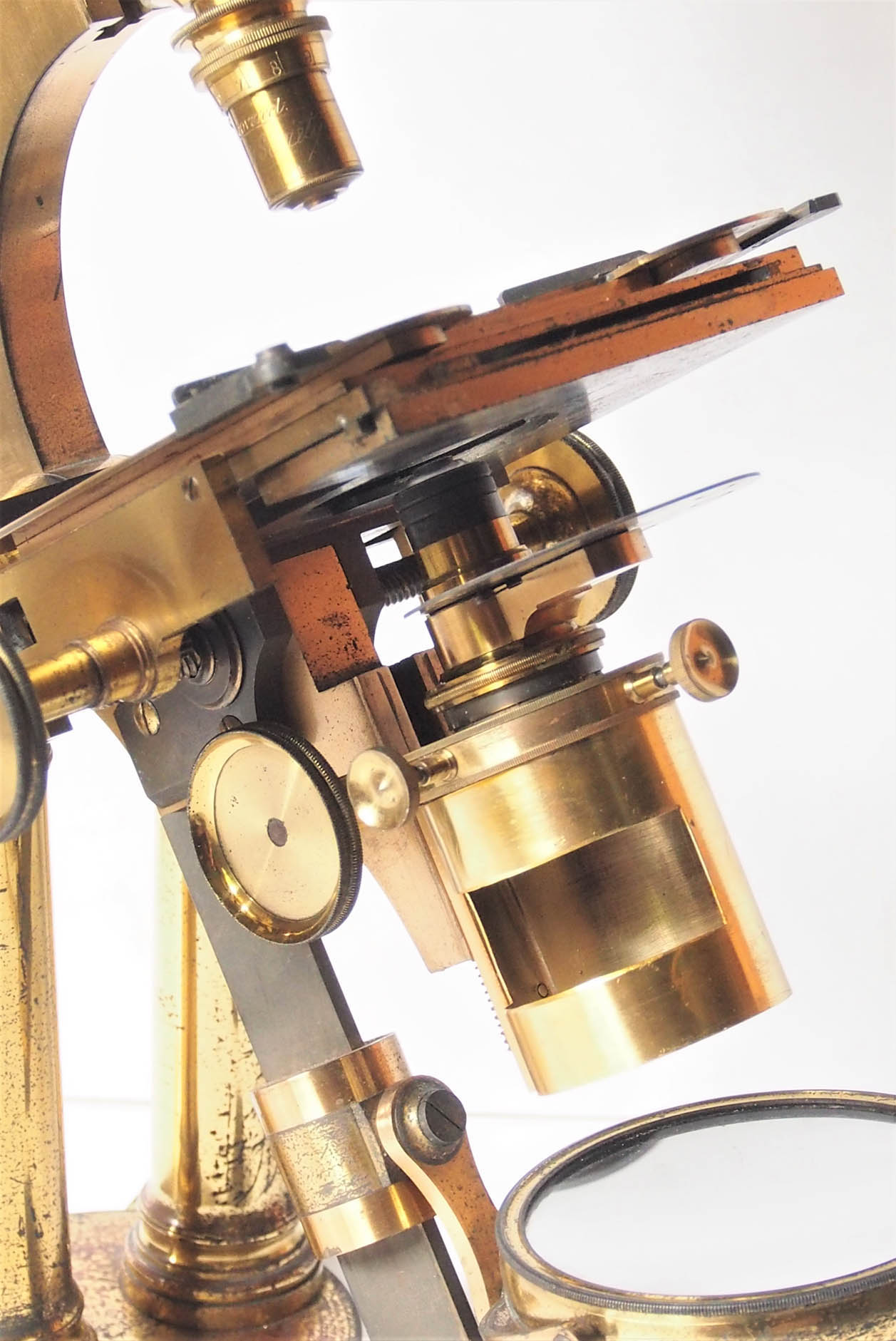
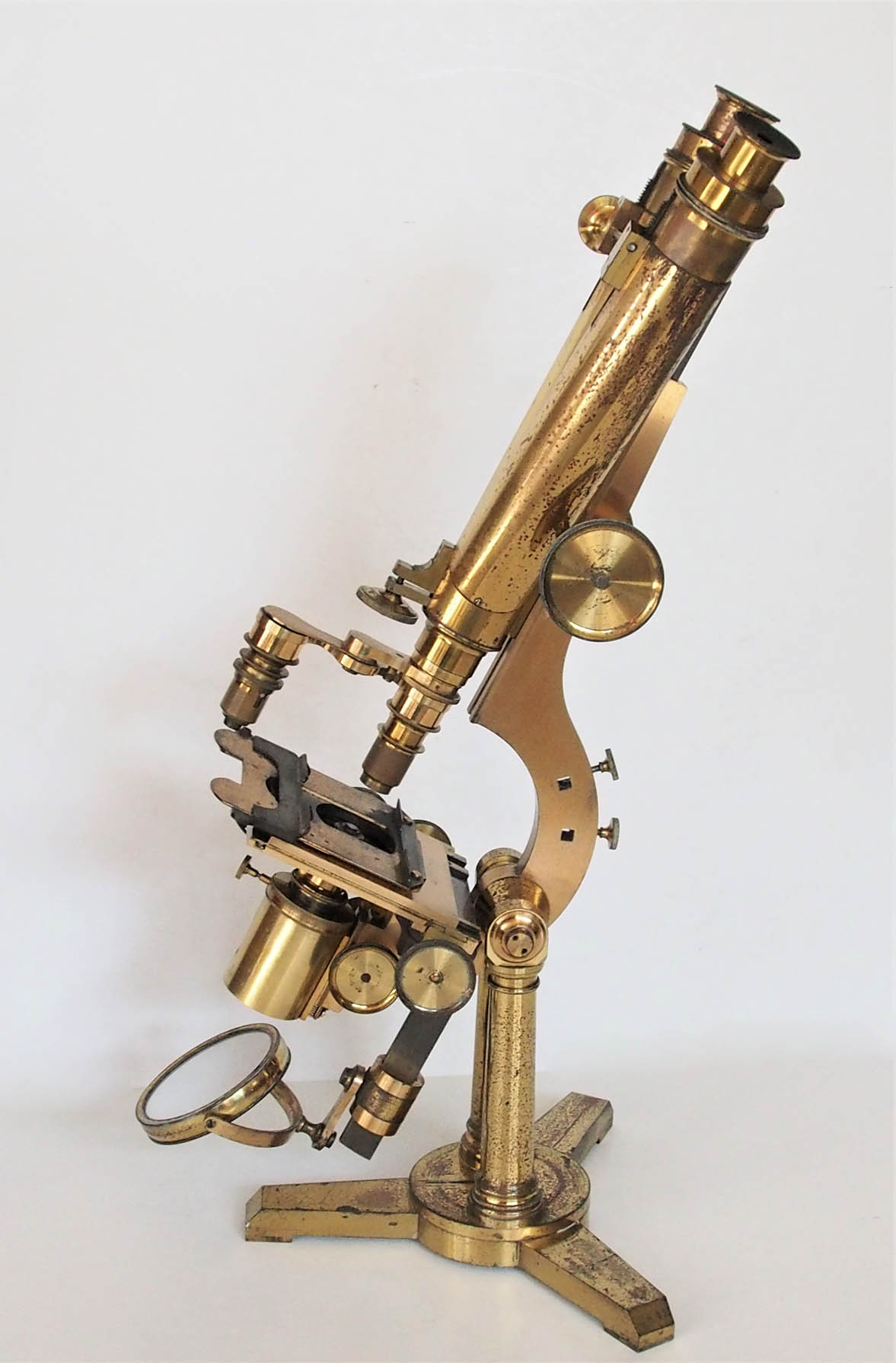
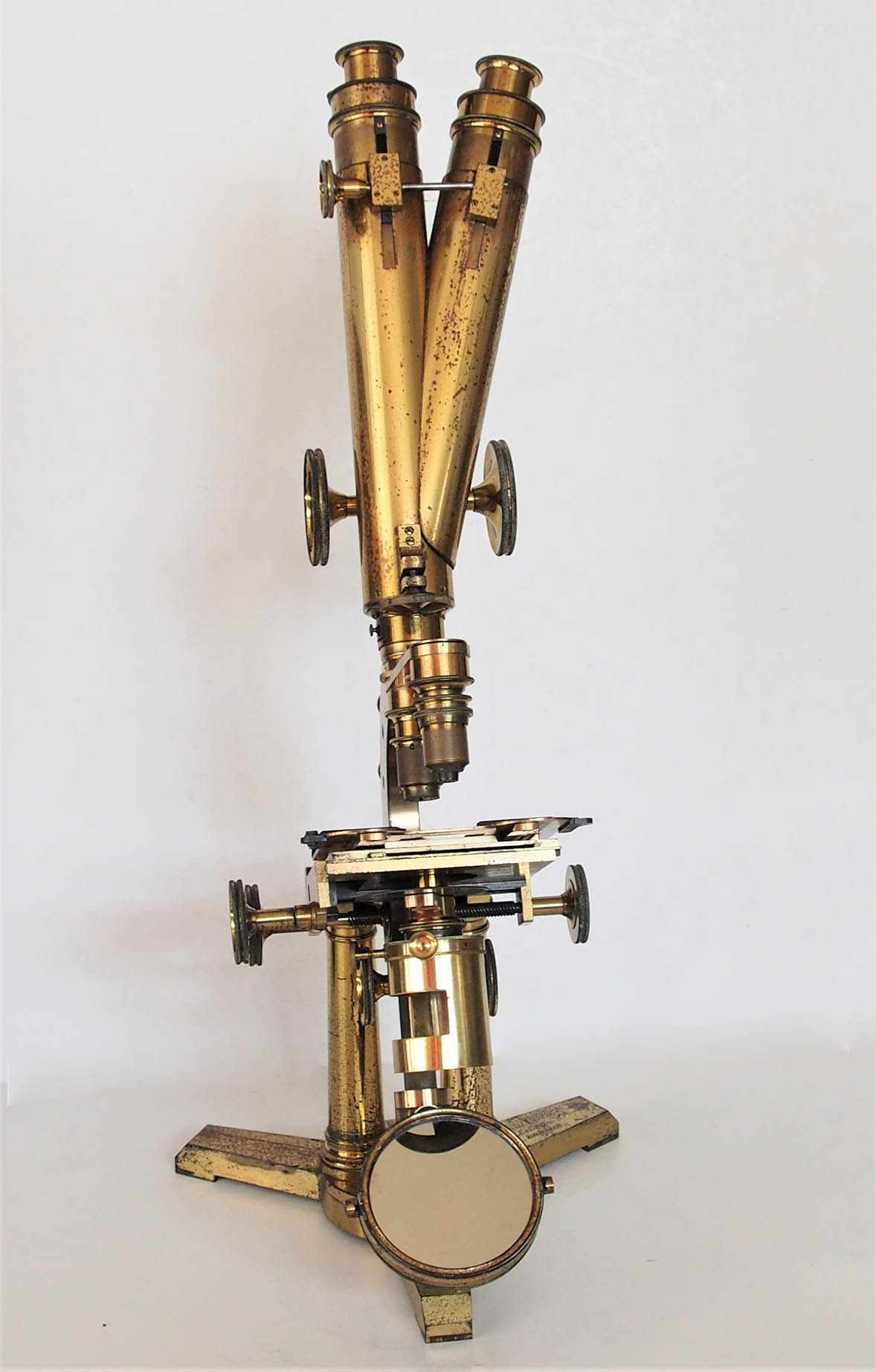
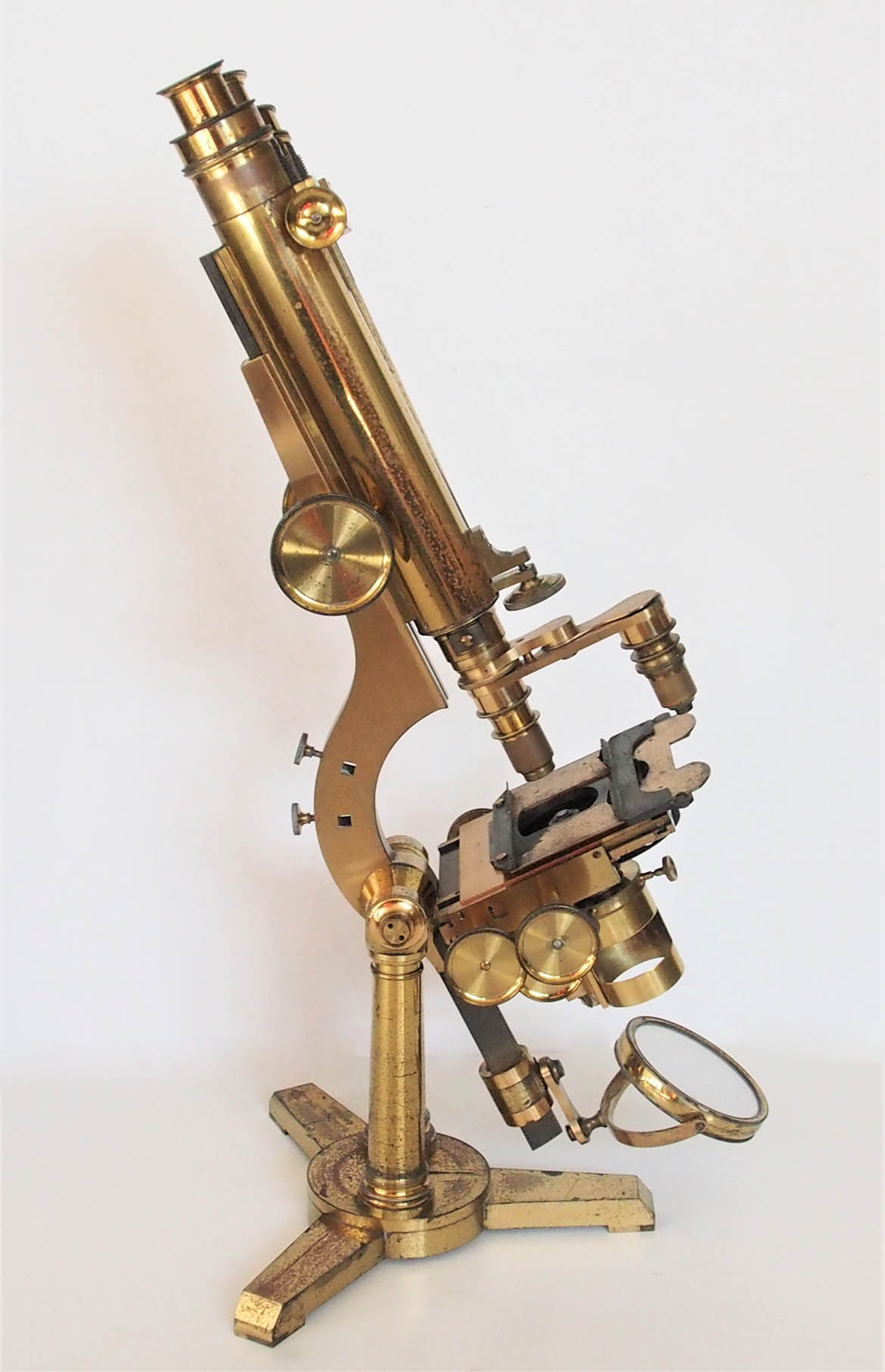
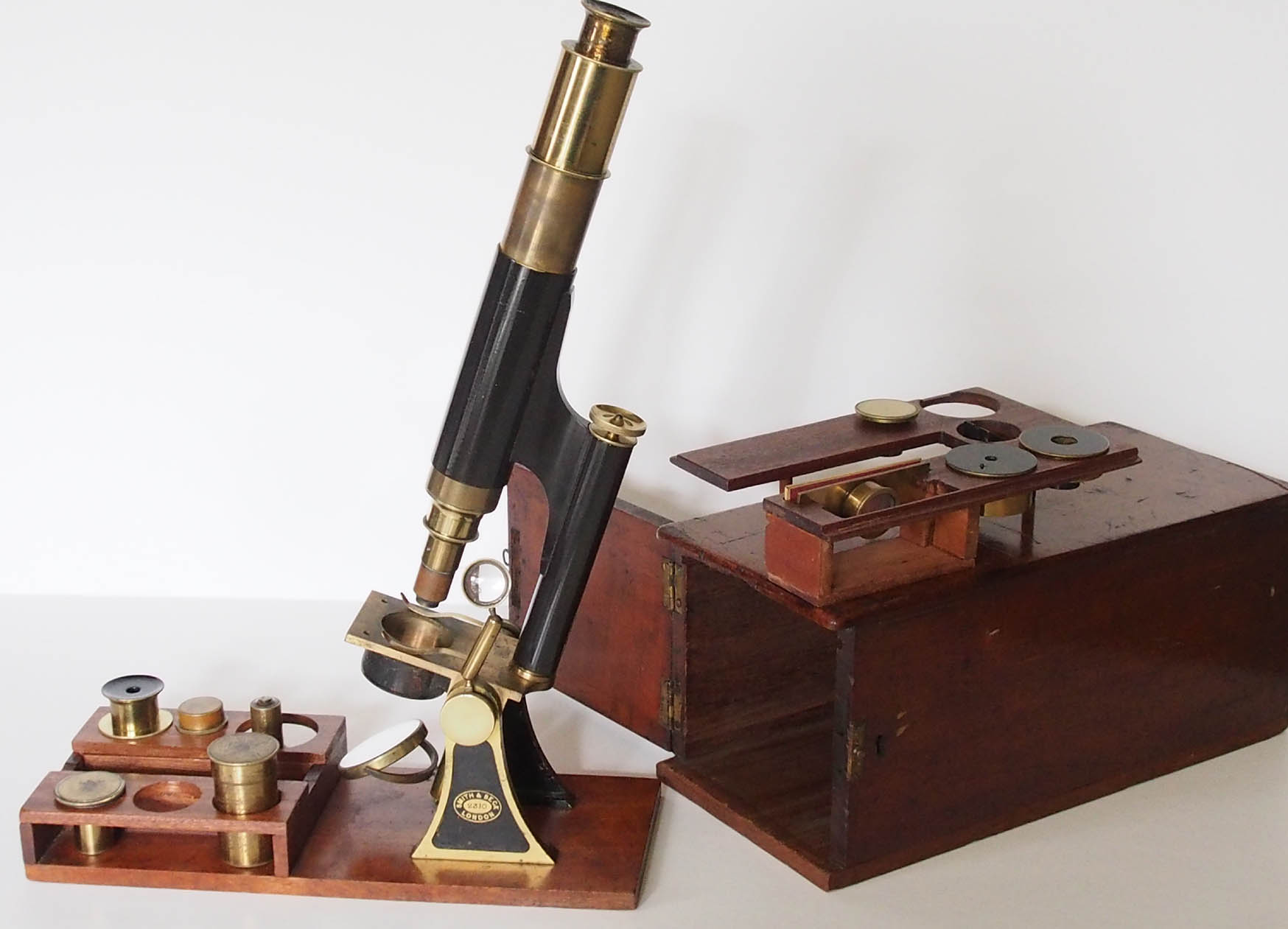
This is an original and well-used example of the binocular version of Smith & Beck's Large Best No 1
microscope, with the square mechanical stage. It is supported by a flat equiaxial cast brass foot, upon which is a rotatable disc from which arise twin pillars holding the limb on trunnions. The foot is signed Smith & Beck, 6 Coleman St, London
, and engraved on the edge of one foot with the serial No 2841. The curved limb is machined with a Jackson-type groove, into which the body tube is fit at its top end, and a substage accessory holder at its lower end. Both are operated by rack and pinion. The limb has two square holes to accept accessories. Each hole has a set screw with a knurled knob to hold the accessory in place. The binocular tube has a Wenham prism in a slide-out drawer, which is placed within the nose-piece tube, which has an RMS thread to take the objective. Fine adjustment is by short lever focus acting on the nose-piece by a graduated knurled knob from the front. Inter-ocular distance is varied by rack and pinion for each tube, with a common knurled knob acting on both. Internal fit for the eye pieces is 35.6 mm. The top plate of the mechanical stage can be rotated by hand, and is fitted with a slide-rest and sprung grip. X- and Y-movements are controlled by knurled knobs, which are in the same plane as the stage. There is a bayonet fitting in the lower plate of the stage to carry a sleeve for accessories, usually a wheel of stops for use of the mirror without the condenser, or a darkwell holder. On this example this sleeve is missing. The substage condenser holder is lowered or raised by rack and pinion, and has a sector cut out in its wall at one end to admit selenites. Internal fit for accessories is 38.8 mm. The large gimbaled plain and concave mirror is on an articulated arm affixed to a cylindrical fitting, around which it can rotate. This slides on a triangular tail-piece.
CASE:
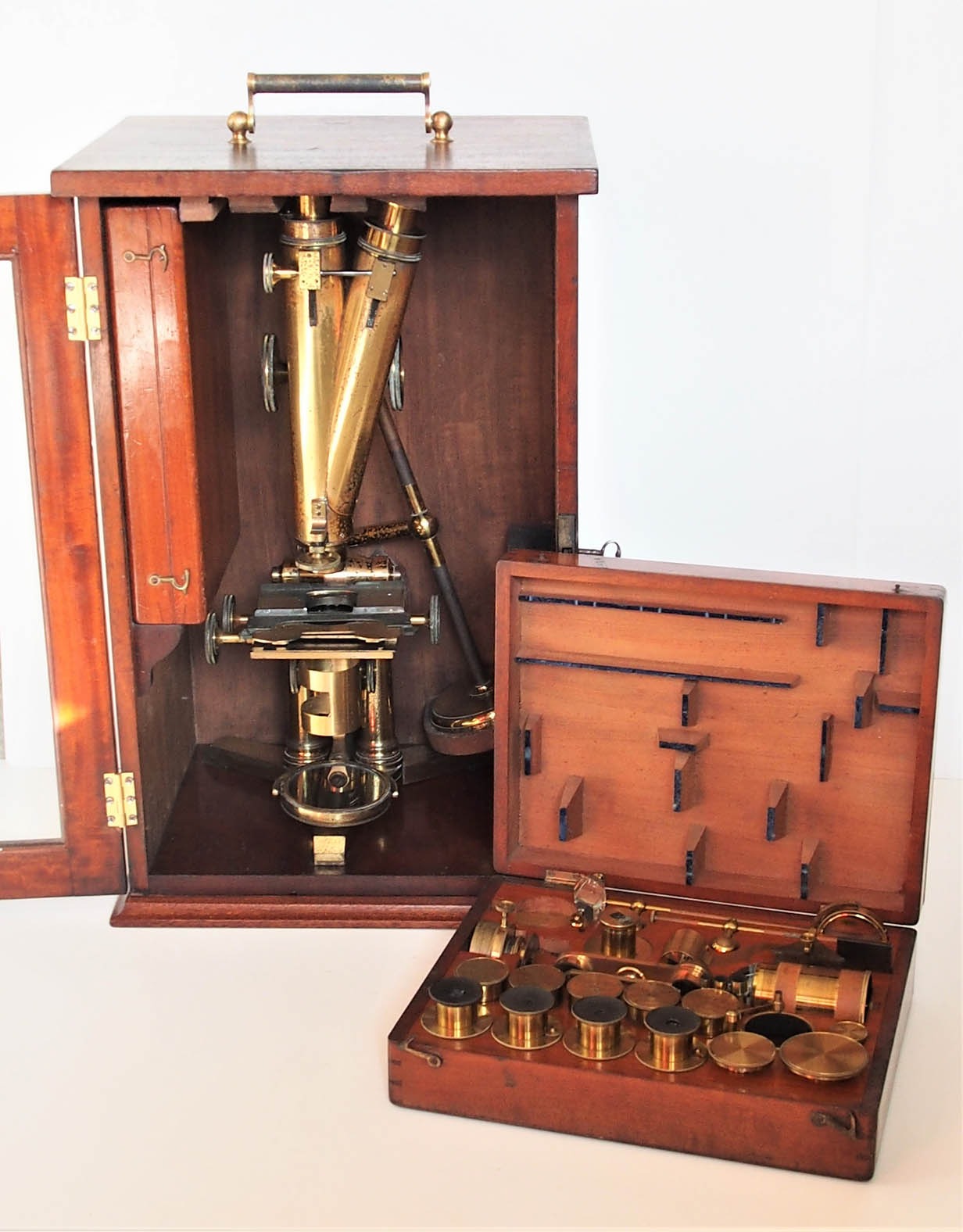
The microscope is contained in a mahogany case measuring 280 x 230 x 488 mm, and slides into the case on a fitted mahogany base with indented recesses for the feet filled in with blue velvet. There are mahogany brackets to hold the large bench condenser, as well as horizontal shelves which the two accessory cases, of which only one was present at the time of acquisition slide into. The central panel of the door is glazed, and is locked with a key.
ACCESSORIES:
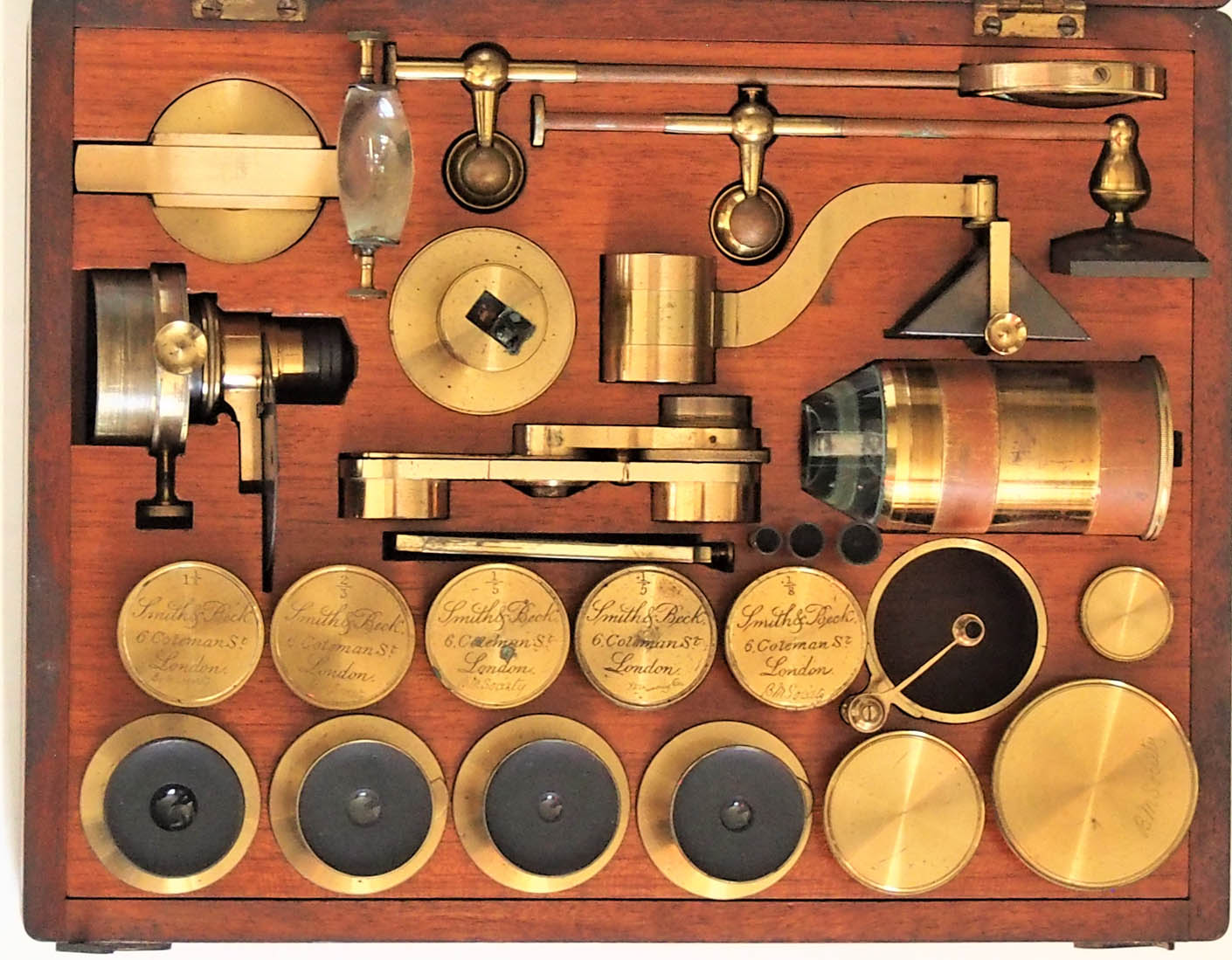
These are contained in a mahogany case measuring 270 x 208 x 78 mm. A number of these have been engraved B.M.S.
or B.M. Society
(Bradford Microscopical Society) and some have engravings with the name of F.M. Rimmington, or Dr. Kay (see below). This case slides vertically in the larger case and is an exact fit.
EYEPIECES:
There are three pairs of eyepieces, including one pair each of low (x5), medium (x8), and high power (x12). One of each is fitted with a moveable pointer, controlled with a small sector lever. One of the medium-power eyepieces has a slot through it to fit a Jackson-type eyepiece micrometer.
OBJECTIVES:
There are five objectives with this set, the majority in their matching cans. The 4/10 and 1/5 inch objectives are fitted with a correction collar with a horizontal line and engraved uncovered
. The collar is calibrated in numbers 0 to 9. The lids of all cans are engraved with Smith and Beck, 6 Coleman St, London
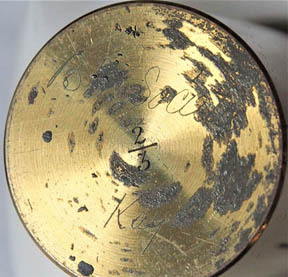
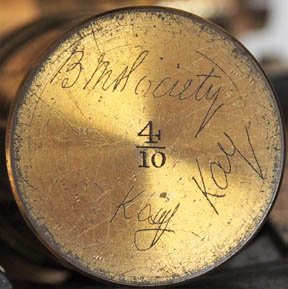
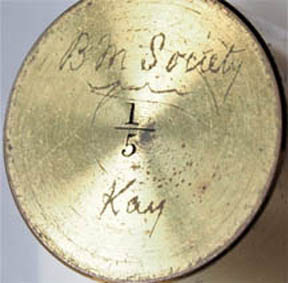
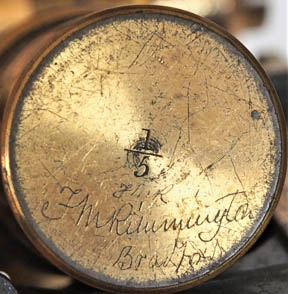
. In addition the cans are engraved with their focal lengths on both the lids and the bottoms. Some cans and/or their objectives have been inscribed with a diamond-tipped pen:
| FOCAL LENGTH |
INSCRIPTION
ON OBJECTIVE |
INSCRIPTION ONCAN LID |
INSCRIPTION ON
CAN BOTTOM |
IMAGE |
|---|
| 1 1/2 In |
- |
BM Society
1 1/2 |
BM Society
1 1/2
Kay |
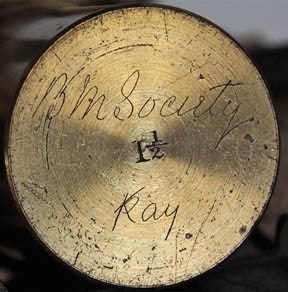 |
| 2/3 In |
- |
BM Society
2/3 |
BM Society
Kay
|
 |
4/10 In
(can lid engraved 1/8) |
- |
BM Society
1/8 |
BM Society
4/10
Kay Kay |
 |
| 1/5 In |
- |
BM Society
1/5 |
BM Society
1/5
Kay
|  |
| 1/5 In |
FMR
FM Rimmington a present from Smith & Beck |
1/5
FM Rimmington |
1/5
FMR
FM Rimmington
Bradford |
 |
LIEBERKUHNS:
There are three Lieberkuhn reflectors, respectively fitting the 1 1/2 in, 2/3 in, and 4/10 in objectives.
OBJECTIVE CHANGER:
Present is an original S & B straight Brooks-type double objective changer. This is also engraved BMS
STAGE ACCESSORIES:
A curved silvered side-reflector fits into one of the square holes in the limb. It has two ball-and-socket joints, and a sliding rod to enable adjustment in multiple positions. It has a blackened protective cap which fits over its reflective surface when not in use. A bulls-eye condenser for stage illumination has an adjustable ball-and-socket joint, and attaches to the limb in the same way as the side illuminator. Three dark wells and a holder for these are present.
SUBSTAGE ACCESSORIES:
There is an adjustable Wenham[-type parabolic dark field condenser with two slightly raised bands on the barrel which provide a friction fit within the substage condenser holder. Its central stop can be screwed up or down to achieve a perfect black background while using objectives of different power.
An achromatic condenser is in a centering mount operated by two knurled knobs at an angle of 90 degrees from each other. It has a single wheel which provides three central dark-field stops, and five apertures of different size for bright-field work. The upper optical element can be removed for use with lower-power objectives.
A right-angled prism can be used instead of the mirror when a more perfect reflection is required. A Nachet's prism illuminator can be used instead of the condenser to provide oblique illumination. It has a rotating mount, so that the specimen can receive oblique rays from all directions through a 360 deg. radius. An adjustable Amici-type prism is mounted for substage use and can be slid sideways in a dovetail slider, and also tilted to project light rays from different angles on to the specimen from below. In addition, an Amici type prism for lower power oblique substage illumination is also provided.
CONDITION:

When purchased, as shown to the left, the microscope stand and carrying case were in patinated condition, with extensive spotting and areas of tarnish, while the bottom of the mahogany case showed signs of water damage, all witness to having been stored in a damp environment for an extensive period of time. The remaining accessory case and its contents however, proved to be in excellent condition. The present owner has gently cleaned the lacquered surface of the stand, only polishing and re-lacquering the central portion of the binocular tube, where the brass had turned red-brown, thus striking a balance between preservation of patina, and improved cosmetics. The substage sleeve was missing, so a replica was made, which also involved the cutting of a new piece of rack. All mechanical parts were dismantled, cleaned, and serviced so that this microscope with such an interesting history is today once again a useable instrument. The case was sympathetically restored, with new glass, and hinges fitted. The present owner has also added a mahogany case of approximately correct dimensions for storing slides, to occupy the empty spot in the larger case.
PROVENANCE:
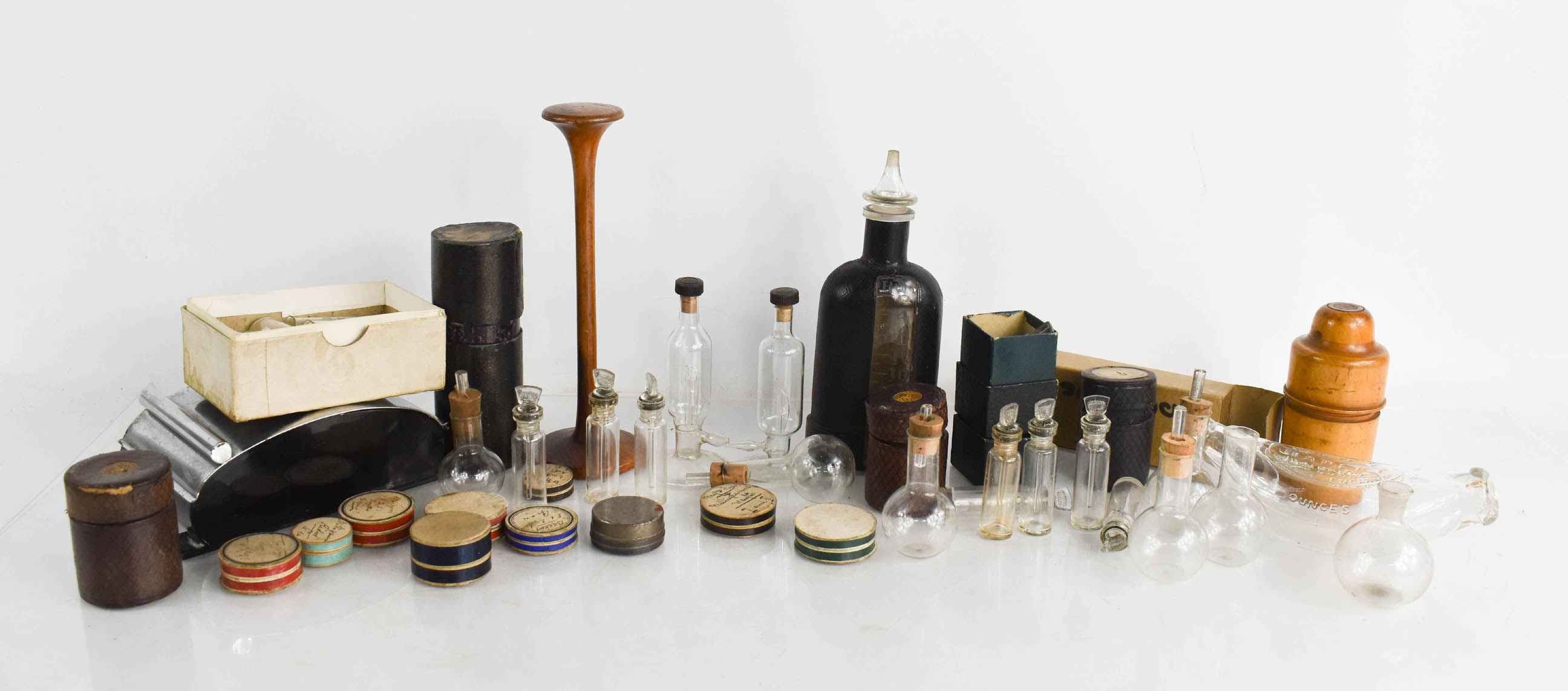
This microscope was part of a consignment of items, some of which are shown here to the left, originating from F.M. Rimmington's Pharmacy sold at auction at The Stamford Auction Rooms in Bradford on 30 April 2022. Smith and Beck's delivery book records that No 2841, a Large Best stand, was sold to F.M. Rimmington
in March 1862. However,there are a considerable number of other listings in this delivery book which record a sale to Rimmington. We can speculate that, being a founder member of the Bradford Microscopical Society, he may have been an unofficial agent for Smith & Beck in Bradford, supplying other members of the BMS with microscopes from his pharmacy. The recorded personal gift of a 1/5 inch objective to him (presumably to thank him for his services/mediation) by Smith & Beck seems to point in the same direction.
SMITH & BECK RECORDS:
Smith & Beck's records indicate that microscopes across their entire model and price range thus moved through Rimmington's hands to buyers, all in all comprising 23 microscopes:
LARGE BEST (No 1):
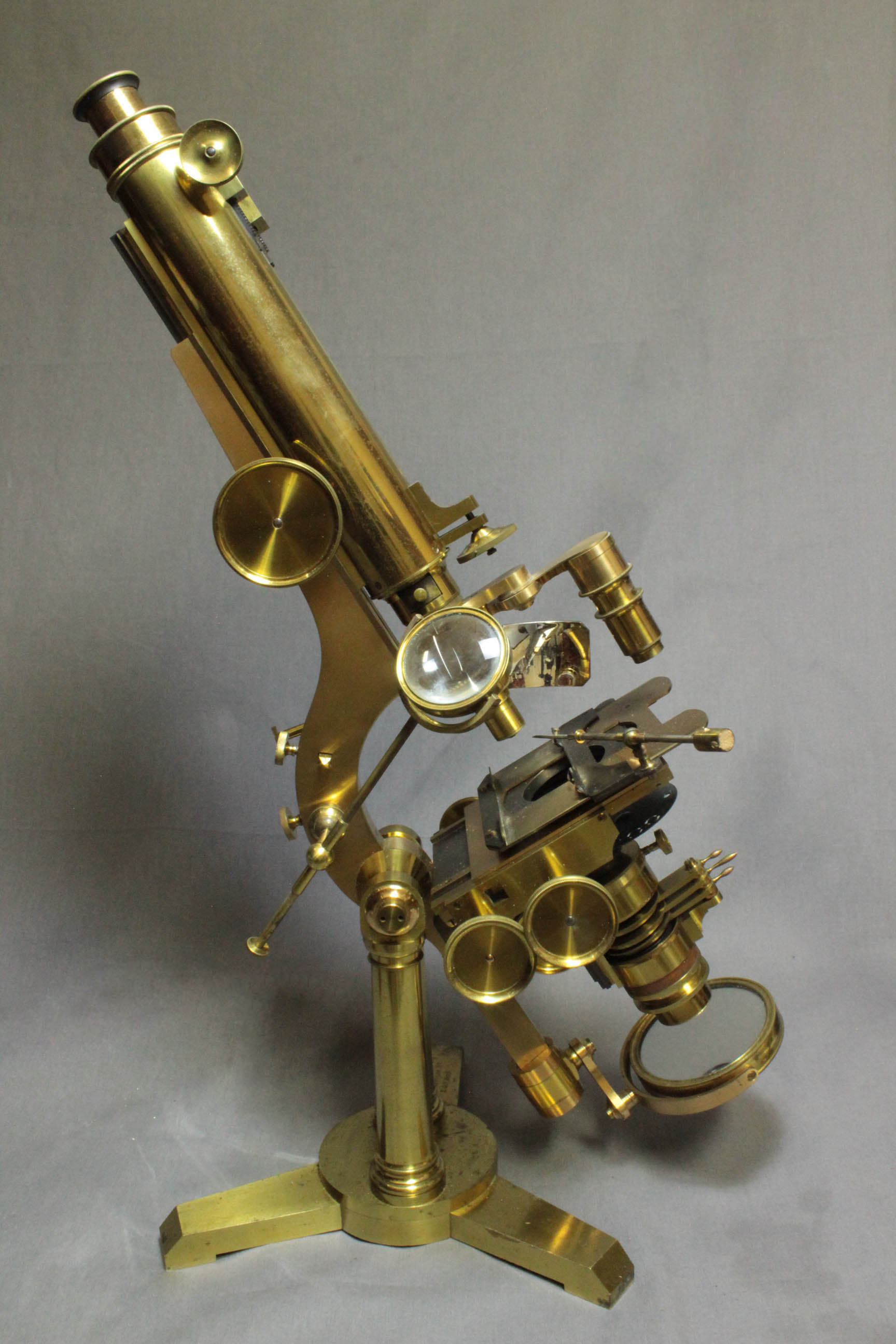
Date Serial No
1529 2/7/1858
2222 3/1860
2674 3/1860
2841 3/1862 (his own, and this particular example)
3040 3/1863
SMALL BEST (No 2):
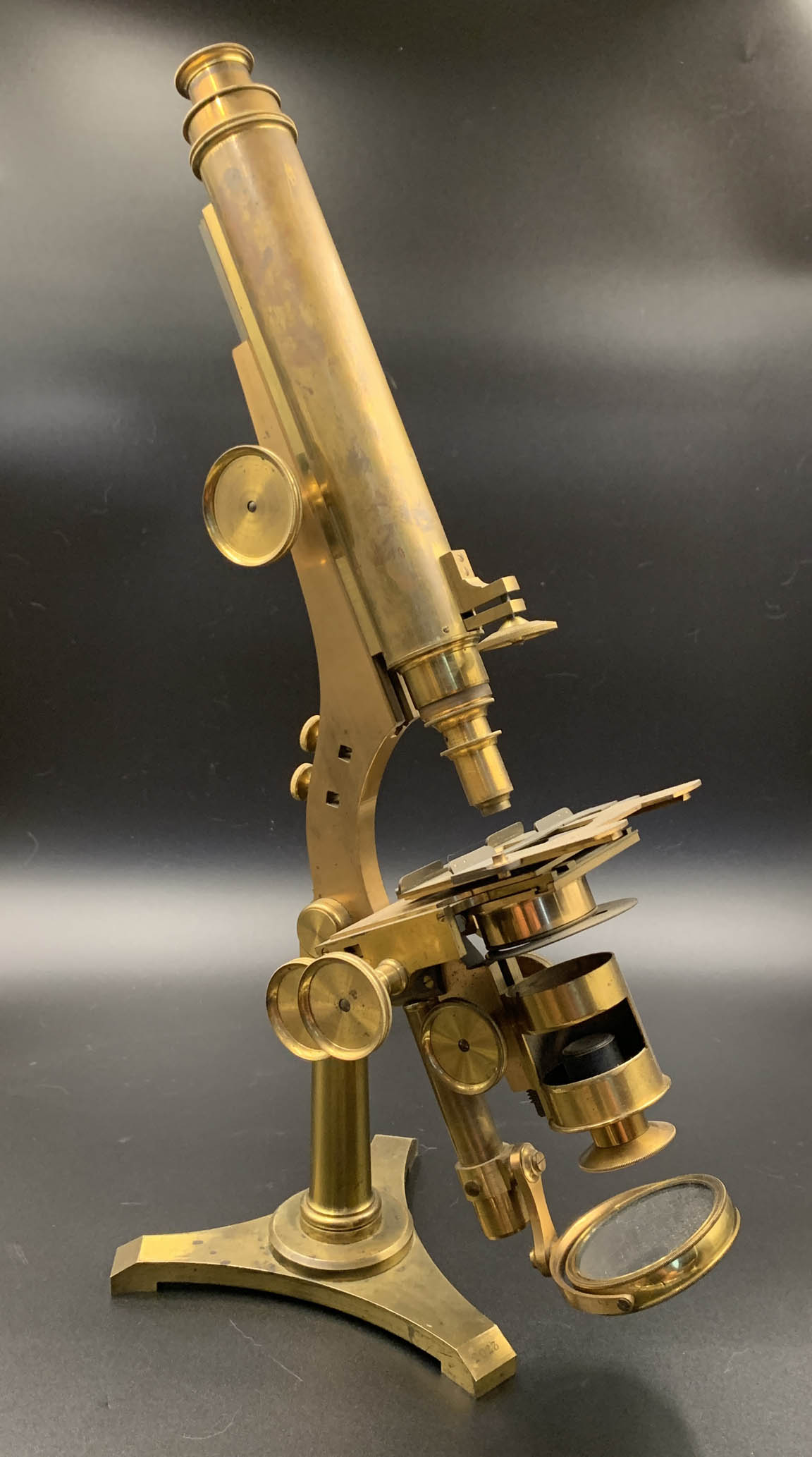
Date Serial No
2009 1/1859
STUDENTS BEST (No 3):
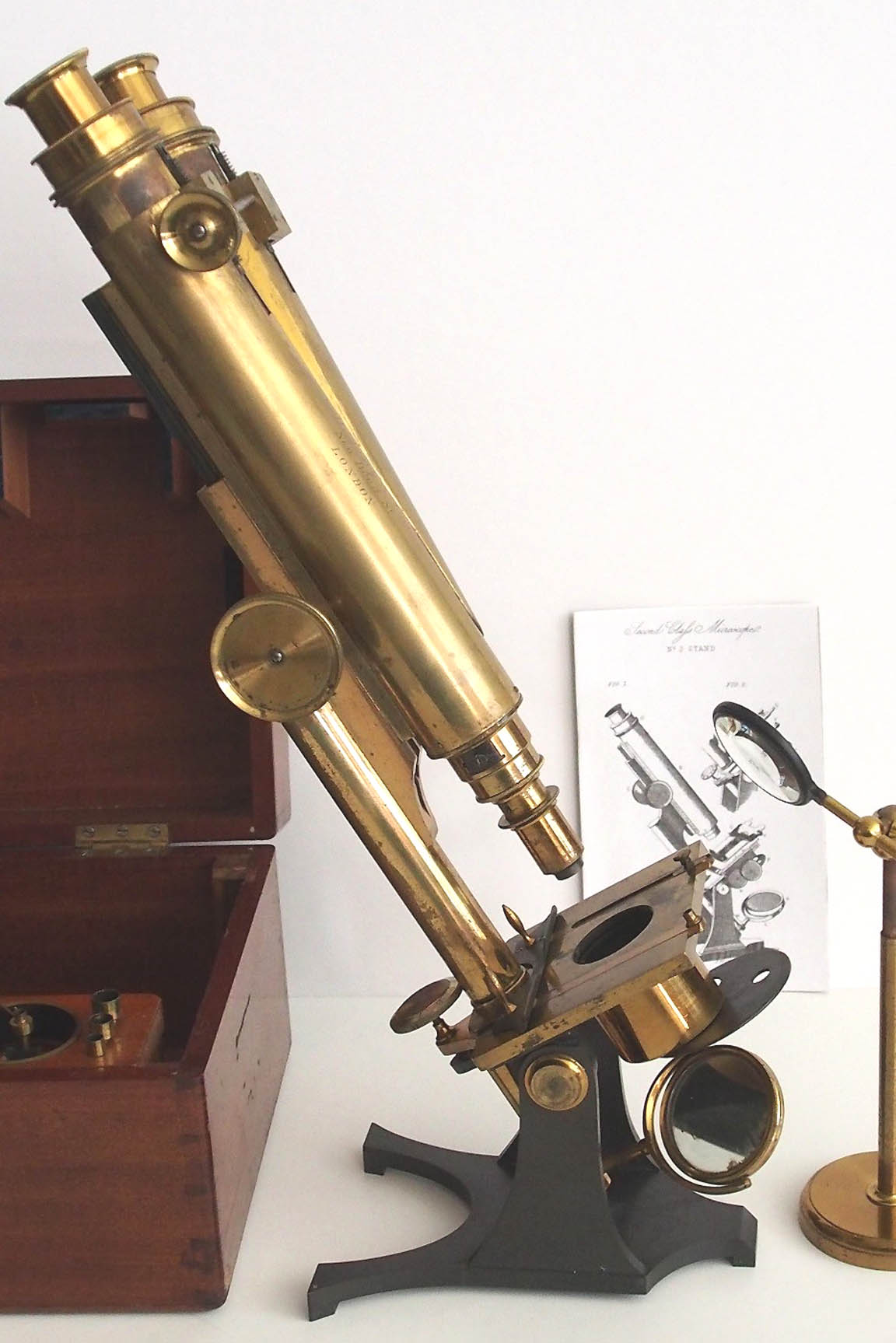
Date Serial No
1829 3/1859
1845 7/2/1858
1854 7/17/1858
EDUCATIONAL:
Date Serial No
1739 4/23/1858
1783 12/1858
2565 3/1862
2571 2/1861
2590 3/1862
2714 3/1862
2735 3/1862
UNIVERSAL:
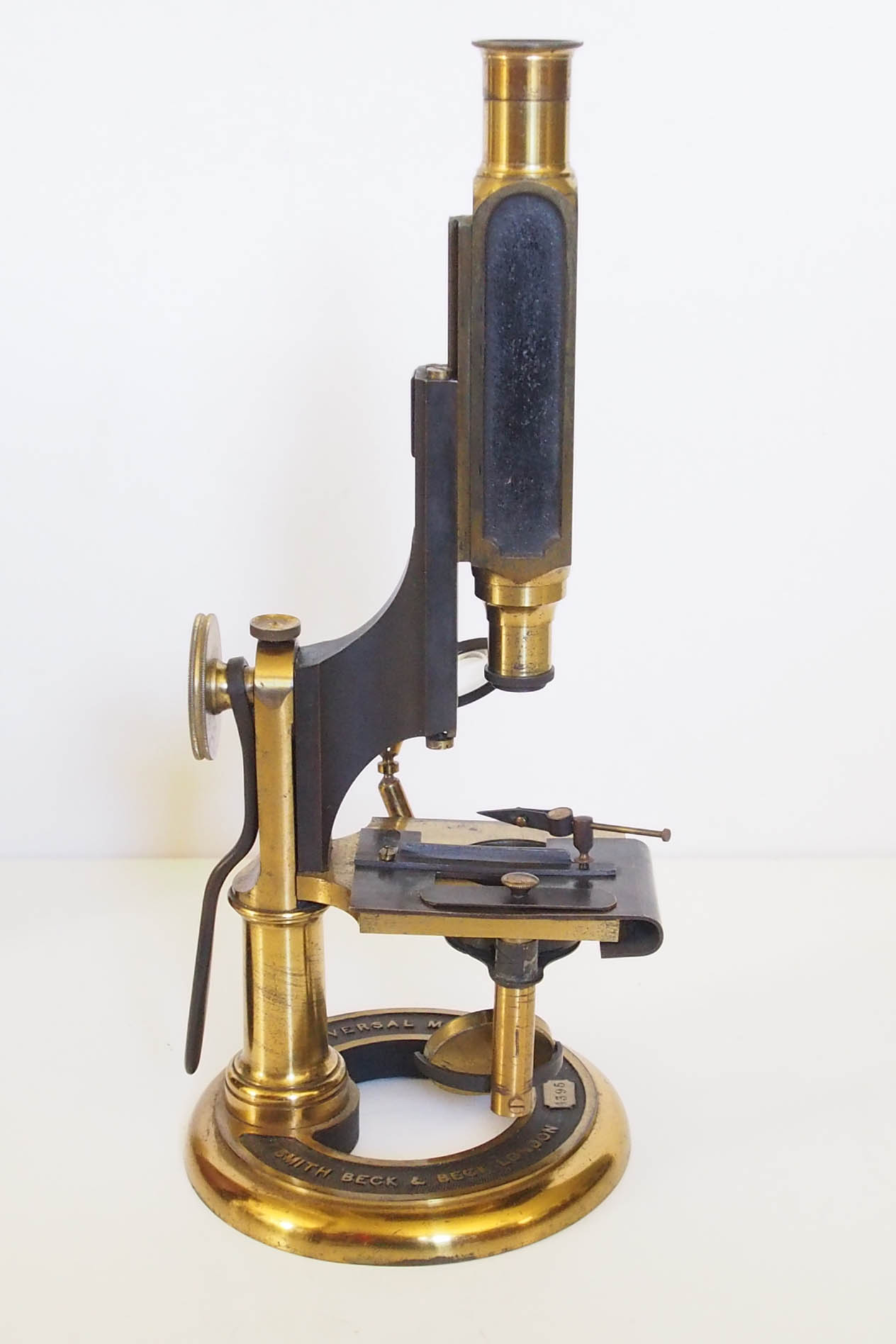
Date Serial No
2979 3/1863
2981 3/1863
3089 3/1863
3121 3/1863
3175 3/1863
3214 3/1863
3218 3/1863
HISTORY OF THE SMITH & BECK LARGE BEST MICROSCOPE:
James Smith was born in 1800, and it is known that initially he worked for the trade, part of this time as the foreman for Tulley the telescope maker. In this capacity he reportedly finished the brasswork for a new model achromatic microscope for Joseph Lister, which can be dated to 1826. It is likely that he continued to make this design of microscope for a number of years, as retailed by Carpenter & Westley, and others, sold in non-achromatic form. Smith left Tulley's employ in 1838, to set out under his own name, producing his own first microscopes in 1839. Unlike for Ross and Powell & Lealand in the triumvirate of major London makers, the original delivery books of James Smith have been preserved, along with an abbreviated notation of models sold, e.g. initially 'Plain' for microscopes without a mechanical stage, and 'Best' for those with. The earliest of his his 'Best' models featured a single pillar arising from a tripod foot, with cross-bracing to the body tube to reduce vibration. This was soon replaced by instruments which had their body mounts ploughed by a machine devised by George Jackson, who was the first to obtain an example of this type. Stand No 22, later fitted with a lever stage, went to Dr. Thomas Hodgkin, of Guy's Hospital, and features as noted on that page on this site. Stand No 41 went to Joseph Lister. No 43 was one of the three original microscopes ordered by the London (later Royal), Microscopical Society from the Ross, Powell, and Smith. By 1843 a two-pillar version had been introduced, initially designated as an 'Extra Large Best'. In both models, substage accessories were fitted in a dovetail slider which inserted below the bottom plate of the stage. In 1846, No 147, a twin pillar 'Large Best' microscope, was sold to Charles Darwin. No systematic nomenclature was adopted until 1847, when Richard Beck had joined the firm, which then became Smith & Beck, and had moved to 6 Coleman Street. As the single-pillar model continued to be produced alongside the two-pillar version, the former was then referred to as the 'Small Best', and the latter as the 'Large Best'. These models were available with three types of stage: the first had the heads parrallel to, but below, the surface of the stage, in an arrangement as used on earlier instruments (see also the early Ross model elsewhere on this site), and maintained for those with a folding base. A second, larger mechanical stage was introduced by 1843, with the heads at right angles to the stage. Finally, a number of stands were made with a lever stage. These alternative features continued to be available when, in 1851, the 'Best'and 'Small Best' models were replaced by 'Improved Large' (No 1) and 'Improved Small' (No 2) instruments, which featured two important innovations: firstly, at the suggestion of George Jackson, the limb was extended below the stage to provide a mount for the substage. The slideways for both the limb and substage were cut at the same time, ensuring good alignment for the achromatic condensers which had been available on Smith's microscopes from 1840 onward. This new design thus introduced the features characteristic of the classic pattern of a monocular microscope, sometimes referred to as the Lister-Jackson or Jackson limb model. A second major innovation was the adoption of standardized production methods such that interchangeability and addition of accessories was possible. For many years, the 'Improved Large'continued to be made with a square stage fitted with a top plate which could be rotated by hand. In 1857 the partnership was joined by Richard's brother, Joseph, the firm becoming Smith, Beck & Beck. By 1866 the square stage was replaced by a circular one, which could be rotated by means of a rack and pinion mechanism, and could be disengaged for manual rotation. When James Smith retired in 1865, the company became R & J Beck, which continued to produce the 'Ímproved Large' model into the early 1890's.
THE ORIGINAL OWNER: FELIX MARSH RIMMINGTON (1818-1897):
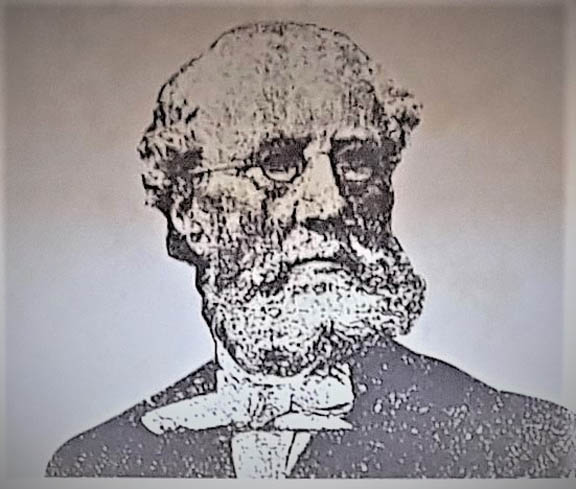
Felix Marsh Rimmington was born on February 14, 1818 at Gateforth in the parish of Brayton (near Selby), North Yorkshire to William Rimmington, a farmer, and Lucy Marsh. He had 9 younger siblings, and, at age 4, he came to Bradford to live with an uncle who was a chemist, before returning to Gateforth for his education. He was later apprenticed to Mr Fell, a Huddersfield Chemist, and also served as an assistant to Mr P Squire of Oxford Street, London, the chemist to the Queen. After learning from the best, Rimmington established his own chemist shop on 40 Ivegate, Bradford in 1842, where he also became a maker of glass apparatus for chemical tests in 1850. In November 1846 an experimental trial of gun cotton blasting prepared by Mr Rimmington for mining purposes took place with most satisfactory results. Felix Marsh Rimmington was a Druggist
when he married Elizabeth Elgey on 21 February 1846 at St Peters (Bradford) cathedral. They would have 4 children, born between 1848 and 1857.
Rimmington was no ordinary chemist; he was very passionate and committed to his profession, often going above and beyond the call of duty. He was keen to share his knowledge with colleagues to help them develop their skills and knowledge. He travelled the country reading his papers at chemistry and pharmacy conferences, and was elected a Fellow of the Chemical Society. He regularly wrote papers based on his investigations and research for international scientific journals, to be read by other chemists. Rimmington was ahead of his time. By 1855, he was analyzing food to detect adulterations to bring about legislation, years before the passing of the Sale of Food and Drugs Act in 1875, which made the unadvertised tampering with food and drugs illegal.
By 1857 the local authorities were approaching Rimmington to acquire his analytical skills and services for criminal investigations. In that year, he assisted the police in investigating a case of suspected poisoning and murder. Rimmington analyzed the contents of the deceased's stomach, and detected a quantity of prussic acid (cyanide), of which there was enough to cause death. One of the most famous cases Rimmington was involved in was the 1858 Bradford lozenge poisoning case, (the infamous Humbug Billy
sweet poisoning), when sweets were accidentally laced with arsenic. This occurred when, instead of an inert filler (daff), arsenic trioxide, also a white powder, was sold by mistake to a sweetmaker, and 5 pounds of the end product sweets were sold from a market stall. Twenty people died as a result, and hundreds became gravely ill. Rimmington analyzed the suspected poisoned sweets, identified what poison was in them, and how much. At court, he was able to state that each lozenge contained 9 grains of arsenic, half of which is sufficient to kill.
Rimmington was obviously a man of many interests, for in 1860 he became one of the founding members of the Bradford Microscopical Society (BMS), which held its meetings at the nearby St George's Hall. He must also have had a strong social conscience, as in 1862 he had a letter published in the Bradford Observer newspaper, which warned ladies about poisonous dresses made from tartan cloth dyed with a green coloring containing arsenic and copper. In 1862, Rimmington's paper: Of Fungous Destruction of Lozenges in a dry Athmosphere
, was read before the Royal Microscopical Society. In 1865 The Lancet published his letter which described a new successful method of treating tapeworms.
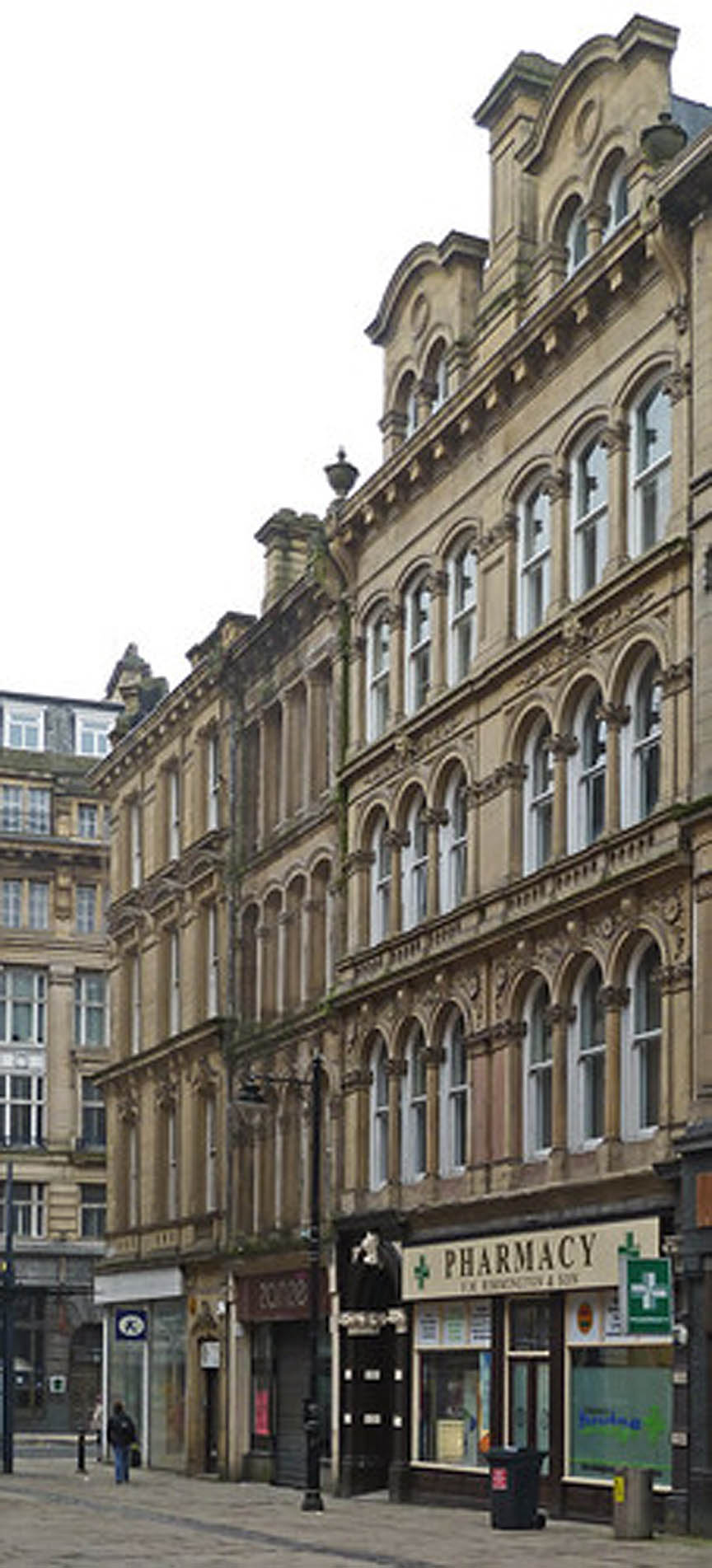
In 1875 Rimmington moved his premises to Bridge Street, where a pharmacy, continuing to bear his name(left), still exists today. In the previous year the local authorities officially recognized his unique skills, expertise and services by appointing him borough analyst
. Rimmington became a key cog in enforcing the 1875 Sale of Food and Drugs Act in Bradford and the surrounding districts. When substances sold in Bradford were suspected of tampering, Rimmington was sent samples to examine. Some of his findings included watered-down milk, and cider that was really molasses, dirty water and fusel oil, a mixture of non-ethanolic alcohols, mainly amyl alcohols. One shocking case he dealt with in 1879 was a sample of 'butter' that he determined to contain 0 % of butter. He continued to assist the police with suspected poisonings by analysing drugs found at crime scenes or examining bodies. In December 1888 Rimmington was involved in a more gruesome and disturbing investigation. The police had asked him to investigate a suspected Jack the Ripper-style murder in Bradford. The remains of eight-year-old John Gill had been discovered, after he was reported missing. His body had a noose around the neck, and was horribly mutilated. One ear had been cut off, limbs dismembered, and his organs removed and placed on him. His chest cavity had been cut open and his shoes placed inside. The police and press were quick to compare this to the then current 'Jack the Ripper' murders in Whitechapel, London. Rimmington investigated the crime scene and the body, checking nearby drains and sewers for discarded evidence. He examined the stomach contents, and found currants from a currant bun eaten just before the murder. A suspect was questioned, but released as the investigation reached a dead end. Was this a case of a copy-cat crime, or had the real Ripper moved north from London? Even today, Jack the Ripper historians and investigators, including crime writer Patricia Cornwell, consider the latter scenario a real possibility. It is not surprising therefore that Rimmington became known as Bradford's very own Sherlock Holmes, a character invented by Sir Arthur Conan Doyle in 1886, but originally modelled on one of his own university teachers, Mr Joseph Bell.
If not a detective, as a chemist, Rimmington can be rightfully regarded as one of the first Crime Scene Investigators, a Victorian 'CSI'.
Felix Marsh Rimmington died at the age of 79 years on 17 June 1897, one year after his wife Elizabeth's death at the age of 82. Both are buried at the Undercliffe Cemetery in Bradford. His son George continued running the family business until his own death in the 1940's. The pharmacy was then run by the Hirst family for three generations. The Bridge Street pharmacy was purchased by Cohen's Pharmacy in 2000, and then became Lloyds Pharmacy. It had the Rimmington's name restored, and went back to being an independent pharmacy in 2009, when two local pharmacists bought it. They have set out to preserve the intriguing story of their predecessor, before it is lost in the depths of time.
THE BRADFORD MICROSCOPICAL SOCIETY:
The work of J.J. Lister on eliminating the problems of chromatic and spherical aberration, which had previously hampered serious observation, had implications for aperture, resolution, and magnification, and transformed the value of the compound microscope. This opened up opportunity for any owner of such instruments to make new discoveries in the natural world, and as a result, there arose the desire for individuals with similar interests to meet and communicate. The first specialist microscopical society, the Microscopical Society of London, was formed in 1839. Its earliest members included botanists, naturalists, doctors, and clerics, and the first President was Richard Owen, an anatomist. The purpose of the society was 'the advancement of the science of the microscope', and it was to be primarily concerned with the needs of the microscopical investigator and was not to be a subdivision of any other scientific grouping. This multidisciplinary aspect was both the society's strength and its weakness. Many of the members were involved with other societies, catering for disciplines such as geology, palaeontology, or were members of the Linnean or Royal Society. The Society had difficulties in organizing the publication of a regular journal, due to lack of contributions, but eventually culminating in the Monthly Microscopical Journal (later the Journal of the Royal Microscopical Society). The pages of these journals also reveal the large numbers of provincial microscopical societies which were being established along the same lines as the London Society during the middle of the 19th century. Reading and Bradford Microscopical Societies were founded in 1860, Oxford in 1864, and Liverpool in 1868.
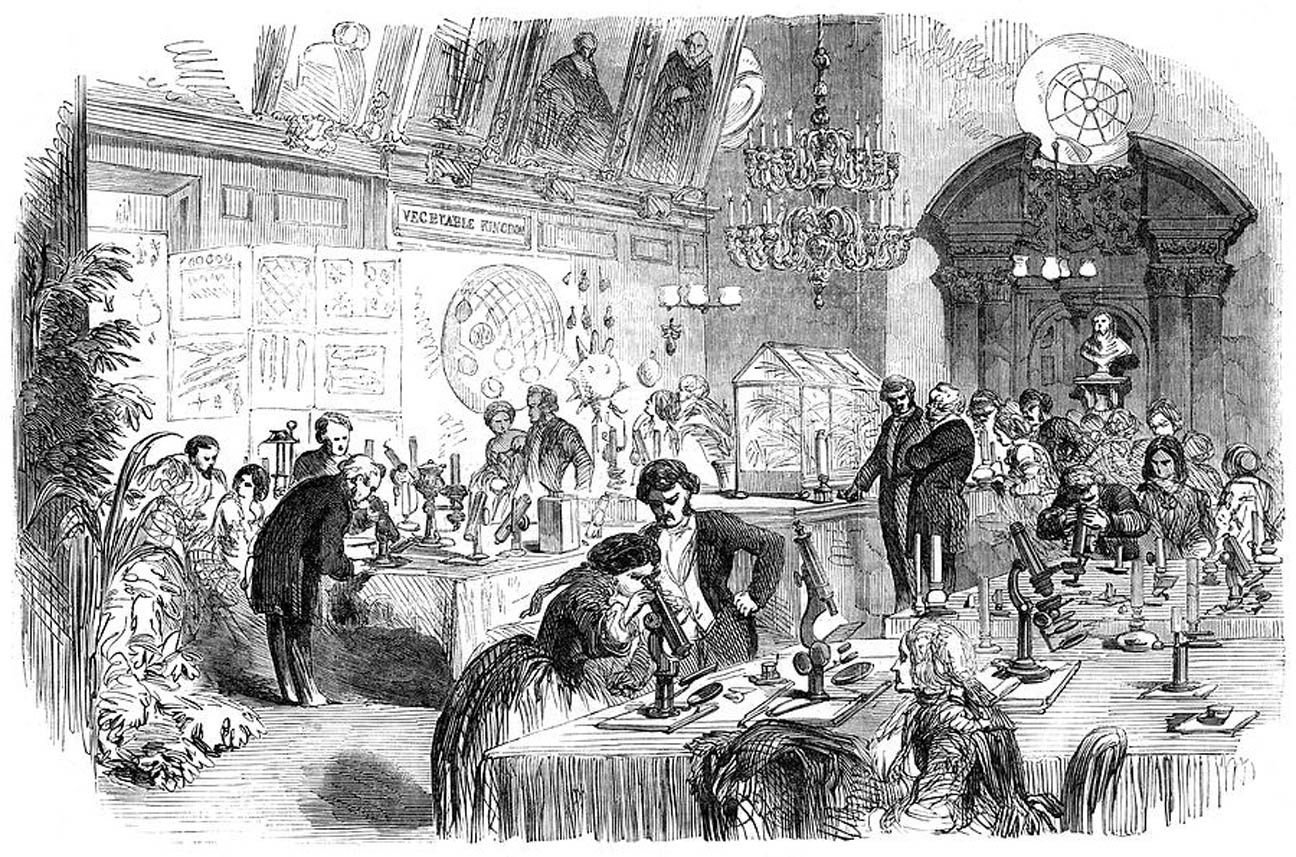
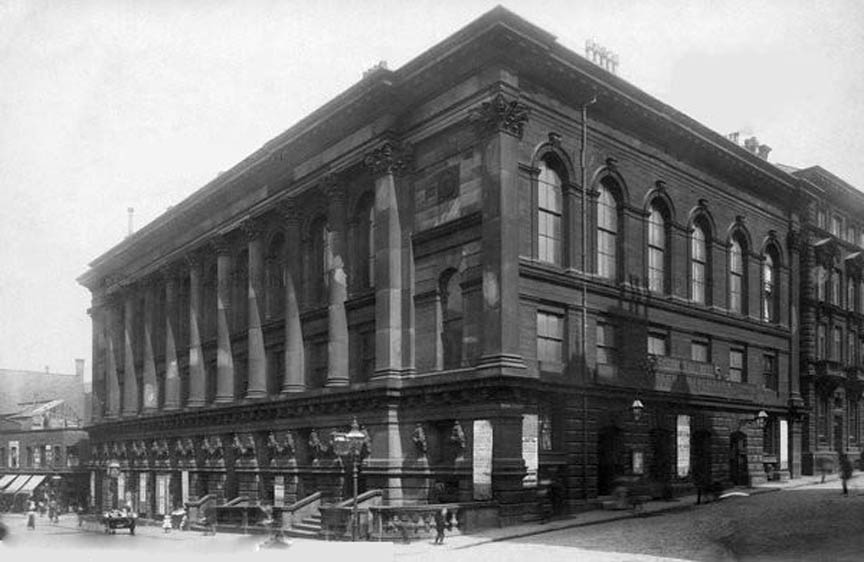 The Bradford Microscopical Society usually met in St Georges Hall, shown to the left. It appears that the Bradford Microscopical Society operated along similar lines as its counterparts elsewhere. A number of different meetings were held each year, some of these known as 'Conversaziones', and other meetings as 'Soirees', often including dinner arrangements and other entertainment such as music. This image to the right shows a 'Scientific Conversazione' held at the apothecaries' Hall from the Illustrated London News in 1855. The account of the occasion ran:
 The wonders of the microscope formed the subject of the evening's entertainment, and never before perhaps in the history of optical science......has the philosphical enquirer been so fully furnished with means... to behold the greatness and wisdom of the Almighty, as displayed in the minutest objects of creation
. As the image suggests, members often travelled (presumably utilizing horse-drawn transport) to these meetings, bringing their microscopes and a selection of their most interesting slides to show others, and what's more, the press also showed an interest in their endeavours. Felix Rimmington must have been one of the founding members of the Bradford equivalent of such a Society, and we can gain an impression of its meetings through - to our modern standards - rather longwinded and floral reports in the contemporary press:
BRADFORD OBSERVER 11 November 1860. Bradford Microscopical Society. It is probably not generally known that for some time a society under this name has existed in our town, its object being to encourage and to systematise the use of that wondrous instrument, by which we are enabled to show that every atom is a world, that is, in the firmament above, so on the globe we tread, system after system, in infinite retrogression, contains within it the reduplication of itself. Impressed by a belief both in the utility and interest of microscopic study, the members of this society prepared an entertainment adapted to conduce both to the pleasure and profit of their friends. The soiree was announced for Tuesday evening, and shortly before eight o' clock the area of St. George's Hall, in which the seance was given, began rapidly to fill with the invited guests. The room was quickly crowded, and presented a scene of brilliancy strongly suggestive of the soirees held the same room twelve months ago, in connection with the meetings of the Social Science Association. Along the centre of the room, running longitudinally, was a series of tables, furnished with microscopes belonging to the several members of the society, many of them of great magnifying power, and all of them, as the modern microscope invariably is, exquisite specimens of mechanical accuracy and skill. Each microscope was attended by its owner, who was ready with the utmost courtesy and clearness to explain the objects he happened to exhibit. At the further end of the room was a very beautiful collection of photographic views, stereoscopes, and other objects of interest, among which we noticed with especial pleasure a stereoscopic photograph of the moon. Those of our readers who know anything of photography, know the difficulty which was so long felt in preparing chemicals susceptible to the influence of lunar rays, and the satisfaction which was felt in the photographic world when the thing was finally accomplished. The table which attracted the largest share of interest was the one attended by Mr. Meade, the president of the association. The unfortunate subject of Mr. Meade's investigation was a frog, the vigorous circulation of whose blood, as seen through the glass, abundantly proved the truth of the theory proposed by Harvey more than 200 years ago. A series of objects exhibited under polarised light by Mr. Laycock excited much attention, as also did an exhibition of animalculae in water, another of blood globules, another of sections of coal, another of the palpitating heart of an unpronounceable Entonomostraca. The entertainment was continued until nearly eleven o' clock and during the evening the material wants of the company were supplied by the provision of refreshments in quantity by no means microscopic. After expressing our personal gratitude to the Microscopical Society, we can only wish that we had existing other institutions of a kindred nature, and that their members were equally willing to lay themselves out for the instruction and pleasure of their friends.
Reports on subsequent meetings covered by the local papers provide a more detailed insight in the activities during these gatherings, and Felix Rimmington, as well as his friend, Dr David Kay, a medical practitioner, also get a mention:
Soiree of the BMS, BRADFORD OBSERVER, 17 Oct. 1861: The way in which God's creation extends to infinity below as well as above the reach of our vision was farther illustrated by the sections on Infusoria (animalcules in water), Acari (mites), Etomostraca (water fleas), Proboscis and Tongue of the Blow Fly, and the Eggs of Butterfly, exhibited by Messrs. Buckley, Miall, Mossman, Broadbent, and Rimmington
, and: Last, but not least in this section, we notice the splendid manner in which the peculiarities of moss fructuation were brought under Dr. Kay's binocular
. The presence of a number of objective holders engraved with Kay's name would suggest that his was also a Smith & Beck binocular microscope, likely a Large Best model. The third Annual Converzatione of the BMS is covered by the BRADFORD OBSERVER, as well as the BRADFORD REVIEW newspapers, in October 1862: The table of the President, Mr. Meade, was in front of the orchestra, and that of the Secretary, Mr. Rimmington, at the opposite end of the room, six other tables occupying the sides. Upwards of thirty microscopes with numerous beautiful objects for exhibition were arranged upon the different stands by the gentlemen who contributed to the entertainment and instruction of their friends
. And: The Flea was, perhaps, the lion of the evening, especially among the ladies, although our old acquaintance the frog's foot, or more correctly the circulation of blood in the frog's foot, exhibited under Dr Kay's glass, was not without enthusiastic admirers
. In this report, there is also an indication that, at this time, Felix Rimmington may have possessed more than one microscope: Minute siliceous bodies, called Heliopelta, were placed under one of Mr. Rimmington's glasses, and the siliceous hairs of a plant under that of Mr. Bruce. The latter gentleman also exhibited, by polarised light, a fragment of crystalline limestone of which Egyptian pyramids are built. Mr. Rimmington showed, by polarised light, under his second binocular, a section of a cat's tongue, armed with the horny papillae or recurved spines, by means of which animals of the cat kind are enabled to lick or scrape the flesh from bones of their prey
. The fourth Annual Conversazione is reported on in the BRADFORD OBSERVER of 19 November 1863. On this occasion, the reporter takes a more comprehensive approach, and reproduces a full list of objects and their exhibitors, which - from a historical perspective - gives an interesting overview of the things these Victorian gentlemen were interested in examining under their 'Brass and Glass'- era microscopes:
1. Sections of Rhinoceros Horn, showed by polarised light, Mr. Laycock
2. Animalcules, and the circulation of the Sap in a Water plant, the Rev. W. Kelly
3. Woody Fibrous Tissues found in coal in the district, Mr Gurney.
4. Parasitic insects (Acari?) from a Water Rat, Mr. Barwick.
4a. Polycystystinious Shells, M. Barwick.
5. Miscellaneous Objects, Dr Lewis.
6. Physiological Specimens, Mr. Sugden.
7. The Eyes of a Spider, Mr. Garnett.
8. Anchor-shaped Spicula from the skin of Synapta (an animal belonging to the star-fish tribe), Mr. Horsfall.
9. Wing Cover (Elytron) of a Chinese Beetle, Mr. Wright.
10. Muscular Fibres, and Fibrillae of the lens of the eye, Mr. Buckley.
11. Eye of a Rat, Dr. Bronner.
12. Compound Eyes of Insects, Mr. Prince.
12a Portrait of Shakespeare, viewed through the compound cornea of a Fly's eye, by which the image is multiplied 500 times, Mr. Prince.
13. Colour Cells, seen in the Petals of Flowers, Mr. Knowles.
14. Crystallization of Salts viewed by polarised light, Mr. Asquith.
15. Sections of some species of Dye Woods, Mr. Woods.
16. Volvox Globator (Globe Animalcule), Mr. Abbott.
17. Eye of a Tortoiseshell Butterfly, Mr. Rimmington.
18. Sting and Poison Gland of a Wasp, Mr. Rimmington.
19. Spirorbis, a minute Marine Annulose Animal, Mr. Rimmington.
20. Anguillulae Glutinis (Past Eels), Mr. Shorrocks.
21. Vascular and Cellular Tissues of Plants, Mr Newboult.
22. Foraminifera, Minute Marine Shells, Mr. Sands.
23. Tongue of a Mollusc (Trochus Ziziphinus), Mr. Lupton.
24. Infusory Animalcules, Mr. Mossman.
24a.Peristome of a Moss, Mr. Crabtree.
25. Milk, Microscopical characteristics of, Mr. Stephenson.
26. Flustrella Hispida (Zoophytes) plant like animals, Mr. Miall.
27. Eye of a Beetle, Mr. Ward.
28. Young Oysters, Mr. Godwin.
29. Section of Cuttle Fish Bone, viewed by polarised light, Mr. Taylor.
30. Circulation of the Blood, Dr. Brown.
It is important to note that here there is no longer any mention of Dr. David Kay, for he died earlier that year. Otherwise, had he still been alive, he would probably have exhibited the final object in this list. It is also observed that:
We missed some of the old objects, and also a few of the usual exhibitors. The Society is subject to usual laws of mutation and mortality. Death has removed some of its earlier supporters, and the ordinary changes of life have sent some to other spheres of labour
One more dinner party of members is reported in the BRADFORD OBSERVER of 8 Dec. 1864, whereby Covers were laid for twenty
, but it appears that apart from wining and dining, no microscopes were employed. Subsequently, one further meeting is recorded in the same newspaper of March 1st, 1866, in which Mr. Louis Miall read a paper. The Application of the Microscope to Palaentology
. After these years of active participation, members of the BMS may have become distracted by their other interests and activities, for, in December 1868, The BRADFORD OBSERVER reports that: The Bradford Microscopical Society, which has been in abeyance for about two years, has just resumed operations
, it having been resolved two weeks earlier, that: ...on the motion of Mr. Behrens, seconded by F.M. Rimmington, that the Bradford Microscopical Society should be resuscitated
. It would seem that thereafter the BMS never regained its original vitality, as, in 1875, a merger takes place, and we see the institution of the Bradford Natural History and Microscopical Society. As per sporadic reporting in the local press, this entity appears to have survived into the 20th Century.
DR KAY, ORIGINAL OWNER OF SOME OF THE OBJECTIVES WITH THIS SET:
Although his exact date of birth has remained elusive, we know that David Kay was born in about 1817 in Scotland, obtaining his MD at Edinburgh University. The Medical Times and Gazette of June 30, 1855, confirms that he obtained his membership of The Royal College of Surgeons (MRCP) through examination that year, as well as passing the examination in the Science and practice of Medicine at the Apothecaries Hall, i.e. his license to practice, standard requirements in those times for those wishing to enter General Practice. The census of 1851 finds him living - then aged 34 - as part of the household of James Douglas, MD, MRCS (Edinburgh), at 14 Drewton Street, Bradford, most likely as part of his training. During the following census in 1861, Kay is aged 44, and working as an M.D. in General Practice
, at 21 Houghton Place. Also listed as present at the address on census day are one George Payne, 'visitor', aged 39, Attorney and Solicitor, of Ipswich, Suffolk
, and Ann Turnbull, housekeeper, aged 43. All are recorded as being unmarried. As per the reporting of the Bradford Microscopical Society meetings, David Kay must have been an active member at that time, and also owned a binocular microscope, presumably a Smith & Beck instrument, given the S & B objective cans inscribed with his name. He used this at the soiree of October 17 1861, an earlier date than the stand we describe here, which was despatched to F.M. Rimmington in March 1862. Smith & Beck did not bring out their binocular on Wenhams' final design until late 1860, after which many owners had their monocular instruments modified to a binocular arrangement by the firm, so Dr Kay's microscope may have been one of the Large Best, or Small Best, stands procured through Rimmington which carry lower serial numbers, as there is no record of a sale to a Dr Kay directly in the S & B delivery books for this period. Unfortunately, by then poor Dr Kay did not have long to live, for he died on March 20 1863, aged 45. The Journal of the Bradford Historical and Antiquarian Sociey records: Of David Kay, M.D., who died in March. 1863, aged 45, it was said, that he never, when well, neglected a call from rich or poor, and was a favourite with all
. His will was read on June 10 1863. The executors are Joseph Smith, surveyor, and Felix Marsh Rimmington, chemist, both of Bradford. The effects were estimated to be below GBP 2000. It is likely that Dr Kay's microscope and accessories were bequeathed to the Bradford Microscopical Society, given the four objective cans which are simultaneously engraved with his name, and 'BMS'. Subsequently, it is also likely that some of the accessories became mixed up, perhaps at a meeting, which would explain their presence with Rimmington's own instrument. From Dr Kay's brief obituary mention, it is plausable that he died from a chronic illness, possibly tuberculosis, perhaps contracted as a result of professional exposure, although all of this remains speculation. It is somewhat of a worry that, five months before his death, he was still at close quarters with others taking a peek through his binocular. But then, the cause of consumption
(tuberculosis), and other contagious diseases was as yet unknown, and it took another 23 years for Koch to discover the small Tuberculosis bacteria......also with a microscope.
BIBLIOGRAPHY:
Beck, R. A Treatise on the Construction, Proper use, and Capabilities of Smith, Beck & Beck's Achromatic Microscopes; 1865; John van Voorst, London.
The British Newspaper Archive
Broomfield, D. Felix Marsh Rimmington biography. www.undercliffecemetery.co.uk/about/history/
Brown, O.,Butler, S., Nuttall, R.H. The Social History of the Microscope. Whipple Museum Publications.
Burnett, W. A. S. Darwin's Microscopes. Microscopy (QJM) Vol 36 (1992) p. 604-627.
Martin, L. V. Francis Wenham and the Microscope. Microscopy (QJMS) Vol 32 (1973) p. 281-295.
Medical Times and Gazette, 1855.
Nelson, E.M. The Microscopes of Powell, Ross, and Smith. III- James Smith and his microscopes. JRMS (1900) p.550-558.
Nuttall, R. H. James Smith, and Smith and Beck; 1839-1852 Part I: The Microscopes. Microscopy (QJM) Vol 36 (1989) p.288-317.
Padgett, L. F. M. Rimmington - The Sherlock Holmes of Bradford. http://badfordblogger.blogspot.com/p/history.html
Padgett, L. Felix Marsh Rimmington. Chemist by Day, Crime fighter at night. http://isuu.com/howdomagazine/docs/howdomagazine_isuu_8/13
Smith and Beck. Catalogue of Achromatic Microscopes; March 1853. Taylor and Francis, Fleet street, London.