Back Button

MICROSCOPE-ANTIQUES.COM     © 2013-25.


SPENCER'S DIATOM: Gyrosigma acuminatum, a famous diatom then and now.
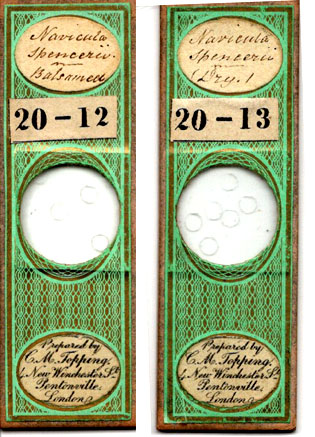
SLIDE:BY C.M. TOPPING

DRY MOUNT

c. 1850


slides"
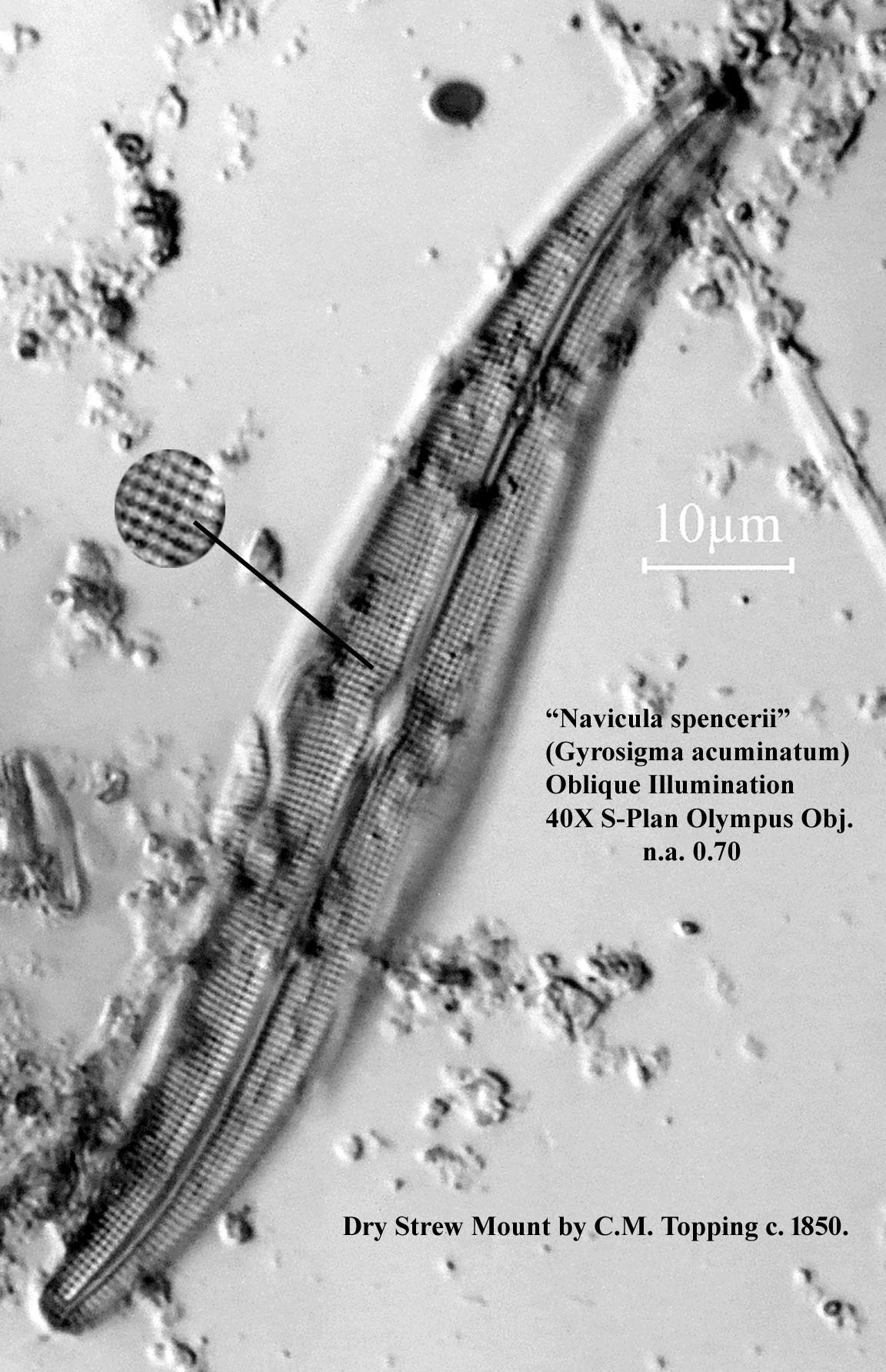
These slides were made by the famous skilled professional English preparer Charles Morgan Topping. They are strews with diamond engraved circles to indicate the location of the named diatoms among the other contents of the slides. It was customary for Topping to supply both dry mounts and mounts in Balsam. The latter was felt to provide better preservation while, for subjects like diatoms, they provided less contrast. In fact, 175 years later, the dry mounts provide much better views than the balsam mounts, regardless of the type of illumination. The distinctive green paper covers are the type that Topping used from the late 1840s to the early 1850s. These slides would likely date to 1848 or later since this species of diatom was first referred to as Navicula spencerii in 1848. My own measurements confirm the identification of the diatoms on this slide to be correct as labeled; the length of the specimen shown above is about 92 microns, the width about 13 microns, and the striae have a spacing of about 19 per 10 microns, all within the specified criteria for G. acuminatum. The median raphe is straight for about 2/3 of its length.

This diatom, famous in the 1840s, as it was a challenging test object, was first described by Kützing in 1833. He initially named it Frustulia acuminata. This diatom was later studied by Jacob Whitman Bailey and he named it Navicula spencerii in honor of the first person to visualize its markings, Charles Achilles Spencer. The use of this name was first reported in the 1848 edition of Van Heurk's The Microscope: Its construction and Management... where its re-discovery was seemingly attributed to Bailey.

Charles Achilles Spencer of the United States reported resolution of the markings of Gyrosigma acuminatum using objectives of his own design, a feat that Europeans were not yet able to duplicate using English or other European objectives. At this stage of his life, Spencer's objectives were superior to others because of his unique early understanding of the concept of angular aperture.

Although this diatom is not a Navicula, this name and variations on it, persisted for many years. In 1853, Rabenhorst reclassified it as Gyrosigma acuminata. Although the genus Gyrosigma was first described by August Heinrich (a.k.a. Arthur Hill) Hassall in 1845, it was not until 1894 that the genus Gyrosigma was clearly defined by P.T. Cleve. In fact some authors, notably William Smith in 1852 and August(a.k.a. Albert) Grunow in 1860 did not believe the genus Gyrosigma existed, insisting it was the same as Pleurosigma and therefore referred to this diatom as Pleurosigma acuminatum. After confirmation that the diatom was indeed a member of the genus Gyrosigma, the name Gyrosigma acuminatum has been accepted as the current name. This is because the species name given by the first person to describe the diatom, takes precedence when the accepted name has been determined. For this reason, the species spencerii is no longer the accepted one for this diatom.

The following table summarizes the changes to the name of Gyrosigma acuminatum:
YEARNAMEAUTHOR
1833Frustulia acuminataKützing
1839Navicula acuminataEhrenberg
1844Navicula acuminataKützing
1848Navicula spenceriiBailey ex Van Heurck
1852Pleurosigma acuminatumSmith
1853Gyrosigma acuminatumRabenhorst
1860Pleurosigma acuminatumGrunow
1894Gyrosigma acuminatum is the accepted nameCleve
1995Gyrosigma acuminatum finalized as the accepted nameSterrenberg

Authors Names referred to above:
Jacob Whitman Bailey
Christian Gottfried Ehrenberg
Albert (a.k.a. August) Grunow
Arthur Hill(a.k.a. August) Hassall
Heinrich Kützing
Gottlob Ludwig Rabenhorst
William Smith
Per Teodor Cleve

VISUALIZING THE MARKINGS OF GYROSIGMA ACUMINATUM:
As is the case with many diatoms, it was eventually discovered that oblique lighting was more likely to reveal the markings of the valve than ordinary transmitted light, even with well-made achromatic objectives. It was with this method that it was then first resolved with European objectives. In my own investigation of some Topping strews containing G. acuminatum, I found that with my 40X Olympus S-Plan objective with an n.a. of 0.70, that transmitted light (even with Kohler illumination) or with dark ground illumination, failed to resolve the markings. Oblique lighting (with proper orientation*), and Interference contrast were successful using the same objective. In fact, I could resolve not only the striae but also the areolae using that objective.

The light has to come in from an angle that shows the details well.

CONFUSION OF NAVICULA SPENCERII (G. acuminatum) WITH NAVICULA HIPPOCAMPUS (G. attenuatum):
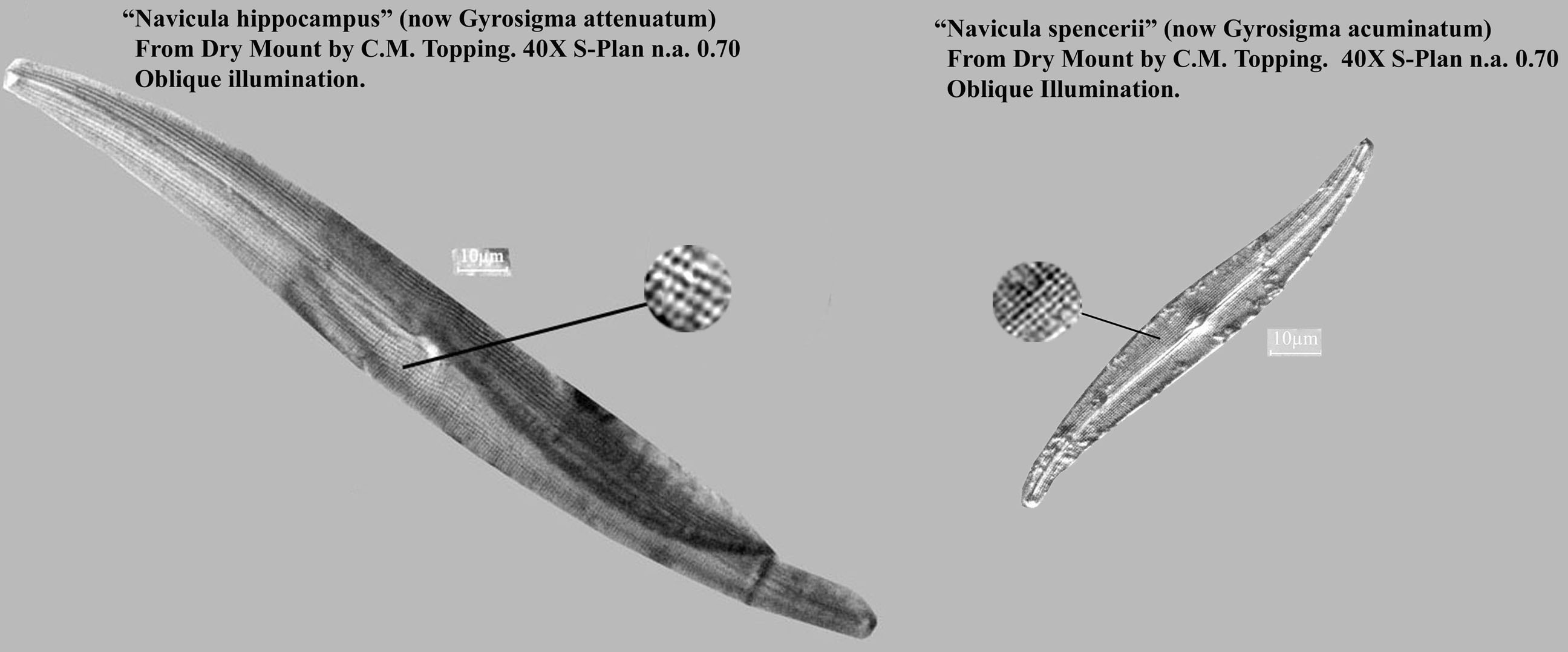
Some authors have referred to N. hippocampus as N. spencerii. although Topping clearly knew the difference. This was undoubtedly an error as the two are dissimilar. Unlike Gyrosigma acuminatum, G. attenuatum is larger, with coarser longitudinal striae that are more distinct than the transverse striae. G. acuminata is smaller and the transverse and longitudinal striae are equally prominent. These differences can be seen in the illustration below:

gyrosigmas"

GYROSIGMA VS PLEUROSIGMA:
For those not acquainted with the difference between these genera in modern classification, the most notable differences are the alignment of the alveolae to form striae. The striae of Gyrosigma can be seen as transverse and longitudinal to the main axis of the diatom. The hallmark of Pleurosigma is that these striae are mostly seen as diagonally oriented. This often requires high resolution objectives and may account for older authors considering this diatom a Pleurosigma.

REFERENCES:

Cleve, Per Teodor (1894) Synopsis of the naviculoid diatoms I. Komngliga Svenska Yetenskabs Akademiens Handliner, n.f. 26(2) 1-194. Hassall, A.H. (1845) A History of the British freshwater algae including descriptions of the Desmideae and Diatomaceae. S. Highley et. al. London, Edinburgh, Paris, U& Leipzig Pritchard, Andrew (1861) A History of Infusoria, living and fossil arranged according to Die infusionsthierchen of C.G. Ehrenberg, containing colored engravings, ... Ed IV Whittaker and Co London

Smith, William (1852) Notes on the Diatomaceae with descriptions of the British species included in the genus Pleurosigma. Annals and Magazine of Natural History; Series 2 9:1-12 with 2 plates.

Smith, William (1853) Synopsis of British Diatomaceae. John Van Voorst London 1:89pp plates 1-31

Sterrenburg, F.A.S. (1995) Studies on the genera Gyrosigma and Pleurosigma (Bacillariophyceae). Gyrosigma acuminatum (Kützing) Rabenhorst, G. spenceri (Quekett) Griffith et Henfrey and G. rautenbachiae Cholnoky. Proceedings Academy of Natural Sciences of Philadelphia 146: 467-480.
Queckett, J (1848) A practical treatise on the use of the microscope including different methods of preparing and examining animal, vegetable, and mineral structures. pp i-XXI, 1-464, fig 1-241 + 9 Plates London and Paris Hippolyte Bailliere Publisher.

Bailey, J W (1849) Some remarks on the Navicula spencerii and on a still more difficult test object. B.L. Hamlen New Haven

Van Heurck, Henry (1848) Le microscope, sa construction et son Maniement, La Technique Microscopique en general...tilization.