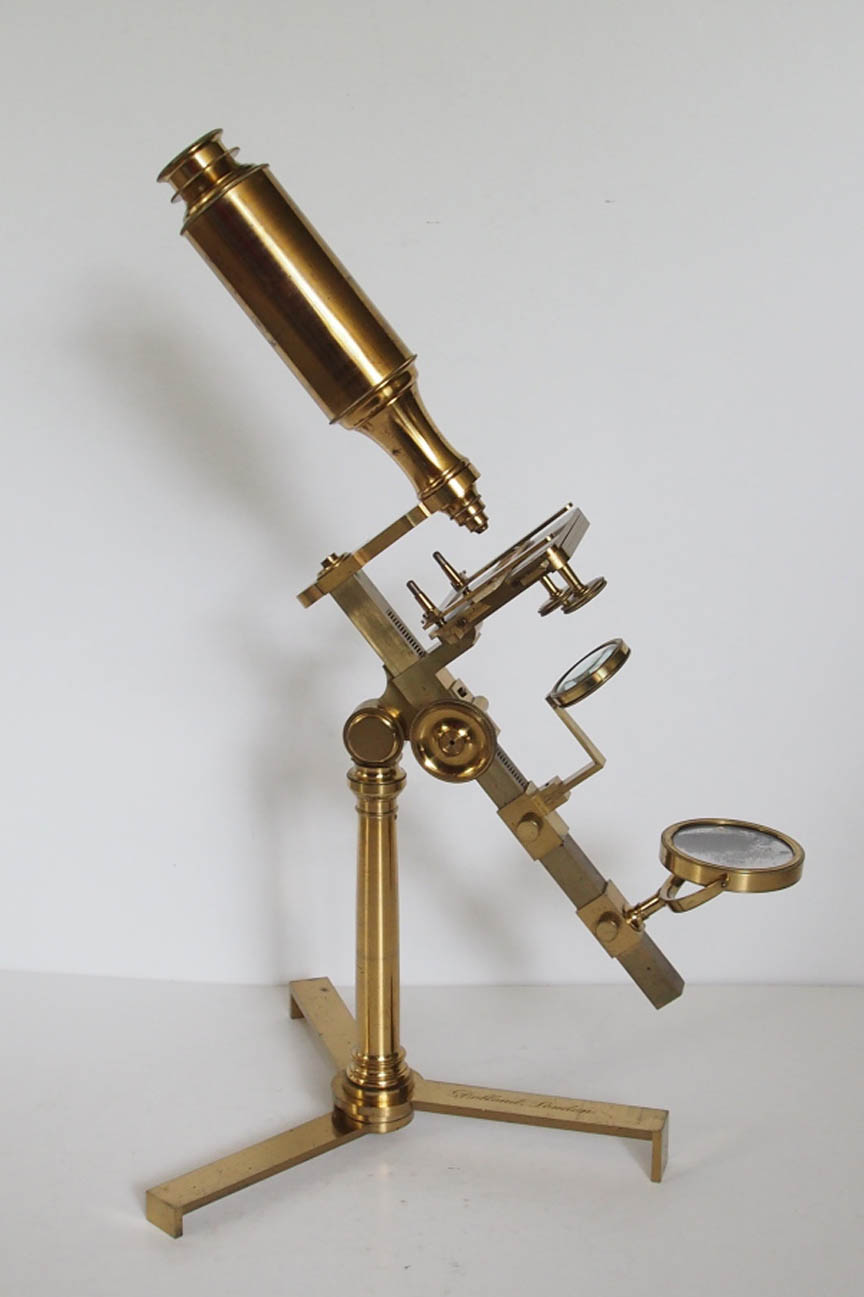
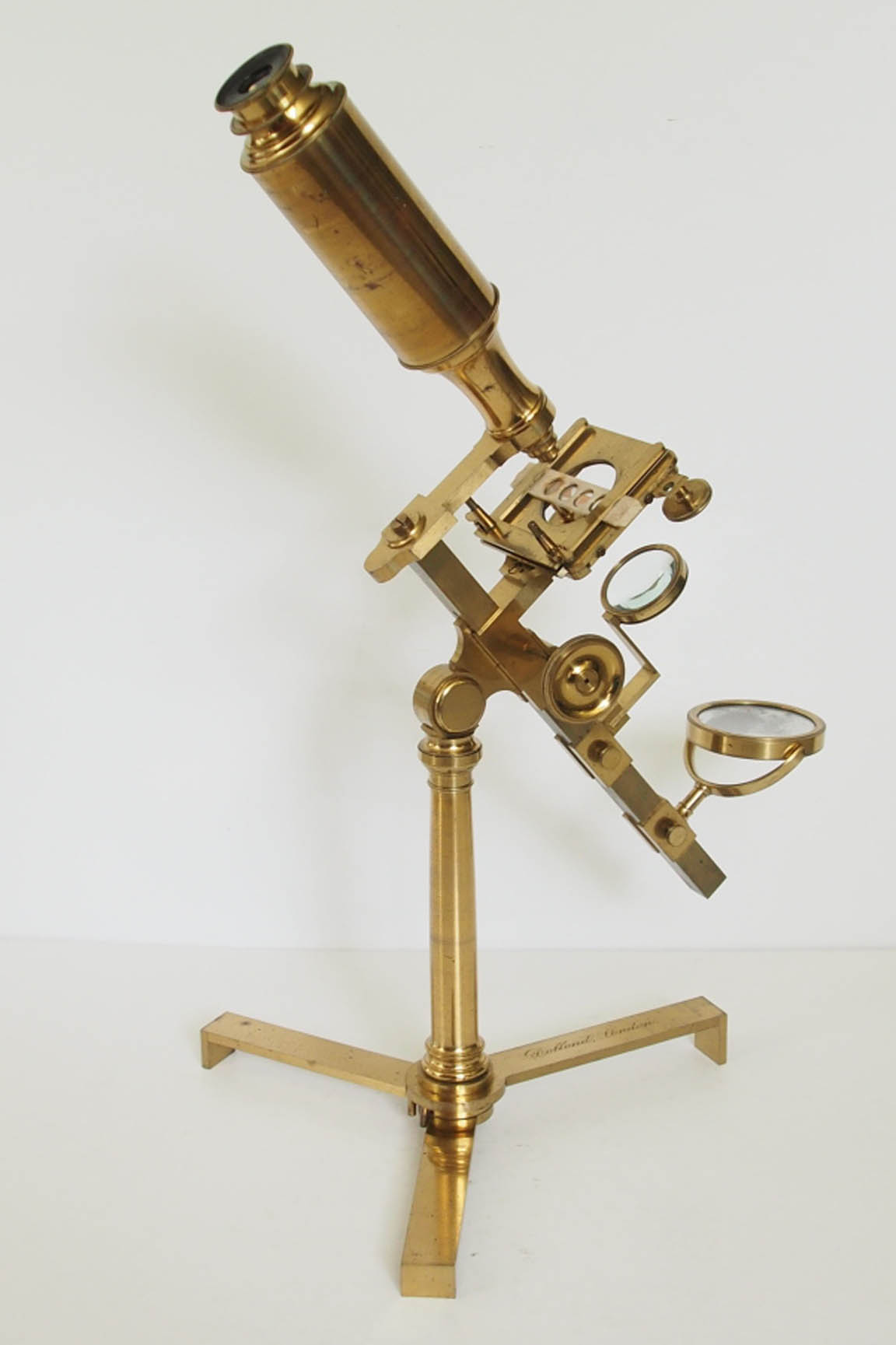
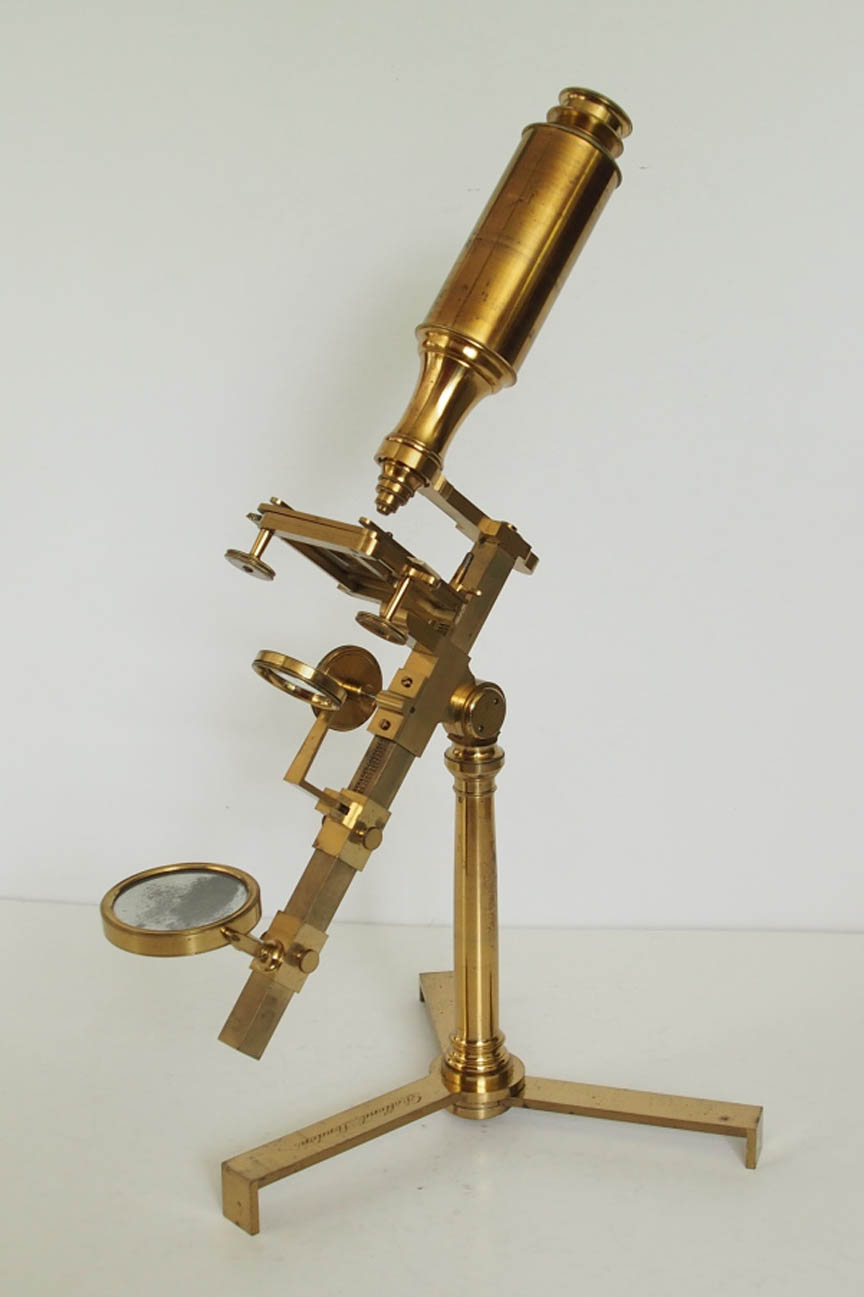
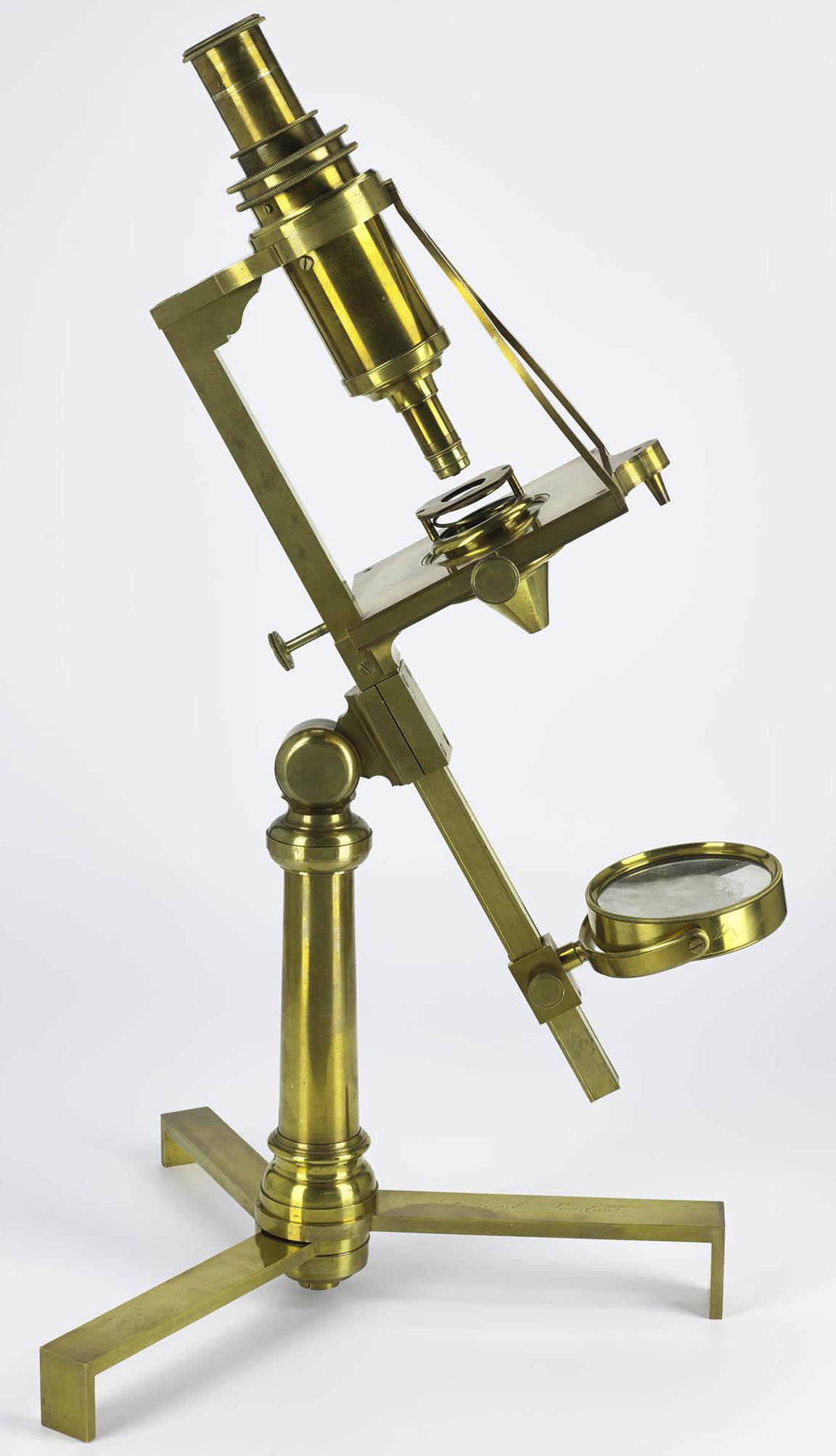
JONES MOST IMPROVED MICROSCOPE WITH ACHROMATIC OPTICS
MAKER:DOLLOND
c. 1830-1835
SIGNED:Dollond, London
Collection of Dr Jurriaan de Groot
Please Click On Any Picture for a Larger Version
DESCRIPTION:
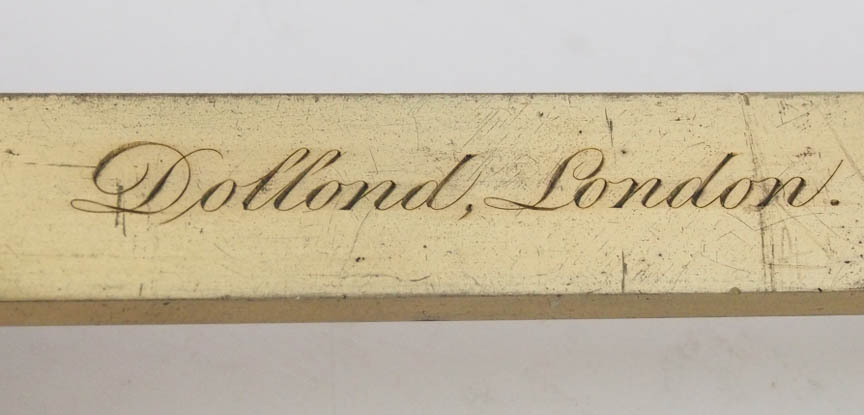 This microscope constructed on the
 Jones Most Improved
plan, is supported by a large brass folding tripod foot, the feet being some 140 mm in length. It is signed on one pod of the foot: "Dollond, London". From its center arises a gently tapering brass pillar, 180 mm high, which extends into a compass joint which can be tightened. This supports the square limb, in which the coarse focus rack is recessed. The pinion is operated by a single knurled knob placed on the right-hand side, and moves the stage support. There is no fine adjustment.The square mechanical stage is controlled by separate knurled knobs protruding from underneath for X and Y movements. There is a sliding U-shaped clamp on top of the stage to hold sliders. This has a groove across the under surface of both arms to hold a glass tube. The lower end of the limb has square sliding supports for an under stage condenser and double-sided flat/concave mirror. These can be slid up or down to optimize illumination of the specimen. A fixed arm is attached to the upper part of the limb, and carries a circular ring in which the lower end of the 153 mm long tapered brass body tube screws in. The top of the optical tube has a large diameter of 45 mm to take the eye pieces. The microscope stands 470 mm tall when in use.
ACCESSORIES:
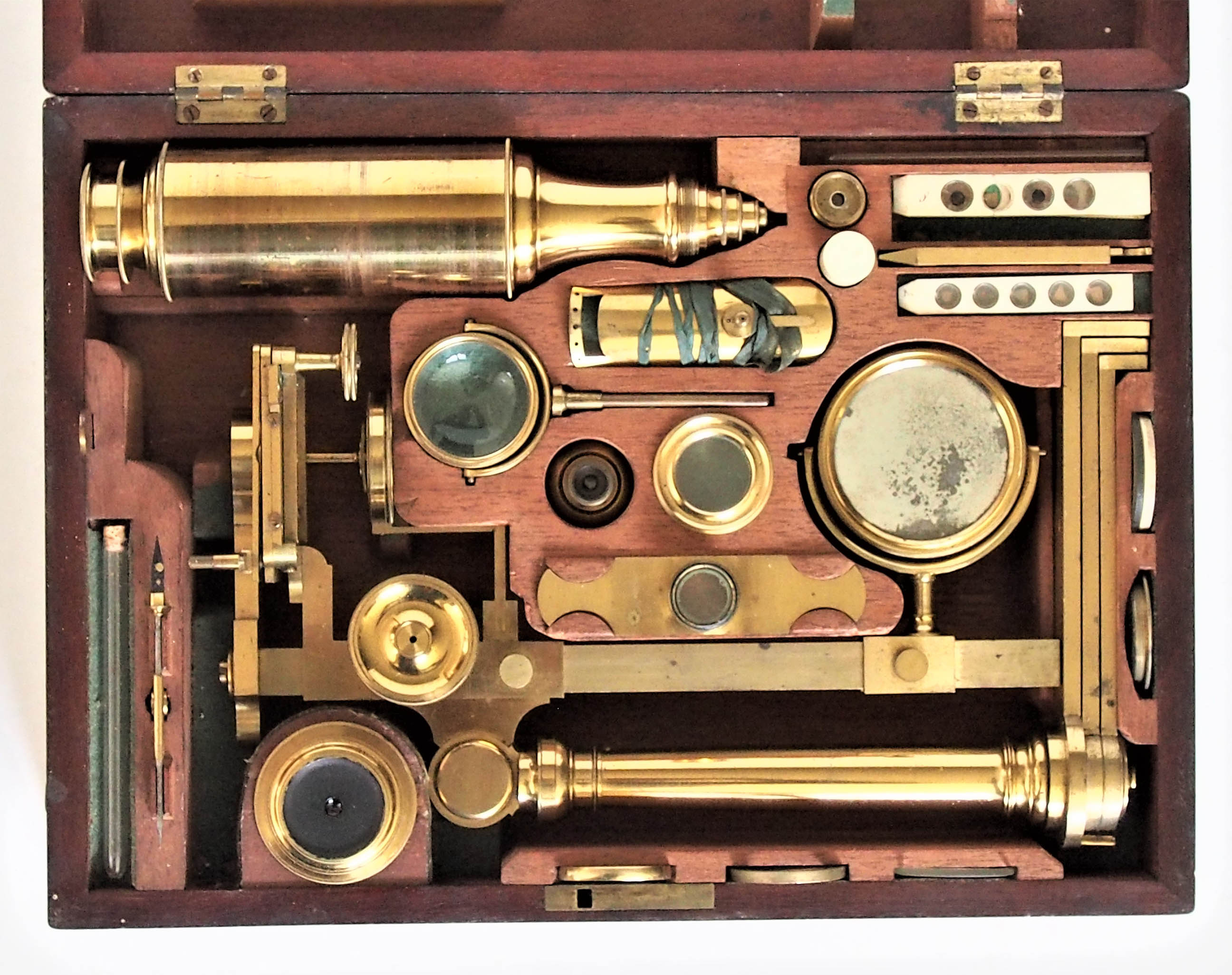
These appear to be complete with no empty spaces left in the case.
EYEPIECES
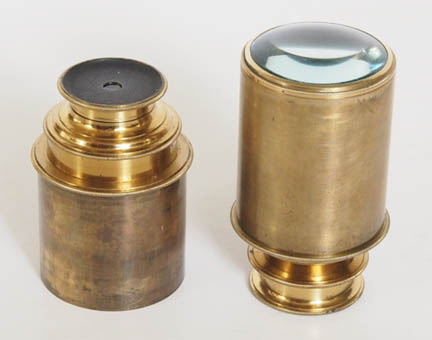 Unusual for a microscope of this design, there are two exchangeable eyepieces with approximate magnifications of x5 and x12, whereas earlier non-achromatic
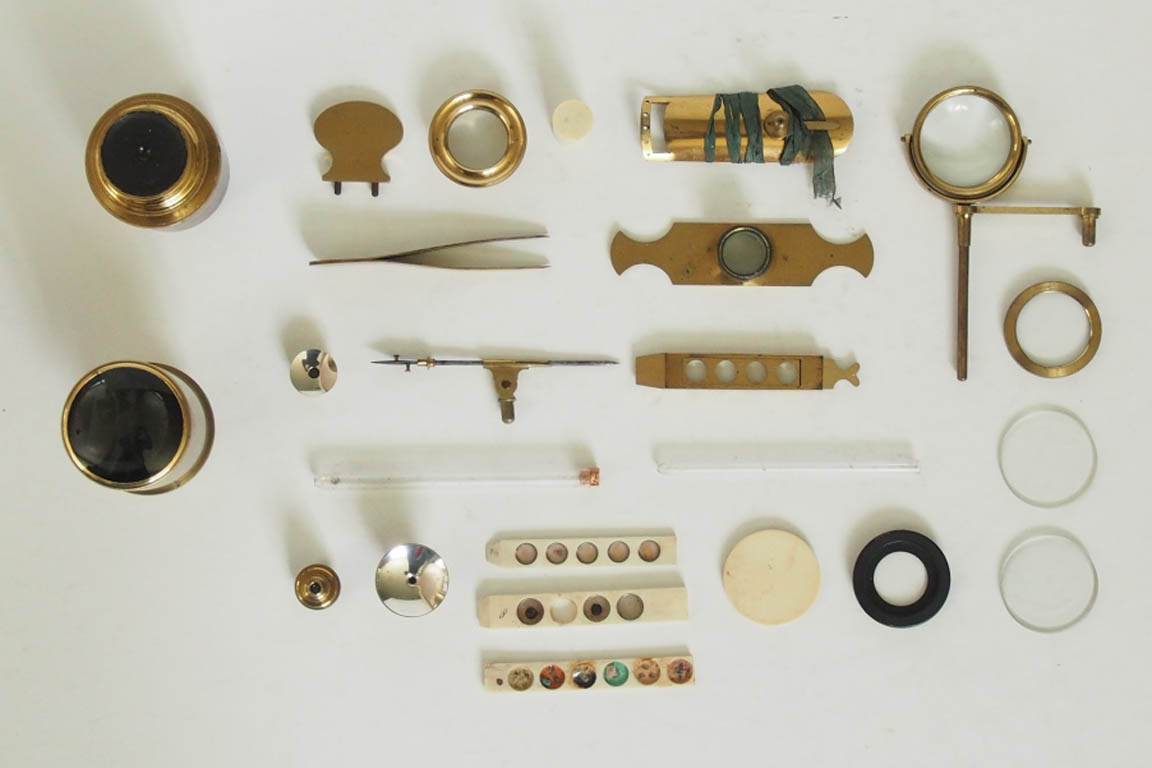
Adams-Jones models featured a fixed field lens and double eye lens design. This twin eye lens feature is retained in the removable eye pieces of this microscope. Also present is an eyepiece micrometer with a ruled grid(q below), which can be screwed below the bottom eye lens of the low power eye piece,
to be used with the stage micrometer.
Unusual for a microscope of this design, there are two exchangeable eyepieces with approximate magnifications of x5 and x12, whereas earlier non-achromatic
Adams-Jones models featured a fixed field lens and double eye lens design. This twin eye lens feature is retained in the removable eye pieces of this microscope. Also present is an eyepiece micrometer with a ruled grid(q below), which can be screwed below the bottom eye lens of the low power eye piece,
to be used with the stage micrometer.
OBJECTIVES
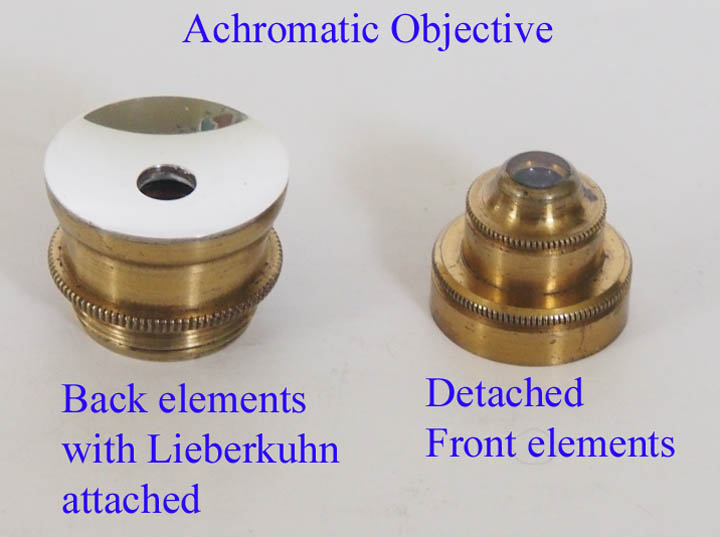
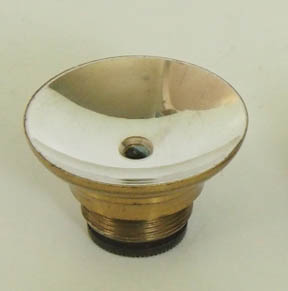 There is one divisible objective made up out of two achromatic combinations. The back element can be used alone or in combination with the front lens, which has a smaller screw diameter. There is also a Lieberkuhn which fits over the back elements, shown fitted to that in the image to the left. In storage, the objective is left attached to the body tube and there are no recesses in the case for a set of non-achromatic objectives, or a disc of objective lenses as was common in earlier Jones most improved models, suggesting that this instrument was originally sold from new as an achromatic microscope. In addition to the Lieberkuhn fitting the achromatic back elements,there is one non-achromatic Lieberkuhn objective with silver reflector(right).
OPTICAL DATA:
Obtained with Cheshire Apertometer and stage micrometer.
| OBJECTIVE | APPROX. N.A. | MAGNIFICATION WITH EYEPIECES |
|---|
| - | LOW | HIGH |
| Back |
0.18 |
46 |
112 |
| Back + Front |
0.36 |
105 |
293 |
Lieberkuhn
(non-achrom) |
0.06 |
32 |
73 |
STAGE ACCESSORIES
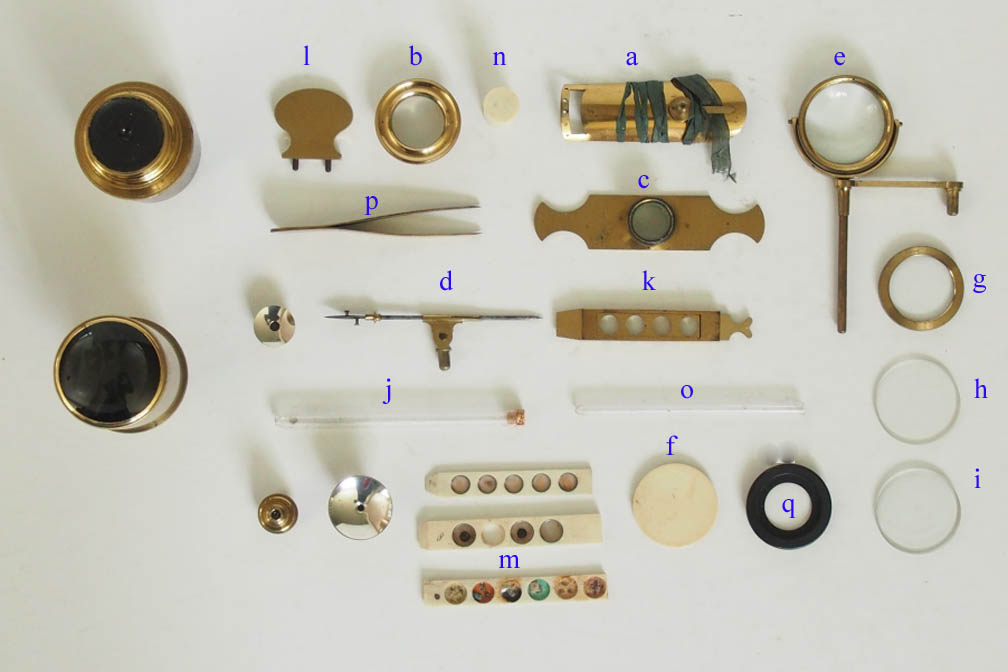
These include a fish plate(a), two live boxes(b & c), stage forceps(d), a stage bullseye condenser with arm(e), an ivory/black disc(f),a brass-mounted stage micrometer(g) engraved with a grid of 1/40 inch divisions, two glass discs, one flat(h) and one concave(i), a glass tube with cork stopper(j), and a brass wet cell slider(k).
OTHER ACCESSORIES
Also present are a brass two-point key(l) to tighten the compass joint, a number of bone sliders(m), talc box(n) with mica talcs (discs), a dipping tube(o), a hand tweezer(p), and a wire cleaner for the glass tube(not shown).
CASE
The flame mahogany case measures 340 (W) x 242 (D) x 105 (H) mm, some internal fittings being covered in green baize.
HISTORY:
This is an example of an achromatic version of a large Adams-Jones most improved
model microscope by Dollond. This reknowned firm of Opticians appears to have provided this microscope from new with an achromatic objective, and it can be dated to the very beginning of the achromatic period.
The prominent business of Dollond was established when John Dollond joined his son Peter in 1752 to establish an optical instrument shop in Vine Court, Spitalfields, London. John patented an achromatic doublet telescope objective in 1758, for which he was rewarded the Copley medal by the Royal Society.
They opened a new business in 1759 located in the Strand, London, where they would be assured of a more affluent clientele. They continued to specialize in the sale of telescopes, but also retailed microscopes of all the popular models, including a case-mounted screw barrel/Ellis type simple model , the
Cuff-type, a Nairne-type chest microscope, and subsequently Jones improved, and most improved models, including the more compact 'complete pocket' variants. These instruments were all non-achromatic, as until then, very few had succeeded in making a truly achromatic microscope objective, and when they did, it was often by trial and error.
A medical practitioner with a great interest in improving the optical performance of the microscope, Charles Goring (1792-1840) had collaborated with Andrew Pritchard on the development of jewel lenses, and he advocated the use of test objects to measure resolving power. In 1823 Goring had approached the
telescope maker Wlliam Tulley to make an achromatic microscope objective for him. Goring knew that if the objective was to be successful, it must be usable at a wide angle of acceptance, for he had observed that his ability to see finely lined natural objects such as wing scales of the moth improved as this angle
increased. This enabled him to guide Tulley, while Tulley's own practice of using white numbers on a white background as a test enabled him to detect both spherical and chromatic abberation. In 1824 Tulley produced for Goring first a 4/10 inch, and then a 2/10 inch triplet objective, and it was with the assistance of J.J. Lister that the first effective 9/10 inch objective was constructed, which could be used at its full aperture of N.A. 0.18. J.J. Lister subsequently showed that by placing two achromatic combinations at a certain distance by combining their aplanatic foci, the combination could also be
corrected for spherical abberation, and published his findings in the Transactions of the Royal Society in 1830.
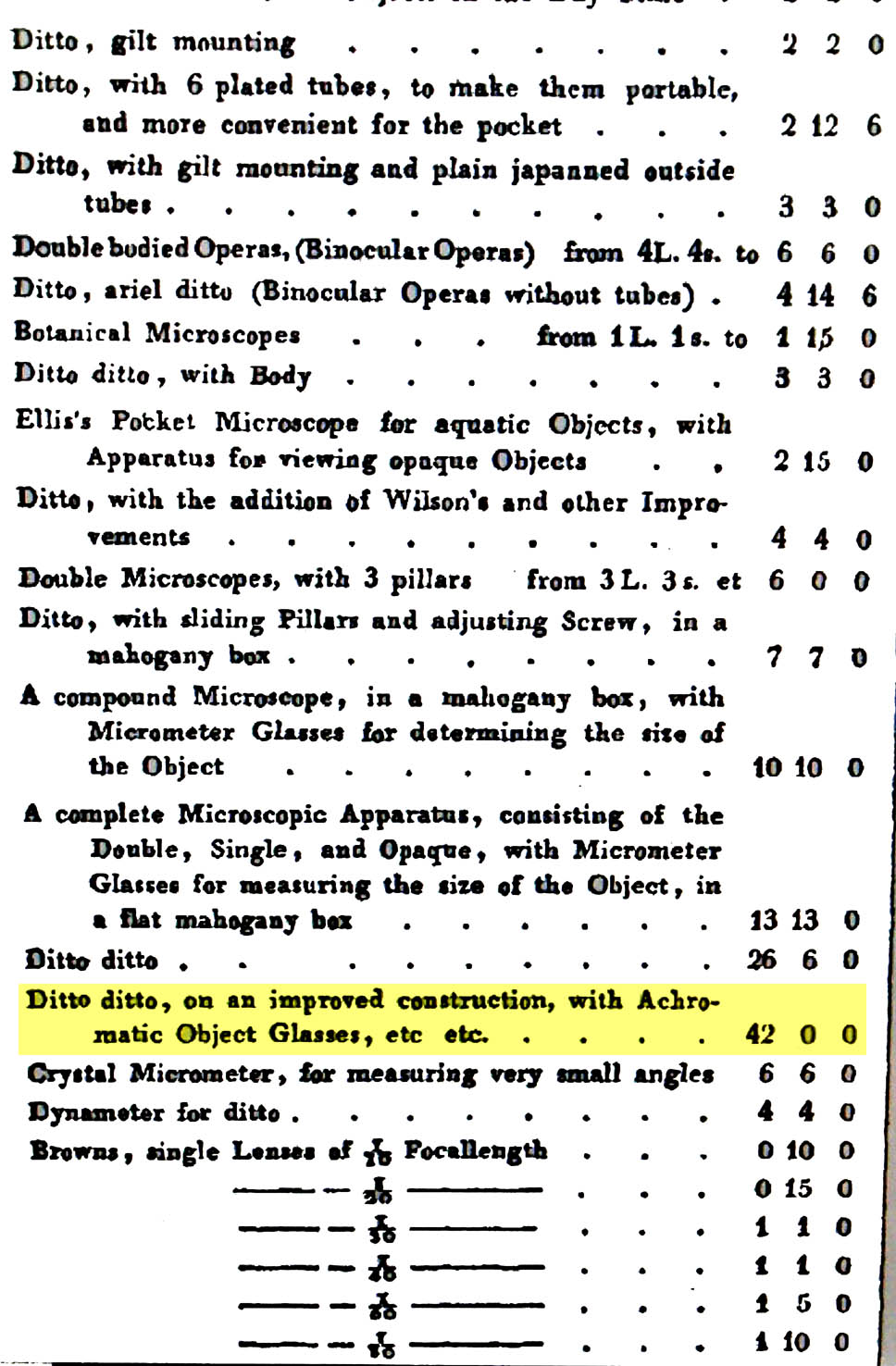 1831 Dollond Catalog entry from Astronomische Nachrichten.
Charles Goring also turned to the firm of Dollond, at the time headed by George (Huggins) Dollond (1774-1852). In a paper published in the Quarterly Journal of Science, he heaps effusive praise on Dollond's attempts at constructing an achromatic objective consisting of two non-cemented triplets (1827), whereby
each combination of 3 lenses were "burnished fast into their cells in the most rigid adjustment. The back combination could be used alone, whilst the additional front corrected the the error of the combination". Goring comments that there is an "inevitable dullness produced in the image of an opaque body, by the multiplicity of surfaces of the 6 lenses, somewhat similar to what occurs when an ordinary object glass is dimmed by moisture; with transparent objects this defect is scarcely felt". It is likely, that Dollond subsequently improved this lens combination by cementing the components of each triplet and continued to sell these objectives as an option with their standard large microscopes of the Adams/Jones most improved type, but only in small numbers. This was probably due to their considerable extra cost, as in their Catalogue of Optical, Mathematical,and Philosophical Instruments made by G. Dollond, Optician to his Majesty, 59 St Paul's Churchyard, London
, published in the Astronomische Nachrichten in 1831,they list their "Complete microscopic apparatus in a flat mahogany box on an improved construction with achromatic object glasses" at the for that time considerable price of GBP 42/0/0, whereas in non-achromatic form this microscope could be had for GBP 26/6/0, and a less elaborate set for GBP 13/13/0.
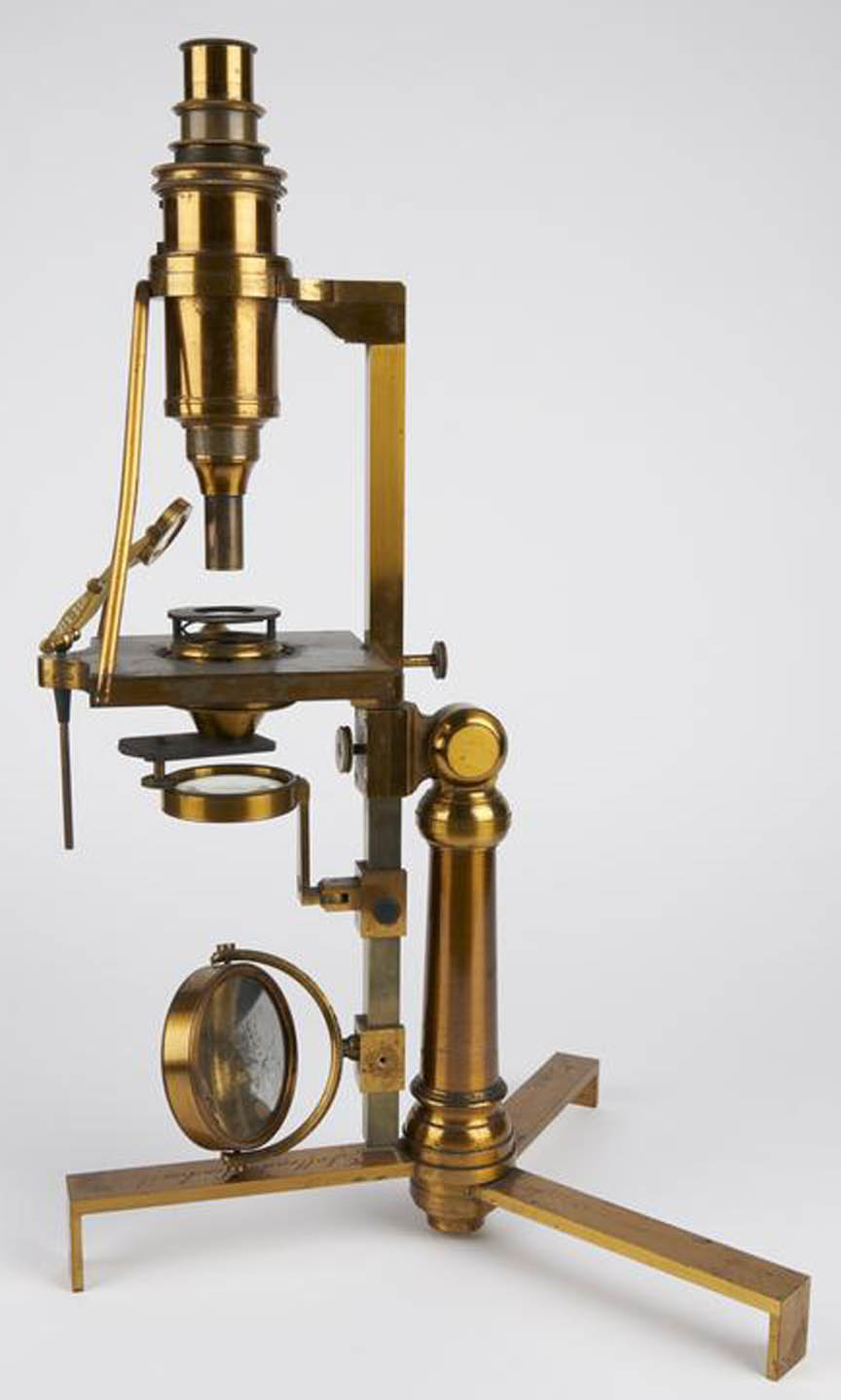
 Two examples of very early Dollond microscopes are known from the 1827-1830 period, of which one is in the National museums of Scotland- and the other in the Science museum collection of London. Like the Lister/Tulleymicroscope these appear cumbersome, and from the microscope presented here it would appear, that Dollond also provided their achromatic objective with their standard Jones most improved microscopes as an option. However,they were too busy filling their orders for achromatic telescopes at that time, so could not fullfill the demand for achromatic microscopes. As a result, Charles Goring turned to Andrew Pritchard, beginning their fruitful collaboration,which resulted in their
 Aplanatic Engiscope
,and their numerous popular works on the microscope, while it also formed the impetus for two new opticians, Andrew Ross and Hugh Powell,to start making achromatic objectives, and their own evolving designs in microscope construction.
CONDITION
The microscope retains most of its original lacquer, is complete, and appears to have been well-looked after, probably reflecting its high cost when purchased. The optics give clear achromatic images. It is of interest, that when using the back lens of the objective alone, there is notable spherical abberation
towards the edges of the field, but this is corrected when used in conjunction with the front element, just as described by Goring (vide supra).
BIBLIOGRAPHY
Frank, A. and Nutall, R.H. Early microscopes by Hugh Powell. Microscopy 32,pp. 196 - 207, July - December 1972
Goring, C.R. Improvements in Microscopes. Quarterly Journal of Science, Literature, and the Arts, pp. 132 - 134 (1825).
Goring, C.R. On Mr. Tulley's thick aplanatic object-glasses for diverging rays; with an account of a few microscopic test objects. Quart. J. of Sc. p.265-84 (1827).
Goring, C.R. On Achromatic microscopes, with a description of certain Objects for trying their defining and penetrating power. Quart. J of Sc. p.410-34 (1827).
Nuttall, R.H. C.r. Goring, J.J. Lister and the Achromatic Microscope. Microscopy 32, Jan -June 1973, p. 253-261.
Nuttall, R.H. Marketing the Achromatic Microscope: Andrew Pritchard's Engiscope. Quekett Journal of Microscopy, 2006, 40, p.309-330.
Nuttall, R.H. Microscopes from the Frank Collection 1800-1860. A. Frank, Jersey, Channel Islands. 1979.
Schumacher. Astronomische Nachrichten, 1831.