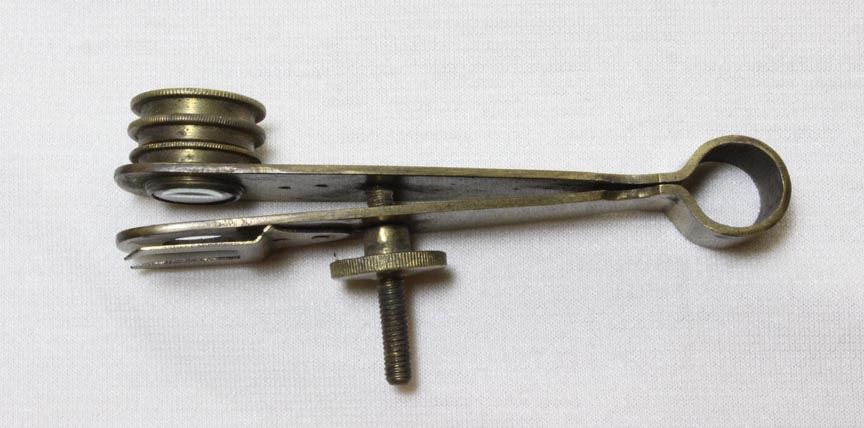
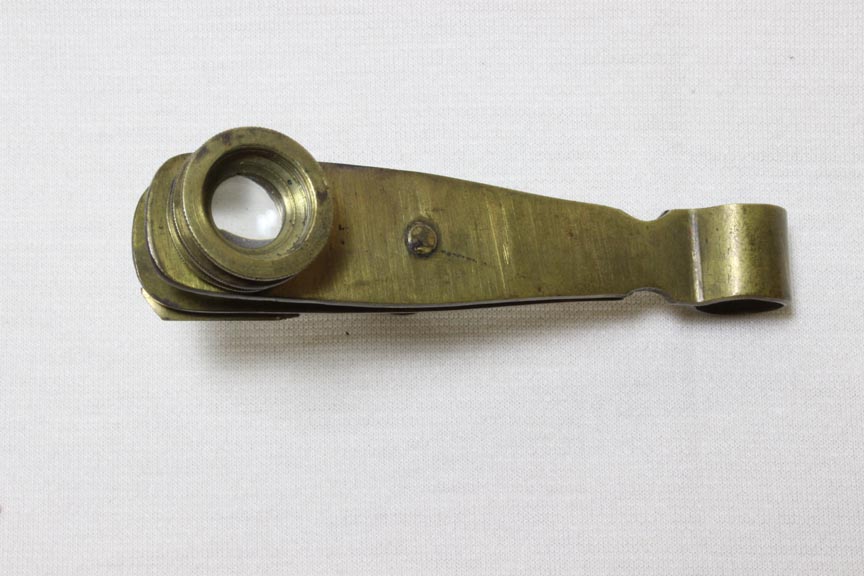
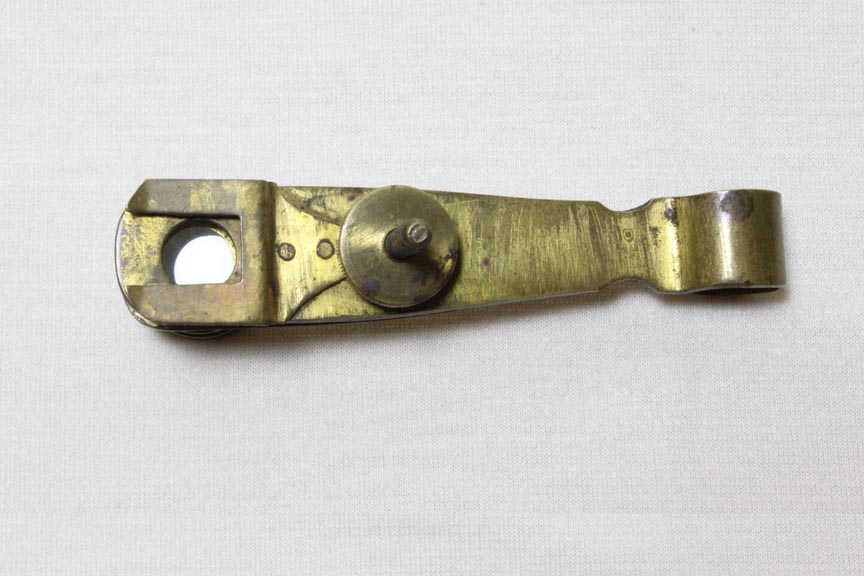
HANDHELD BRASS SIMPLE MICROSCOPE WITH THREE STACKED LENSES :
c. ? MID or LATE 19thC. (?)
? ENGLISH
DESCRIPTION:
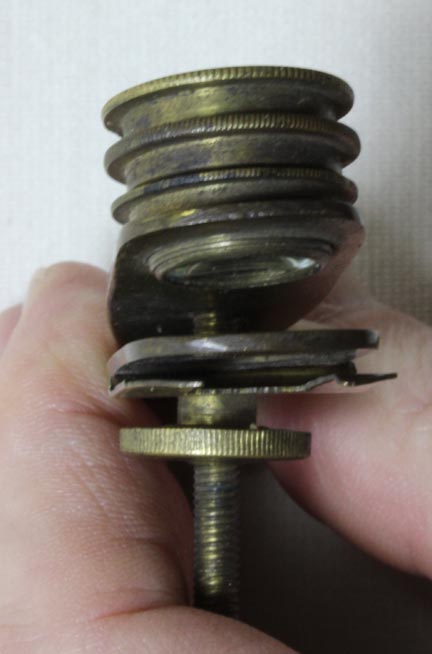 This microscope is identical to figure 307 in the Billings collection. Its main part is a bent piece of brass which through its shape imparts some degree of elasticity. It accepts three simple lenses which can be used singly or in combination. A small two-pronged support will accomodate a narrow slide. Focus is achieved by a knurled nut acting on a screw permanently attached to one side and projecting through a hole in the other. Thus the nut, acting on the outside, when tightened, pushes the two limbs together, and when loosened allows the springiness of the brass to expand back outward. The instrument is made of lacquered brass with some wear to the lacquer.
HISTORY OF THIS MICROSCOPE
This is a design which was likely made initially in Great Britain and apparently copied elsewhere. A similar design is the example signed by Spencer & Son from Dublin. The example shown on this page has substantial differences in construction however. The focus on the model shown here operates by tightening or loosening the knurled nut down on the outside, where as the Spencer & Son example uses a screw pushing the two pieces apart from the inside surfaces. Furthermore, in the Spencer model the knurled knob turns the screw whereas in this unsigned example the screw is fixed. The brass is much thinner in this unsigned example, and the design is not as ornate and a bit crude. The knurling on this instrument is rather plain and squared off. Lastly, this example is designed to hold small slides but has no stage like the Spencer example. The date and place of origin of this instrument is open to question and some authorities believe, because of the thinner brass, and the simpler features, it may be of later origin-later 19th to early 20th century. Some authors believe it may be American in origin. As yet I have found no advertisement or other record to be able to firmly date it. Instruments made of thin brass like this that do date from the 19th century were usually either from the USA or from France, hence the reason some authors believe it may be of American origin. One might expect thicker brass and a finer finish if this instrument were from mid-19th century England.