VERTICALLY SECTIONED MICROSCOPE OBJECTIVE
MAKER: Bausch & Lomb
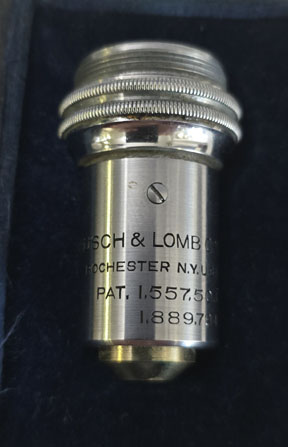
SIGNED:Bausch & Lomb Opt. Co, Rochester, N.Y. U.S.A., PAT. 1,557,503, 1,889,794
PATENTED: DEC. 6, 1931
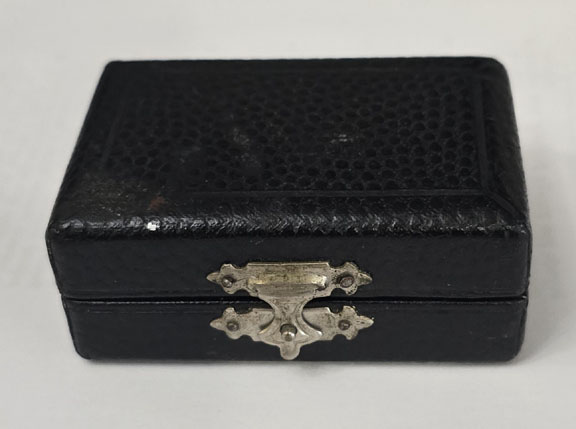
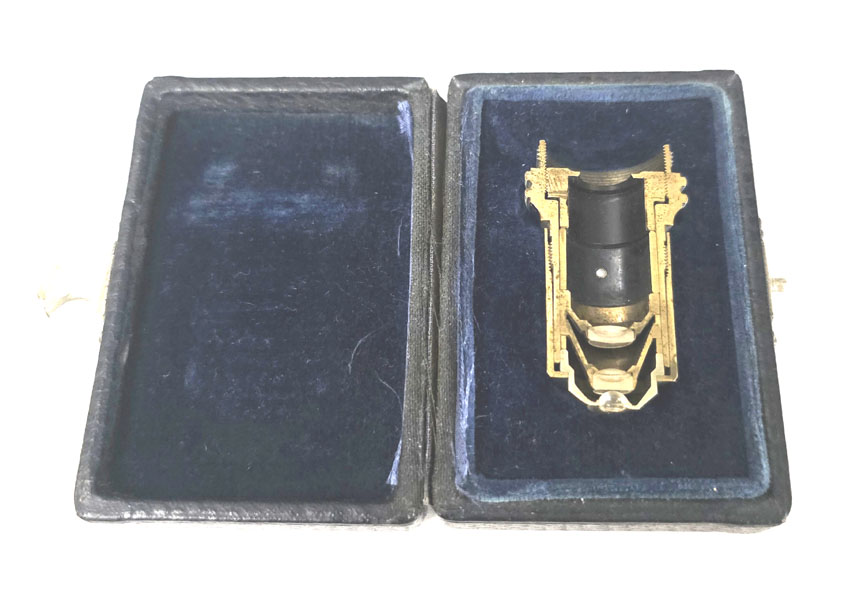
Microscope objectives which have been vertically sectioned, and supplied by the manufacturers to illustrate their construction are rare. This example is of a design patented in the U.S.A. by Bausch and Lomb in 1931 and was an improvement in the design patented in 1925. It came in its own dedicated case, with black leather on the outside and dark blue velour lining the inside.
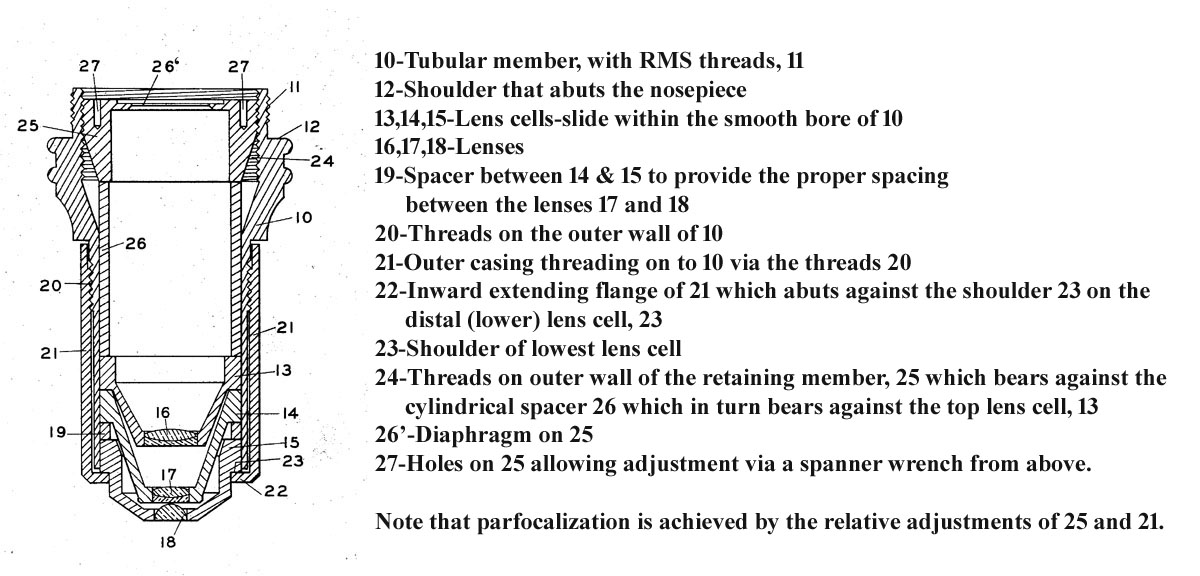
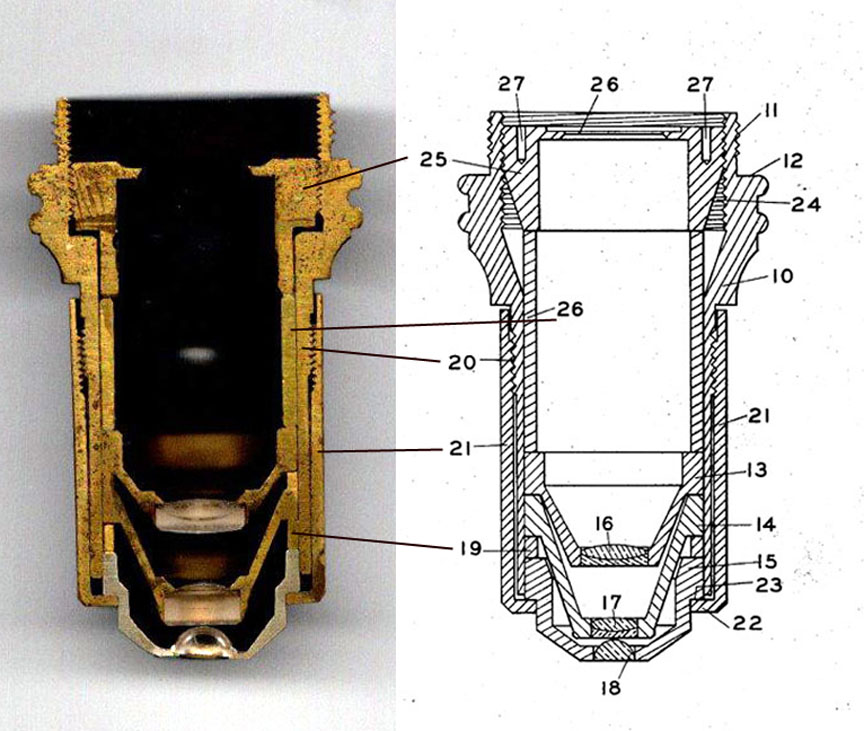
The design provides flexibility in spacing of the two proximal elements by a spacer (#19), and adjustment in parfocality via adjustments of the depth of the optical train within the barrel of the objective via the nut
, #25, which can be adjusted via a spanner wrench from the top holes(27). The outer tube is adjusted to meet the bottom of the optical train, thus securing the parfocal distance. Because the outer diameter of the lens mounts are all precisely the size of the central bore(10) they are all centered in respect to each other and also to the optical axis of the body tube.
The optical arrangement of this objective is the usual type as originated by Lister about 1830. There is a distal hemispheric lens to collect the light from the specimen. This is followed by an achromatic doublet that corrects chromatic aberration, and then a second achromatic doublet that corrects spherical aberration. This is needed because the aplanatic focus of any achromatic doublet is not at the same location as the achromatic focus. A doublet can however be made with the aplanatic focus either more distal or more proximal to the achromatic focus; by putting an achromatic doublet the undercorrects the aplanatic focus followed by a another that overcorrects, the doublets can be spaced such that the achromatic focus and the aplanatic focus are at the same place for the entire group of lenses, creating an image that is both aplanatic and achromatic at the same focal point.
It may be that this item was designed to illustrate the mechanical aspects of this objective, rather than its optical components.
REFERENCE: Kile, D (2025) Cross Sections of Microscope Optics: Objectives and Eyepieces. Queckett J. of Microscopy 45: 151-165.